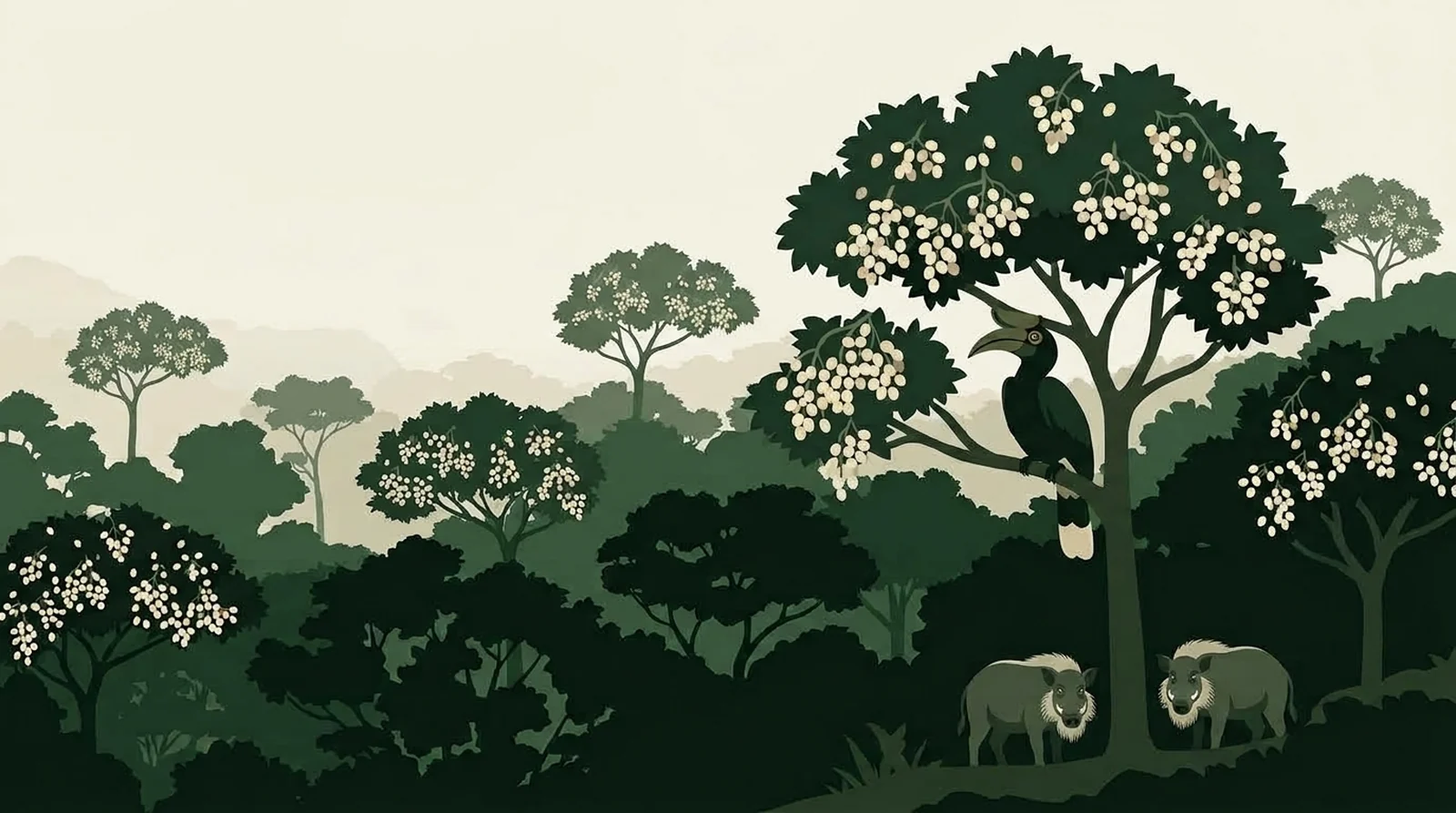
Spanning 438 square kilometres, the lowland rainforest of Danum Valley waits for a climatic cue to fruit in unison. Walk the trails with an expert guide to discover a forest that operates on a complex multi-year cycle.
The quiet forest canopy
For most of the time the canopy in Danum Valley is green and quiet. Fruit is scarce. The animals that live here full-time have to adapt to these lean years. Bornean orangutans survive on what ecologists term fallback foods. They eat a lot of leaves and strip the inner bark from woody vines like Spatholobus to extract the sparse nutrients. Because this food is low in calories they conserve energy. They travel short distances and rest often. This quiet behaviour makes them harder for guides to spot in the high canopy.
Other species face similar challenges. Malayan sun bears often lose body condition during these intervals. The forest floor belongs to the insects and a few resident small mammals. The entire ecosystem is waiting.
Dipterocarp trees and seeds
The cycle is driven by the dipterocarp family. These towering hardwoods account for up to 80% of the emergent trees in Danum Valley. Instead of fruiting every year they hold back. They wait for intervals of anywhere from 2 to 10 years.
When the climatic cue arrives they act in total synchrony. Hundreds of different species flower in sequence over a few weeks. The forest fills with the hum of millions of giant honey bees arriving to pollinate the blooms. Microscopic flower thrips breed directly on the developing buds.
A few months later the fruit matures and detaches. Dipterocarp seeds have long wings that make them spin like miniature helicopters as they fall. They carpet the forest trails by the million.
After the seeds fall they form a seedling bank. Dipterocarp seeds germinate almost immediately and cover the forest floor in green. These seedlings can survive in the dark understorey for up to 15 years. They grow fractions of a millimetre a year while waiting for an adult tree to fall and open a gap of sunlight.
The reason they do this is survival. The seeds are highly nutritious and lack chemical defences. If the trees produced a small amount every year the local rodents and insects would eat the entire crop. By withholding food for years the trees starve the seed-eating populations and keep their numbers low. When the massive seed rain finally comes there is too much food for the animals to finish. They gorge until they are full and millions of seeds remain untouched on the floor to germinate.
Dry spells and cool air
Because so many different species flower at precisely the same time they need a clear signal to start. That signal comes from the weather.
The trigger is tied to the El Niño-Southern Oscillation. This weather pattern periodically disrupts the aseasonal climate of the Bornean rainforest. Researchers monitor 2 main triggers. One is a severe drop in nighttime temperatures. When El Niño clears the usual cloud cover the air cools rapidly for several nights in a row. The other is a prolonged dry spell. This happens when less than 40 mm of rain falls over a 30-day period.
When the trees detect this climatic shift they stop producing leaf buds and switch their cellular energy to flowers. The result is a massive burst of reproduction across the forest.
Wildlife during a mast
When the seeds fall the forest floor turns into a feast. Animals that have scraped by on sparse diets suddenly have more calories than they can consume. Ground-feeding animals like porcupines and pheasants gather to eat the seeds and Malay civets and leopard cats shift their hunting grounds to follow them.
In the canopy the boundaries break down. Macaques, hornbills and orangutans converge on the heavily fruiting branches. They feed side by side in a temporary truce driven by abundance. Malayan sun bears use the sudden bounty to recover their body weight.
In the past the Bornean bearded pig was the most visible part of this event. Massive herds would migrate long distances to reach the fruiting forests. They turned over the forest soil as they foraged and reproduced rapidly on the rich diet. A severe outbreak of African Swine Fever swept through Sabah in 2021. It caused a 99% population collapse in places like Danum Valley and Tabin. While there are early signs of recovery the great herds are currently gone and a bearded pig is now seen with luck on any stay.
Orangutans in the canopy
A common worry is that when food is everywhere the animals spread out and become harder to find. The reality is the opposite for the Bornean orangutan.
When a mast happens their diet shifts completely. Fruit consumption skyrockets to make up almost all of their feeding time. They gorge on the lipid-rich dipterocarp seeds and wild durians to build fat reserves for the next famine. Because the fruiting trees are massive emergent structures they act as beacons. Orangutans from surrounding areas migrate to these specific trees.
Researchers in Danum Valley have recorded local orangutan densities spiking from 1.3 individuals per square kilometre to 4.4 during peak fruiting. A skilled guide who knows where a large tree is fruiting will often find multiple individuals in the same area. A mast year makes orangutans a realistic target.
Primary and secondary forests
The mast phenomenon works best in untouched primary forest like the core of the Danum Valley Conservation Area. Research by the South East Asia Rainforest Research Partnership shows that in forests that have been selectively logged the density of adult dipterocarp trees is much lower. Total seed production in logged sites is often a quarter of what primary forests produce. When a mast occurs in a logged area the seed volume is often too low to overwhelm the predators.
However the secondary forests around the conservation area have their own wildlife advantages. GPS tracking shows that Bornean pygmy elephants actually avoid the deep primary core of Danum Valley. They prefer the secondary forests where the canopy is around 13 metres high and sunlight reaches the ground to grow the plants they eat. Orangutans also heavily use these logged areas as long as the strangler fig trees were left intact. Your guides will choose where to walk or drive based on what you want to see.
Predicting a mast
If a mast makes for such good wildlife viewing the natural question is how to time your trip to match it. The honest answer is that you cannot plan a trip years in advance around this event.
The cycle is too irregular. There were major events in 2010, 2014 and 2019 but only minor localised fruiting in 2023 and 2024. Because it depends on unpredictable weather anomalies no one knows exactly when the next big one will happen.
The trees do give a warning. When the climatic trigger hits the forest blooms. Guides walking the trails see the petals on the ground and hear the pollinators in the canopy. From the moment the flowers appear it takes 3 to 5 months for the fruit to develop and fall.
Choosing your travel dates
Do not wait for a mast to book your trip. The forest is active all year round and the guides in Danum Valley are experts at finding wildlife whether the trees are fruiting or not.
If you are determined to see the forest at its most chaotic the only way is to be ready to travel at short notice. When the guides report that the general flowering has started that is the time to arrange a trip for 3 or 4 months later.
If you are planning normally pick your dates based on your own schedule. Let the team know what animals matter most to you and they will arrange the guides and the nights around giving you the best possible odds on the days you are there.
Arranging your Danum Valley stay
Entry to Danum Valley is strictly managed and permits are arranged alongside your accommodation. Travel and health insurance is advised for any visit to Danum Valley. Cover that includes emergency evacuation is sensible in a place this remote. Send the team your ideal dates, the size of your party and the wildlife you most want to see. A 3 night stay is the standard for Danum Valley and gives you enough time on the trails to experience the different habitats. They will come back with what can be arranged and the guides who give you the best chance on the trails.
--- Sources referenced on this page: South East Asia Rainforest Research Partnership (SEARRP), IUCN Red List (August 2026), published ecological papers on dipterocarp phenology. Facts verified 8 September 2026.