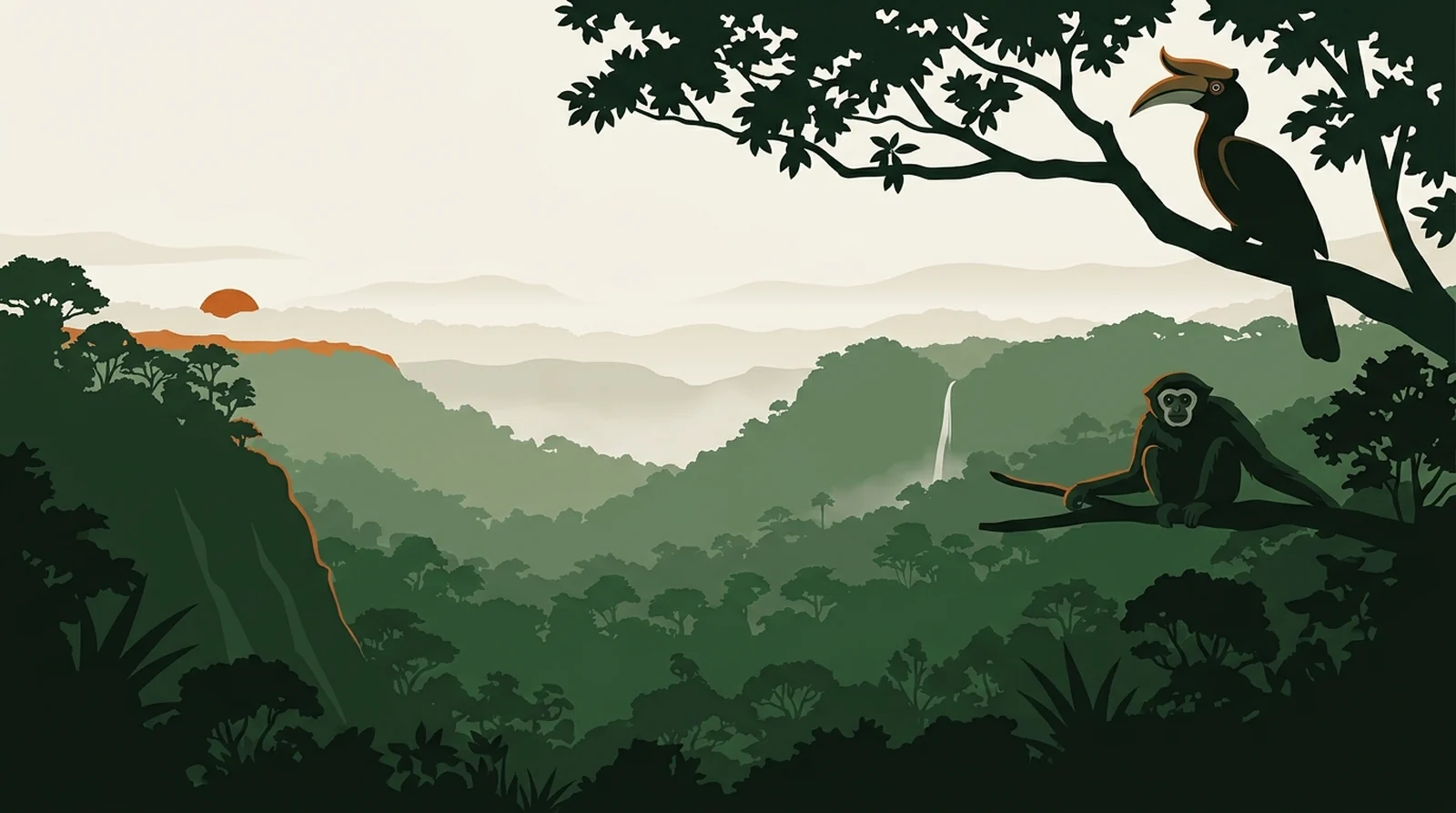
Sabah's primary forest wilderness
Maliau Basin
Located deep in central Sabah, Maliau Basin is a 588.4-square-kilometre conservation area defined by an unyielding escarpment, heath forests and the sheer physical demand of its trails.
Why go
Sedimentary rock basin
Located 190 kilometres from Tawau via logging tracks, Maliau Basin is a 588.4-square-kilometre conservation area enclosed by a steep escarpment. The interior trails are muddy, steep and physically demanding, climbing from lowland dipterocarp forest into highly acidic heath forest. You will appreciate the physical challenge when you reach the massive seven-tiered Maliau Falls deep inside this isolated basin.
Gazetted by the Sabah State Assembly in 1997 as a Class I Protection Forest Reserve, Maliau Basin holds the strictest legal safeguard against commercial logging. In 2012 an additional 46,603 hectares of the surrounding buffer zone was reclassified to Class I to secure the perimeter. The terrain is a formidable circular sedimentary structure measuring roughly 25 kilometres across. Formed from Neogene mudstone and sandstone deposits, the steep slopes effectively isolate the interior. Water inside the basin drains exclusively through the Maliau River as it forces a path out through the Maliau Gorge.
Because of this topographical barricade, the ecology here evolved without human hunting or clearing pressures. There is no archaeological evidence of permanent human settlement inside prior to modern expeditions. The "Lost World" narrative is accurate regarding this lack of historical settlement. However the area is far from unexplored. Yayasan Sabah and global institutions have maintained intense scientific monitoring grids, camera traps and botanical surveys across the reserve since the late 1990s. The isolation you feel on the trails is real but the forest is deeply known to science.
Deep forest trekking
Maliau Basin suits you if you enjoy demanding treks and want to spend time with unusual plants and insects. The trekking tests your endurance on steep and muddy trails under equatorial heat and high humidity. The rewards are deep immersion in an ecosystem of a lineage some 130 million years old, the chance to photograph rare pitcher plants and the satisfaction of reaching the spectacular Maliau Falls. If you want air-conditioned rooms, fine food and high odds of seeing orangutans from a boardwalk, you should choose Danum Valley. Maliau provides adventure, isolation and highly specialised flora.
The habitat gradient
The elevation changes across the basin create a dramatic habitat gradient. At the lowest external drainage points around 200 m above sea level, the habitat is mixed lowland dipterocarp forest. This is where the Maliau Basin Studies Centre sits, 27 kilometres from the main Shell Maliau Gate. The Studies Centre provides comfortable rooms, research facilities and the easiest access to the forest margins. For guests who prefer not to trek into the deep basin, the Studies Centre features a 231 m canopy skybridge suspended 26 m above the forest floor.
As you ascend the escarpment, the forest transitions. Around 500 m near Agathis Camp the dense understorey of the lower montane forest begins. Higher up on the southern plateau around 1,005 m, the environment changes into tropical heath forest. Known locally as kerangas, this forest occupies about 21 per cent of the basin. The soil here is leached white sand. It lacks nutrients and forces plants to adapt into carnivorous forms. The temperature drops roughly 0.75 °C for every 100 m of ascent so the upper rim requires a light jacket at night.
Steep interior circuits
Independent trekking is unconditionally prohibited. All groups enter the forest accompanied by a licensed nature guide and a forest ranger equipped with VHF radios. The trails are undulating and demand a high baseline of cardiovascular fitness, balance and muscular endurance. Management advises against children under 12 attempting the deep basin loop. Families or less fit travellers should base themselves at the Studies Centre for shorter day walks.
The standard expedition is the 5D/4N Southern Basin Circuit. From the Studies Centre, a 4WD transfer takes you to Agathis Camp at 531 m. This serves as the trailhead. The first leg from Agathis Camp to Nepenthes Camp covers 7.5 km and takes about 5 hours of continuous trekking. It is widely regarded as the most strenuous leg of the circuit. The route is a relentless climb from the lowland dipterocarp zone into the lower montane and heath forests. Nepenthes Camp sits at 945 m on the southern plateau and provides bunk beds in open-sided shelters where you use your own sleeping bag.
The next leg runs 7 km from Nepenthes Camp down to Ginseng Camp at 645 m. Taking around 5 hours, this undulating path is often the most visually varied day of the circuit. It crosses the ecotone between the heath forest and the lower dipterocarp forest. The final extraction from Ginseng Camp back to the Agathis Camp trailhead covers 9 km of mixed dipterocarp rainforest and takes about 5 hours.
A 5D/4N itinerary is the recommended choice. It allows you 2 consecutive nights at Ginseng Camp and treats the journey to Maliau Falls as an out-and-back day hike. The distance to the falls is 4.5 km each way and takes roughly 2 to 3 hours per direction. The final approach involves precipitous descents assisted by fixed ropes.
The 4D/3N option requires a gruelling 10 km push from Nepenthes Camp directly over the falls and on to Ginseng in a single 7-to-8-hour march while carrying full packs. To manage the physical strain, you should hire local porters. They carry a strictly enforced maximum of 12 kg each. You must carry your own sleeping bag, quick-dry towel and battery-operated headlamp for the nights in camp.
Interior waterfalls
The Murut name Maliau translates as Land of the Giant Staircase. The heavily stepped sandstone geology has produced at least 19 distinct named waterfalls throughout the river system. Tannins leaching from the nutrient-poor kerangas soils give the water a tea-coloured tint.
Maliau Falls is the major objective for trekkers. Reached by a demanding hike from Ginseng Camp, this massive 7-tiered waterfall dominates the gorge. The sheer volume of water and the surrounding amphitheatre of primary rainforest make it the primary photographic objective.
Ginseng Falls is a 27 m drop located a short walk from Ginseng Camp. You can swim in its tranquil plunge pool to refresh yourself after the long descent from the plateau. Takob Akob Falls drops sheerly off the escarpment edge and is accessed via an optional 2 to 3 hour return trek from Nepenthes Camp. Giluk Falls sits higher up between 900 m and 1,000 m. It is rarely visited by trekking groups.
While not a waterfall, the 33 m observation platform at Nepenthes Camp offers a critical landscape viewpoint. Built directly into the canopy of a giant Agathis tree, it lifts you entirely above the canopy line so you can look out over the unbroken greenery of the inner basin stretching toward the opposing rim.
Deep forest mammals
The mammal fauna here is rich. Over 80 species are formally recorded in the basin.
Large mammal populations exist and are heavily documented by science using long-term camera-trap networks. Data collected from undisturbed primary forest inside the basin shows a density of 1.9 Sunda clouded leopards per 100 square kilometres. During an 81-day capture window researchers recorded 59 detection events of 4 distinct individual clouded leopards. Sun bears, bearded pigs, the Bornean yellow daytime muntjac and the endangered banteng are all present in the conservation area. Also recorded are 13 species of small carnivores including the Malay civet, the common palm civet and the Sunda stink-badger.
Bornean pygmy elephants occasionally use the periphery and buffer zones. The steep escarpment barricade effectively prevents large herds from penetrating the deep basin. In the canopy, a landmark study logging 15,817 camera-trap nights recorded 18 mammal species that ground surveys missed. These include nocturnal flying squirrels and the Bornean gibbon. The northern grey gibbon has been recorded traversing the canopy at 36 m above the ground. Red leaf monkeys frequently move through the mid-to-upper canopy levels along the Nepenthes and Ginseng trails. You will likely hear Bornean gibbons calling across the basin at dawn.
Night drives are restricted to the access roads near the Studies Centre on the exterior boundary. These edge habitats are the best places here to look for nocturnal wildlife. Thomas's flying squirrel, the red-cheeked flying squirrel and various civets are regular on the night drive with slow lorises seen with luck.
Primary rainforest birds
Maliau Basin holds between 270 and 290 recorded avian species. The primary rainforest is a vital stronghold for the Bornean bristlehead. It travels the canopy in noisy parties and commands the attention of global birders. Terrestrial birds include the endemic red-breasted partridge, the crimson-headed partridge and historical records of the highly nomadic Bulwer's pheasant. Pittas are well represented with the blue-headed pitta, black-headed pitta and banded pitta all recorded in the lowland and lower montane zones.
As you climb into the lower montane and heath forests, the bird community changes to include highland endemics like the mountain serpent eagle and the Bornean spiderhunter. Temminck's sunbird frequents the flowering canopy. The peregrine falcon uses the sheer sandstone cliffs of the escarpment for nesting and hunting grounds.
Birding on the deep basin trekking circuits suits you if you enjoy combining birdwatching with demanding walks. The steep paths demand your attention and the closed canopy makes scanning with binoculars a challenge. For the best birding you should focus on the access roads and the perimeter of the Studies Centre. The forest edges there provide clear sightlines into the canopy to find mixed feeding flocks and hornbills. Night drives from the Studies Centre are used to seek out the Bornean frogmouth and various forest owls.
Endemic insects and beetles
The topographical isolation of the basin has created a living laboratory for invertebrate taxonomy. High rates of micro-endemism draw entomologists and macro photographers from around the world. For these specialists, Maliau is unparalleled.
The highly acidic blackwater streams support specialised aquatic communities adapted to low nutrient loads. In 2018, a citizen-science expedition in Maliau Basin discovered 3 riffle beetles entirely new to science. Belonging to the genus Grouvellinus, they include Grouvellinus leonardodicaprioi, a tiny beetle that plays a critical role in nutrient cycling within the untouched hydrology. Terrestrial leaf litter in Maliau Basin has yielded previously undescribed beetles like Dermatohomoeus maliauensis and Clavicornaltica sabahensis.
The basin's hymenopteran fauna features deep-forest specialists. Recent taxonomic revisions of the Hypoponera predatory ants used genetic material from Maliau. New species of the trap-jaw ant genus Myopias have been described from leaf litter samples collected in Maliau Basin. Aquatic entomology is represented by new caddisflies like Oecetis mesospina and Oecetis apelqvisti collected via light traps in Maliau Basin. Katydid diversity is immense with recent surveys describing Cercoteratura reniforma, Pseudoteratura bifurcata and Tapiena dimidia.
High-intensity light trapping surveys show the basin is a recognised global hotspot for moths. The crambid moth Arthroschista hilaralis has been routinely observed engaging in sweat-feeding behaviour on researchers. Endemic moths like Amata prepuncta and Aethalida borneana have also been recorded.
Borneo is the global epicentre of stick and leaf insects. The undisturbed canopy supports heavily armoured ground-dwelling species and elaborate mimics like the endemic Haaniella echinata, Calvisia sammannani and Dinophasma guttigerum. For visiting macro photographers the lantern bugs are the ultimate subjects. Large sap-sucking planthoppers like Pyrops sultanus, Pyrops whiteheadi and Pyrops transversolineatus are typically found resting on specific host trees near the Studies Centre. They drill into the bark and exude honeydew which in turn attracts complex communities of ants and wasps.
The most productive insect photography happens at night when high ambient humidity and moonless conditions trigger massive emergences. Because Maliau is a Class I Protection Forest Reserve you may photograph but never collect. Removing any biological material requires complex pre-approved scientific permits from Yayasan Sabah and the Sabah Biodiversity Council. Macro photographers rely on sturdy tripods, off-camera flashes and immense patience.
The heath forest
The botanical life is dictated by the underlying soils. Over 2,000 plant species grow here. The transition from the rich loamy lowlands to the heavily leached sandstone of the upper rim forces plants to adopt highly specialised strategies that cannot survive elsewhere.
The nitrogen-poor kerangas soils of the upper plateau support carnivorous pitcher plants. The basin holds 8 distinct species of Nepenthes. Nepenthes stenophylla grows in the basin alongside the spectacular epiphytic Nepenthes veitchii which clings to the trunks of canopy trees. These plants actively excrete hydrogen ions to regulate a low pH around 2.5 to optimise the digestion of insect prey.
The basin is one of the few secure strongholds for Rafflesia tengku-adlinii. Originally discovered in 1987 on Mount Trus Madi and formally described in 1989, it was subsequently discovered spreading across Mount Lotung within Maliau. One of Malaysia's smallest Rafflesia species, it measures roughly 20 to 25 cm in diameter. Lacking roots, stems or leaves, it lives entirely as an invisible endophyte inside the tissues of its host vine until it erupts into a 5-lobed orange flower covered in warts. Sightings depend entirely on unpredictable 6-to-9-month blooming cycles so witnessing one requires extreme luck.
The heath forest is also immensely rich in delicate orchids with over 80 species recorded. Fragile rhododendrons grow alongside the towering Agathis conifers that dominate the rim canopy and provide the structural support for the observation platforms.
River amphibians and reptiles
The perpetual high humidity provides excellent conditions for herpetofauna. Visual spotting requires dedicated night-walking along the streams. The amphibian diversity includes the large-eyed litter frog commonly found around Nepenthes Camp and distinct lineages of slender toads that inhabit the damp leaf litter.
The highly acidic nature of the Maliau River severely restricts fish life. Only 3 known fish species live in the entire river system. This paradoxically creates a predator-free haven for amphibians where tadpoles thrive without heavy fish predation. Reptiles are present to capitalise on this including the venomous Kinabalu pit viper and various agile bronzebacks that actively hunt in the understorey.
Mandatory forest permits
Entry into the Maliau Basin Conservation Area is strictly controlled to preserve its state. You cannot arrive independently. All visitors must obtain advance permission from the Environmental Management Division of Yayasan Sabah. You must book through a licensed tour operator who arranges the necessary permits, guides and forest rangers on your behalf.
You must show proof of travel insurance to enter. Your policy must explicitly cover emergency helicopter evacuation. Ground rescue from the deep basin takes a very long time and is virtually impossible for serious injuries.
The overland journey
Maliau Basin is deeply remote and requires a long overland journey. From Tawau, the drive takes 4 to 5 hours. Paved roads transition to graded gravel and finally to unsealed logging tracks for the 190 km approach to the security gate. From Kota Kinabalu, the overland journey runs via Keningau and takes 6 to 7 hours. Flying from Kota Kinabalu to Tawau is the sensible choice to bypass the road fatigue.
A 4WD vehicle is mandatory for the final approaches. The active and abandoned logging arteries become deeply rutted and impassable to standard vehicles during tropical downpours.
The recommended stay is 5 days and 4 nights for the deep basin trek. This duration allows you to pace the ascents and spend 2 consecutive nights at Ginseng Camp. If you prefer to stay at the Studies Centre and do day walks, a 3D/2N or 4D/3N stay is sufficient.
Dry season forest trails
Sabah does not have a single dry season and rain falls all year. The relatively less wet months from March through August offer the best trail conditions. Heavy monsoon rains from November to January turn the steep clay descents into impassable mud slides and often lead to sudden trail closures by management. Heavy-duty leech socks are strictly mandatory as the trails swarm with terrestrial leeches immediately after rain.
Your basin expedition
If the steep trails and botanical focus of Maliau Basin fit what you want to do, tell the team your available dates and group size. They will arrange the permits, guides, porters and 4WD transfers for the 5D/4N circuit. If you prefer to stay at the Studies Centre for day walks, let them know and they will shape an itinerary that avoids the deep basin camps.
--- Sources referenced on this page: Sabah State Assembly, Yayasan Sabah, Sabah Forestry Department, Sabah Wildlife Department, Sabah Biodiversity Centre, Global Conservation, IUCN, UNESCO. Facts verified 2026-09-09.

Pairing it with Danum
Botanists and endurance walkers
Choose the deep basin circuit if you enjoy demanding treks and want time to study plants or photograph insects. It is a gruelling physical experience for people who want primary rainforest in its most unforgiving and authentic state. The trail camps offer bunk beds and open-sided shelters.
If you want air-conditioned rooms, fine food and high odds of seeing wild orangutans and pygmy elephants, you should choose Danum Valley. Maliau offers an uncompromising adventure and botany focus while Danum provides comfort and megafauna in the primary forest.
Combination trips
Related
Keep planning
Questions the team is asked
Yes. The trails involve steep climbs over exposed roots and deep mud in extreme humidity. You need strong cardiovascular fitness and good muscular endurance.
Yes, terrestrial leeches are abundant especially after rain. Heavy-duty leech socks are mandatory for all trekking.
Clouded leopards are resident in the deep forest and seen with luck.
The satellite camps inside the basin (Agathis, Nepenthes, Ginseng) provide bunk beds or stretcher hammocks under open-sided wooden shelters. Bring your own sleeping bag, quick-dry towel and battery-operated headlamp for the shared shelters.
You must carry your personal items like a sleeping bag and quick-dry towel. You can hire local porters to carry up to 12 kg of your gear to lighten the load.
No. The DaMaI complex is a candidate actively pursuing nomination but is not yet inscribed on Malaysia's official Tentative List.
Plan your trip
Plan your Maliau Basin expedition
Contact the team to arrange your four-wheel drive transfers, trail permits, guides and porters for a five-day trek into the deep basin.