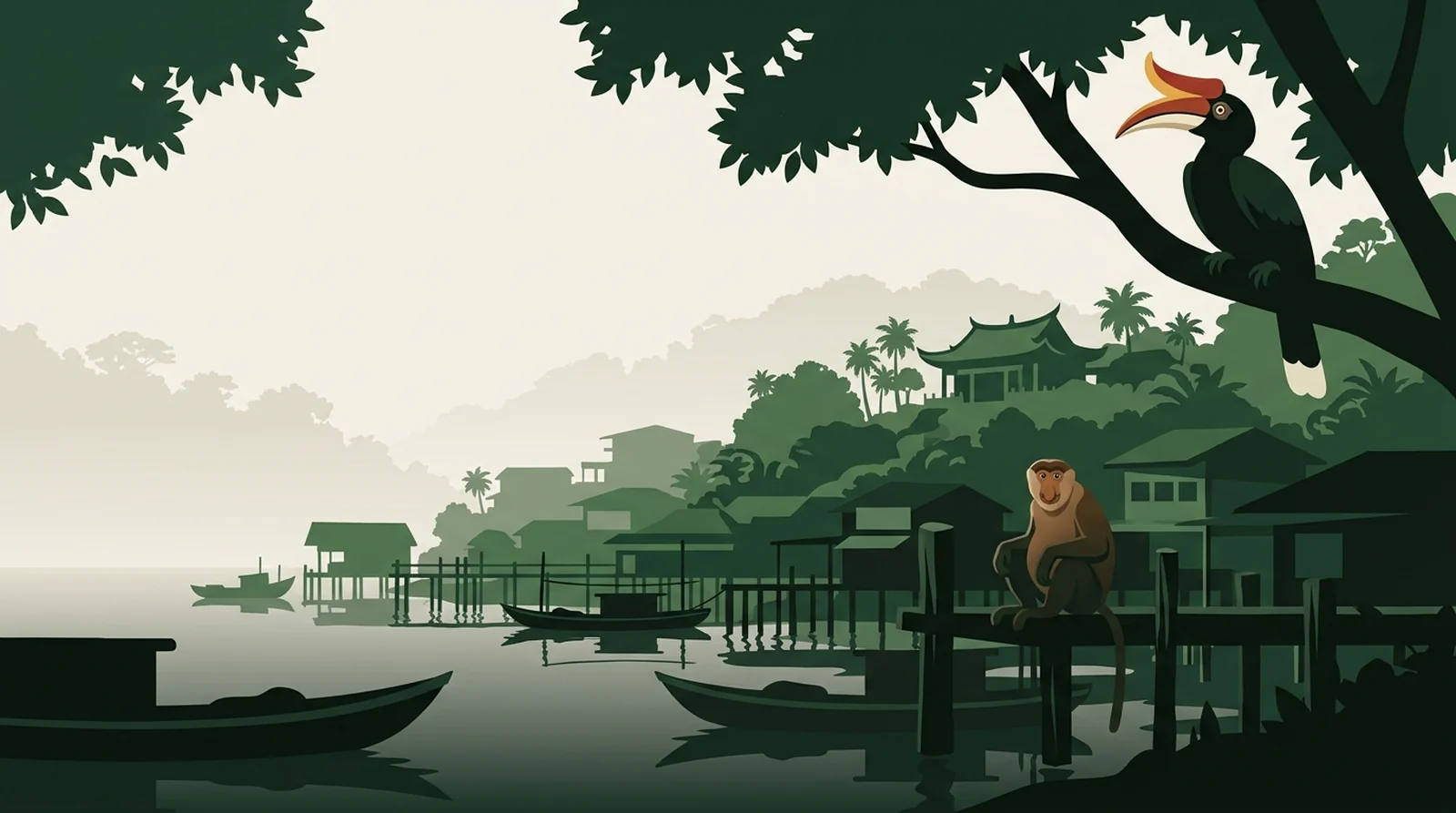
Arrival point for Sepilok
Sandakan
The coastal arrival point for eastern Sabah. Most travellers land and head straight into the forest but a morning here is essential for anyone tracing the 1945 history.
Why go
Coastal arrival point
Sandakan sits on the eastern coast of Sabah, functioning as the primary arrival point for the region's wildlife destinations. Most travellers land and transfer immediately to the forest, but a morning here is essential for tracing the profound 1945 war history. Withdraw the cash needed for your forest stay in Sandakan, as Sepilok and the remote river lodges have no ATMs.
Sandakan is a working coastal town that functions as an arrival point. When you fly into Sandakan airport you are landing just 17 kilometres from the edge of the Kabili-Sepilok Virgin Jungle Reserve. Because the primary rainforest and the wildlife lodges are located outside the town limits, Sandakan itself is a place of transit rather than a basecamp. You arrive here to move on or you spend a morning here to understand the region's profound Second World War history before heading into the trees.
When to stay in town
If you are coming to Sabah for the wildlife you do not need to spend a night in the town centre. The lodges at Sepilok and on the Kinabatangan River are where you want to wake up. The team recommends landing, gathering your cash from the town's ATMs and transferring immediately to your forest accommodation. However if the military history of 1945 is a reason for your journey, Sandakan requires a dedicated half-day. The town holds immense emotional weight for Australians and for the Sabahan families who lived through the occupation. Visiting the memorial sites is a deeply moving addition to a wildlife itinerary.
Flights and onward transfers
The logistics of eastern Sabah rely on Sandakan's airport. You fly into Sandakan directly from Kota Kinabalu or Tawau. Some distances are long so flying between regions is usually the better choice. If you are arriving from Mount Kinabalu you can return to Kota Kinabalu and fly or take a 5-hour private transfer overland.
Once you land, moving on is straightforward. E-hailing applications work reliably for the 17-kilometre drive from the airport to the Sepilok complex or you can take the local public bus that departs the Sandakan terminal 4 times a day. If you are heading to Danum Valley or the Kinabatangan River, the lodges organise private transport from Sandakan directly to their properties. Be sure to withdraw all the cash you need for your entire forest stay while you are in Sandakan. The ticketing counters at the wildlife centres mandate cash and there are no ATMs in the Sepilok area or at the remote river lodges.
Camp and death marches
For Australian visitors and veterans' families, Sandakan represents the greatest single atrocity committed against Australians in war. Following the fall of Singapore in February 1942, Allied prisoners were shipped to Sandakan to construct a military airstrip. By early 1945 there were 2,434 prisoners of war incarcerated at the camp. The death toll comprised 1,787 Australians and 641 British personnel.
The history of the camp is marked by immense suffering and extraordinary local resistance. In mid-1943 the Japanese secret police discovered a clandestine radio built by the prisoners. The retribution was severe. The Japanese executed Allied officers and local Sabahan civilians who had smuggled intelligence and medicines. Command of the camp passed to Captain Susumi Hoshijima. He reduced rations and ordered the construction of a notorious punishment cage. By late 1944 over 1,100 prisoners had died in the camp from disease and starvation.
As Allied bombing destroyed the airstrip in 1945, the Japanese command ordered the prisoners relocated 260 kilometres inland to Ranau. What followed were 3 forced marches through primary jungle and steep ravines. The first march of 455 men began in January. A second march of 536 men left in May and a final group of approximately 65 to 75 men were forced onto the track in mid-June. The 288 sick men who were left behind at the camp perished or were executed by July.
At the Ranau destination, the massacres continued until 27 August 1945. This was 12 days after the formal surrender of Japan. Among the last to die were 2 Australian doctors named Don Picone and John Oakeshott. They bravely refused to escape so they could remain and care for their dying men. By the end of August 1945 exactly 2,428 of the men were dead. Not a single British soldier survived. The remains of the victims were eventually moved to the Labuan War Cemetery in 1949.
The only men to survive the ordeal were 6 Australians. Their survival was entirely dependent on the immense courage of the local indigenous and Chinese communities. Villagers risked their own lives and those of their families to smuggle food and guide the escapees to Allied lines. This heroism is commemorated across the state alongside the tragedies of the local resistance. One such tragedy was the execution of 175 members of the Kinabalu Guerrillas at Petagas in January 1944.
Sandakan's historical sites
If you have a morning before a flight, the historical sites are compelling and carefully maintained. The Sandakan Memorial Park sits on the exact site of the former camp and is funded by the Australian government. It preserves the original perimeter alignments, a rusted excavator and the camp boiler alongside an interpretive pavilion featuring first-hand survivor accounts. Because the site carries immense emotional weight, the team recommends visiting in the early morning when it is quietest. Allow yourself 90 minutes to process the history before lunch.
Closer to the bay, the restored 1946 timber Agnes Keith House provides a window into the colonial and civilian wartime history. It was the home of the American author of Land Below the Wind who documented her internment. The house is open daily from 9am to 5pm. Nearby, St Michael's and All Angels Church is one of the few stone buildings in Sandakan to survive the Allied bombing. It houses magnificent stained glass Windows of Remembrance and Friendship Windows. These were designed by Australian artist Philip Handel and donated by Australian relatives in 2004 as a gesture of profound gratitude to the Sabahan community. The church is open on Monday and from Wednesday to Saturday.
Coastal seafood restaurants
Sandakan is a working town on the coast, built on a timber and cocoa history. The restaurants and seafood spots worth your time are confirmed at enquiry. Tell the team what your schedule allows and they will arrange the stops that fit your transfers and match your tastes.
The wildlife reserves
From the airport or the town centre, the Sepilok complex is a brief drive west. This 4,362-hectare Class VI Virgin Jungle Reserve is the premier accessible wildlife destination in the state. It holds the Sepilok Orangutan Rehabilitation Centre established in 1964. Here you can observe rehabilitating apes. The facility uses a glass-enclosed outdoor nursery to protect the orangutans from human respiratory viruses and soil-borne pathogens.
Immediately adjacent is the Bornean Sun Bear Conservation Centre. Here you stand on elevated canopy boardwalks and gaze downward 10 to 30 metres into forested enclosures to watch rescued sun bears foraging. Just down the road, the Rainforest Discovery Centre offers a rigidly engineered 347-metre steel canopy walkway standing 25 metres high. This provides a stable platform for birders seeking the Bornean bristlehead. It also features an open-concept bird hide along the Pitta Trail where the endemic Sabah partridge is a realistic target.
If you are continuing to the Kinabatangan River for wild proboscis monkeys and elephants, your river lodge will coordinate your overland transport from Sandakan. The journey to Danum Valley follows a similar pattern. Private transfers take you from the coastal hub deep into the interior.
Time in Sandakan and Sepilok
For a pure wildlife itinerary, you do not need to stay any nights in Sandakan town. You land and head straight to Sepilok. Spend 2 or 3 nights near the reserves to give yourself time for the canopy walkways and the dawn birding. Sepilok Nature Resort offers an orchid garden and a lake that attracts stork-billed kingfishers. MY Nature Resort borders the reserve with a boardwalk of about 305 metres and a dedicated flying-squirrel viewing deck.
If you are specifically tracing the war history or planning to trek the 140-kilometre mountain section of the Death March trail with a specialised operator, plan for 1 or 2 nights in the town to anchor your arrangements.
Wildlife & highlights
What you're likely to see


Related
Keep planning
Questions the team is asked
No. Sepilok has its own excellent rainforest lodges positioned right on the edge of the reserve. It is much better to wake up at Sepilok than to commute from the town.
There are no ATMs within the Sepilok complex. You must withdraw all the Malaysian Ringgit you need in Sandakan before you travel to the wildlife centres.
The lodges in Danum Valley organise private transport from Sandakan, coordinating with your flight or your prior accommodation.
Formal commemorative services are held annually on 15 August, coinciding with the anniversary of the official surrender that ended the war. Services are also held on Anzac Day (25 April).
The first 100 kilometres of the original route is now oil palm plantation and is not suitable for trekking. However, specialised operators run guided treks along the 140-kilometre mountain section.
Plan your trip
Plan your Sandakan arrival
Tell the team your flight details and they will coordinate your airport transfers, war memorial visits and onward transport to the surrounding forest lodges.