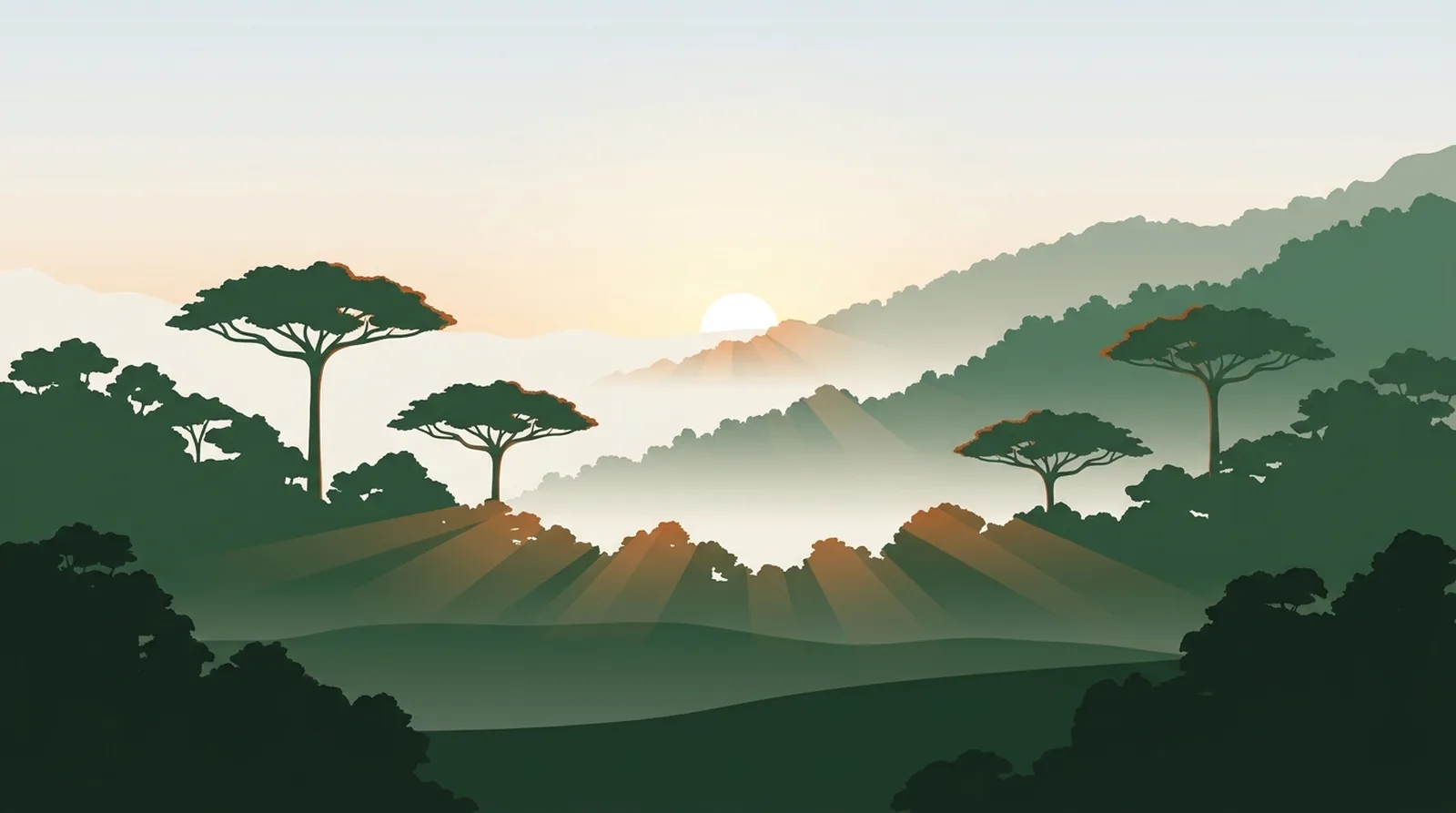
Flagship Sabah primary rainforest
Danum Valley
2.5 hours by road from Lahad Datu, Danum Valley is 438 square kilometres of lowland rainforest that was never logged with three very different places to stay inside it.
Why go
Primary lowland rainforest
Danum Valley protects 438 square kilometres of primary lowland rainforest located 2.5 hours by road from Lahad Datu. You will appreciate the early starts as you explore the canopy walkway before the equatorial heat sets in later that morning. Look for wild unhabituated orangutans high in the trees and join a night drive to search for western tarsiers, seen with luck.
The Danum Valley Conservation Area is a 438-square-kilometre block of Class I Protection Forest Reserve managed by Yayasan Sabah. It was gazetted in 1995 to protect a core of lowland dipterocarp rainforest that was never subjected to commercial logging. A research station opened here in 1986 and the valley has since become one of the most intensively studied tropical ecosystems in the world.
Because the core was never logged, the forest structure remains entirely intact. The canopy is dense and intercepts up to 90 percent of the available sunlight. The shaded understorey shapes how the wildlife moves and how you see it. The trees here are immense dipterocarps that follow a cycle known as mast fruiting. Every few years they fruit synchronously to overwhelm seed predators. During these irregular mast events the forest transforms as nomadic animals arrive to feed on the sudden abundance. During the long periods between mast years the resident animals rely heavily on keystone resources like the strangler figs that fruit in the canopy.
The deep primary forest
Danum Valley is demanding but it repays the effort. The relative humidity rarely drops below 80 percent so take your time on the trails and give yourself breaks to cool down. Proper leech socks are part of your kit for walking the forest trails. The wildlife is entirely wild and unprovisioned so sightings require patience and a good guide rather than a quick stop at a feeding platform.
If you are coming to Sabah strictly for wildlife photography, be prepared for the emerald shadow of the primary forest. The light under the canopy is very low and traditional photography parameters often fail. You will need fast lenses and the willingness to push your camera to ISO 6,400 or 12,800 to freeze the movement of a primate in the branches. If you want easy sunlit photographs of animals at eye level, the river cruises on the Kinabatangan will suit you better. If you want the authentic raw experience of finding animals in one of the oldest forests on Earth, Danum Valley is the one.
Towering emergent dipterocarps
The sheer scale of the trees is often what strikes visitors first. The forest is dominated by the Dipterocarpaceae family. These trees produce the towering emergents that break through the main canopy layer and provide the pathways for arboreal primates.
Danum Valley holds the record for the tallest known tropical tree in the world. It is a yellow meranti tree named Menara and measures 100.8 metres from the lowest point of its buttress root. The word Menara means tower in Malay. It was first identified by airborne LiDAR in 2014 and physically climbed and measured by researchers from the South East Asia Rainforest Research Partnership in January 2019. Menara stands on a steep slope in a sheltered valley far outside the established trail grids. To protect its shallow root system from soil compaction, its exact location is obscured and there is no public access protocol. You cannot visit Menara on a tourist trail but knowing it is out there gives you a sense of the forest's immense scale.
Forest trails and canopy walkway
The activities at Danum Valley revolve around walking the trails, exploring the canopy and taking night drives.
The Danum Canopy Walkway at Borneo Rainforest Lodge spans 360 metres in length and sits 27 metres above the forest floor. It is anchored directly to giant emergent hardwood trees including the menggaris and the urat mata. The walkway is exclusive to lodge guests and you reach it on a 2-kilometre guided hike. Departures start at 6am to catch the morning bird activity before the equatorial heat sets in. Each span takes 2 or 3 guests at a time to limit bounce. The suspension bridges sway underfoot so a monopod or beanbag is a better support for your camera. In 2026 some sections were closed due to dying anchor trees but a modified bypass loop allows guests to still safely access the sound sections.
The Danum Trails cover everything from short interpretive walks to rigorous treks. The Coffin Cliff trail at Borneo Rainforest Lodge is a steep, demanding ascent to an ancient Kadazandusun burial site where centuries-old ironwood coffins are wedged into the rock face. It offers a panoramic viewpoint and leads down to the Fairy and Serpent waterfalls. The natural jacuzzi pool provides a shallow river spot for a refreshing midday dip. At the Danum Valley Study Centre, trails like the 3.5-kilometre route to Tembaling waterfall require you to hire an official forest ranger to ensure safety in the deep forest.
The Danum Night Drives run for about 1.5 hours after dinner. Borneo Rainforest Lodge uses silent electric buggies alongside traditional vehicles to minimise acoustic disturbance while the Study Centre relies on standard 4x4 safaris. The electric buggies drastically reduce engine vibration and increase the likelihood of encountering sensitive mammals. Guides use red-filtered spotlights to protect the sensitive eyes of nocturnal primates and strictly prohibit bright white flashes.
River rafting along the Danum River is a guided group activity available at Borneo Rainforest Lodge and replaces the older individual river tubing option. At the Study Centre the Segama River Suspension Bridge is undergoing major maintenance in late 2026. This temporarily restricts access to certain long-distance trekking routes on the far bank.
Year-round tropical rainfall
Sabah has no single dry season and the east coast runs on a different calendar to the west coast. For Danum Valley and the Lahad Datu interior, the station data from 1985 to 2010 shows 2,849 mm of rain a year. January is the wettest month with about 315 mm and April is the driest with about 156 mm.
Rain falls all year and never closes the forest. What changes is the trail mud and the river level. The green season runs roughly from November to February and the peak season runs roughly from March to October. Danum Valley is good all year and April and May are the least wet months. When heavy torrential rain does fall, the canopy walkway is evacuated for safety and night drives are aborted because mammalian activity ceases. Be sure to pack dry bags and copious amounts of silica gel for your camera equipment because lenses will fog instantly when moved from air-conditioned chalets to the ambient jungle air.
Three distinct jungle properties
There are 3 distinct places to stay in the Danum Valley area and each offers a very different experience.
Borneo Rainforest Lodge is the flagship luxury property. It stands on the bank of the Danum River with 31 chalets spread along boardwalks under the trees. It has air-conditioned rooms, excellent meals and highly trained specialist guides. A construction and expansion project runs from 1 January 2025 to 22 January 2027 to add 9 new chalets. If you want comfortable rooms for a rainforest lodge and the exclusive use of the canopy walkway, Borneo Rainforest Lodge is the one.
The Danum Valley Study Centre is a working scientific research station managed jointly by the South East Asia Rainforest Research Partnership and the Danum Valley Management Committee. It offers comfortable rooms for a research station and a cafeteria shared with international field biologists. You can explore the short trails near the centre independently and hire an official ranger for the longer walks. If you want to spend your days birding and get close to the rainforest research taking place here, the Study Centre is the one.
INFAPRO is located about 11 kilometres from the Study Centre. It manages a massive reforestation area for carbon offsets. The resthouses here offer comfortable rooms. Guests can visit the massive dipterocarp seedling nurseries and participate in the Forest Keeper package to plant a named tree and fund its care for 5 years.
Travel routes and stay length
The process of getting there starts with a flight to Lahad Datu. From Kota Kinabalu or Sandakan you fly into Lahad Datu airport. From Tawau, you can take a bus or arrange private transport to Lahad Datu.
From Lahad Datu, private transport organised by your lodge takes you into the valley. The journey takes roughly 2.5 hours and runs mostly along unpaved logging roads. Private transport can also be arranged directly from Sandakan, Sepilok or the Kinabatangan to Danum Valley. Be sure to allow a full 24 hours between your last dive and your flight if you are arriving from Sipadan.
The team recommends a stay of 3 or 4 nights. This gives you enough time to experience the canopy walkway, take a night drive, tackle the Coffin Cliff trail and spend a quiet afternoon waiting for a fruiting fig tree to draw in the primates. A 2-night stay suits a shorter trip focused on a few guided activities.
Wildlife & highlights
Canopy primates and nocturnal mammals
Danum Valley's orangutans are unhabituated. The populations here are entirely wild and rely on natural food sources like the hemi-epiphytic strangler figs. From April to October they often concentrate along the Segama River and the primary trail grid behind the Danum Valley Study Centre. This makes them much easier to locate. An orangutan is seen on most stays feeding high in the trees.
Red leaf monkeys are resident. Their maroon coats make them highly visible against the green leaves and they frequently move through the mid-canopy in the early morning. These monkeys are highly specialised folivores that consume a diet rich in young leaves. They often descend from the canopy to consume clay-rich soils at natural mineral licks to neutralise dietary toxins.
Bornean gibbons are heard every dawn and seen with luck as they sing complex vocal duets to defend their territories. Finding them requires tracking their whoops to the upper canopy to watch them swing through the branches. They rely entirely on arm-swinging to navigate and never come to the ground.
Bornean elephants were formally recognised as a distinct endangered subspecies by the IUCN in June 2024. They are highly nomadic and their presence in the deep primary forest is episodic. GPS telemetry studies show that they actually prefer degraded secondary forests where the open canopy allows their food plants to grow. Bornean elephants are resident and usually use the unpaved logging access roads to bypass thick riverine vegetation.
Night drives reveal a completely different set of animals. Red giant flying squirrels, Malay civets and common palm civets are regular on the night drive. The western tarsier and the Bornean slow loris are seen with luck on the night drive as guides scan for their eyeshine in the mid-canopy. Tarsiers are bizarre nocturnal primates with massive eyes that cannot rotate within their sockets. Instead they can turn their heads nearly 180 degrees in either direction. The Bornean slow loris possesses a unique defence mechanism where a gland on its elbow secretes a toxin that delivers a venomous bite when mixed with saliva.
Sambar deer are regular on the night drive grazing near the clearings along the main access roads. Wallace's flying frog is a spectacular amphibian that uses massive webbing between its toes to glide between trees. It is resident and descends to muddy pools to spawn after heavy tropical downpours. Rajah Brooke's birdwing butterflies are seen on most stays when massive flocks of males gather to puddle at natural mineral seeps on the riverbanks.
The bearded pig is resident with early signs of recovery recorded in Sabah. The marbled cat, the flat-headed cat and the vulnerable Sunda clouded leopard are resident. The clouded leopard has a population density of just 0.8 to 4.4 individuals per 100 square kilometres across Borneo so it is seen with luck.

Pairing it with Danum
Primary lowland rainforest
The Danum Valley Conservation Area is a 438-square-kilometre block of Class I Protection Forest Reserve managed by Yayasan Sabah. It was gazetted in 1995 to protect a core of lowland dipterocarp rainforest that was never subjected to commercial logging. A research station opened here in 1986 and the valley has since become one of the most intensively studied tropical ecosystems in the world.
Because the core was never logged, the forest structure remains entirely intact. The canopy is dense and intercepts up to 90 percent of the available sunlight. The shaded understorey shapes how the wildlife moves and how you see it. The trees here are immense dipterocarps that follow a cycle known as mast fruiting. Every few years they fruit synchronously to overwhelm seed predators. During these irregular mast events the forest transforms as nomadic animals arrive to feed on the sudden abundance. During the long periods between mast years the resident animals rely heavily on keystone resources like the strangler figs that fruit in the canopy.
Combination trips
Related
Keep planning
Questions the team is asked
Yes. The primary forest floor is home to terrestrial leeches. You must wear proper specialised leech socks for all ground-level trekking because standard hiking socks offer zero protection.
No. Menara stands in a sheltered valley far off the established trail grids to protect its shallow roots from soil compaction. There is no public access protocol and viewing it is not a bookable tour option.
Yes. To photograph primates in the canopy or birds in the understorey, a 400mm to 600mm lens is required. You will also need a camera capable of shooting at high ISO settings to handle the low light of the emerald shadow.
No. Rain falls throughout the year in Sabah's interior. April and May are statistically the least wet months but you should expect high humidity and rain showers regardless of when you travel.
You can walk the short interpretive trails near the centre independently. However any trek exceeding a few kilometres such as the Tembaling waterfall trail strictly requires you to hire an official forest ranger for your safety.
Plan your trip
Plan your Danum Valley stay
Tell the team when you want to track wild orangutans in the primary forest and they will check availability at Borneo Rainforest Lodge.