Why the valley matters
Conservation and science in Danum Valley
438 square kilometres of unlogged lowland rainforest protected by a landmark 1995 gazettement. Visiting Danum Valley means funding the anti-poaching patrols and supporting one of the world's most productive tropical research stations.
Covering 438 square kilometres of unlogged lowland rainforest, Danum Valley protects some of the tallest tropical trees on earth. Decades of intensive field research here proved the ecosystem's value and secured its permanent protection from commercial timber extraction. When you visit this tropical research station, the conservation fees embedded in your permits directly fund the anti-poaching ranger patrols.
438 square kilometres of Class I Protection Forest Reserve
The 100-metre Bukit Atur atmospheric tower tracking global climate baselines
The 50-hectare ForestGEO plot mapping 260,000 individual trees
Active restoration at INFAPRO accelerating carbon recovery by 50 percent
Direct funding from your stay to Yayasan Sabah's conservation patrols
Access to the Danum Valley Study Centre and its working scientists
Danum Valley is 438 square kilometres of lowland rainforest that was never logged. It sits 2.5 hours by road from Lahad Datu and it holds some of the tallest tropical trees on earth. People come here for the orangutans seen on most stays and for the gibbons heard every dawn but the reason the wildlife is still here is the science. In the 1980s researchers set up a camp on the edge of the Danum River to study the forest. Over the next forty years their work proved how valuable this ecosystem is and gave the state government the exact data it needed to protect the area permanently from commercial timber extraction. Today the research station is one of the most productive in the tropics and tourism provides the financial machinery that keeps the perimeter secure. When you book a stay inside the valley, the conservation fees embedded in your permits pay for the anti-poaching ranger patrols and the physical facilities. This guide explains how the protection works, what the science is finding and what you actually see of it when you visit.
The history
Unlogged primary forest core
Danum Valley matters because it is a living laboratory of intact primary forest surrounded by a vast area of recovering secondary woodland. In 1970 the Sabah State Government granted a massive 972,000-hectare timber concession to Yayasan Sabah. The foundation is a statutory body mandated to generate revenue for the socio-economic development of the state and selective logging was the dominant economic driver of the era. A decade later the foundation's board of trustees made a voluntary and highly consequential decision to excise 43,892 hectares of untouched unlogged forest from its commercial harvesting plans. That excised area became the Danum Valley Conservation Area. It is now completely protected and it acts as the ecological baseline for the region. By comparing the intact core with the selectively logged reserves outside it, researchers can measure exactly how a rainforest recovers and what wildlife needs to survive.
The research
Danum Valley Study Centre
The scientific effort at Danum is anchored by the Danum Valley Study Centre. Established in 1986, it serves as the physical base for the South East Asia Rainforest Research Partnership. The partnership began in 1984 under the Royal Society and the resulting work has made Danum one of the 3 leading tropical research stations in the world alongside Barro colourado Island in Panama and La Selva Biological Station in Costa Rica. The facility has hosted over 500 research projects including 156 post-doctoral studies, 175 doctoral studies and 85 master's degrees. The resulting output spans more than 700 peer-reviewed publications that shape modern tropical ecology.
One of the most ambitious projects is the 50-hectare ForestGEO plot. Part of the Forest Global Earth Observatory network administered by the Smithsonian Institution, this plot lets researchers track differences across the lowland dipterocarp forest and changes over time. Researchers initiated the plot in 2010 and they map, measure and identify every single woody stem with a diameter at breast height greater than 1 centimetre. The grid currently holds roughly 260,000 mapped stems across nearly 700 tree species. Researchers repeat the census every 5 years to record which trees have grown, died or taken root and assess how shifting rainfall and drought affect the forest.
The work extends from the subterranean root networks to the upper atmosphere. The Malaysian Meteorological Department operates a 100-metre atmospheric monitoring tower on Bukit Atur, 10 kilometres by road from the study centre. The tower sits at an elevation of 427 metres above sea level and it rises well above the 70-metre dipterocarp canopy. Established in 2003, it functions as a global station within the World Meteorological organisation's Global Atmosphere Watch network. Because the station sits inside a vast expanse of unpolluted primary forest, it provides the international scientific community with an uncorrupted atmospheric baseline to conduct eddy-covariance measurements of greenhouse gases, reactive trace gases and aerosols to calibrate global climate models.
Forest governance
Class I forest protection
The landscape was not spared by accident. Its protection was a deliberate negotiated outcome driven by the science. Following the initial decision to spare the 43,892 hectares, a decade of intensive field research helped convince the state government to formally protect the site. In May 1995 the Sabah State Legislative Assembly officially gazetted the conservation area as a Class I Protection Forest Reserve under the Forest Enactment 1968. This status permanently prohibits commercial logging and extractive activities distinguishing it from commercial reserves.
The governance structure was solidified by the Forest Rules 1996 which established the Danum Valley Management Committee to oversee the reserve's integrity and prevent unilateral exploitation. The committee brings forestry authorities, researchers and conservation organisations together to oversee the reserve. The main members include the Sabah Forestry Department, Yayasan Sabah, the Sabah Wildlife Department, the Ministry of Tourism, Culture and Environment, Sabah Parks and WWF-Malaysia alongside Universiti Malaysia Sabah and the Forest Research Institute Malaysia. Researchers planning field studies in the valley must secure permits through the state's access application system under the Sabah Biodiversity Enactment 2000.
The research
Tropical ecology field discoveries
Decades of research at Danum Valley have changed how scientists understand tropical forests. These findings anchor the conservation work.
- The giant of the tropics: Danum Valley conceals the world's tallest known tropical tree. Named Menara, it is a Yellow Meranti that measures exactly 100.8 metres. Researchers discovered it using airborne Light Detection and Ranging and verified the height with a physical tape drop. Despite weighing 81,500 kilograms, its centre of gravity is highly symmetrical and keeps it from buckling under its own weight on a steep jungle slope.
- The logged forest sanctuary: Groundbreaking aerial nest surveys proved that Bornean orangutans do not just survive in untouched primary forest. They can maintain healthy population densities in repeatedly logged woodlands like the Ulu Segama and Malua reserves. These findings helped conservationists recognise how much wildlife recovering forests can support.
- The dipterocarp waiting game: To outsmart seed-eating insects, the giant canopy trees of Borneo coordinate their reproduction. They drop millions of seeds simultaneously in massive unpredictable mast fruiting events designed to overwhelm and satiate predators.
- The insurance policy of biodiversity: Across a 500-hectare experimental site researchers planted 16 different species of dipterocarps in various combinations. They found that diverse mixtures act as ecological insurance because species with dense wood survive droughts while lighter-wood species grow rapidly.
- Carnivore coexistence: Camera trap data from Danum Valley revealed that carnivores like the clouded leopard and the Malayan sun bear share the same hunting grounds by keeping to distinct active hours.
- The drought paradox: Standard restoration practice involves cutting invasive liana vines to stop them strangling young trees. Long-term monitoring revealed that during extreme climate-induced El Niño drought events, the shade from the liana canopy actually reduces soil moisture evaporation and increases seedling survival rates.
- The unstratified canopy: Challenging the classic textbook illustration of neatly layered rainforests, satellite lasers aboard the International Space Station revealed that the vast majority of tropical forests lack distinct multi-level canopy strata.
Conservation funding
Yayasan Sabah conservation fees
When a conservation itinerary claims that a luxury stay saves the rainforest, you should look for the financial mechanics. In Sabah, the funding runs through the organisation responsible for the reserve. The Danum Valley Conservation Area is geographically located within the larger Yayasan Sabah forestry concession. Yayasan Sabah operates a commercial tourism arm that exclusively manages Borneo Rainforest Lodge situated within the reserve. The high daily tariffs commanded by the lodge are not solely absorbed as corporate profit. Instead a formalised conservation fee is extracted from every guest's entry permits and accommodation costs.
These localised revenues channel directly into Yayasan Sabah's Conservation and Environmental Management Division. This internal division bears the financial responsibility for maintaining the integrity of the Class I Protection Forest Reserve. Money from visitors helps pay for anti-poaching ranger patrols, perimeter gates and the facilities used by the management committee and scientists. Your stay gives the state government a financial reason to keep the forest strictly protected. It proves that intact biodiversity generates socio-economic value equal to or superior to commercial timber extraction.
The research
INFAPRO forest restoration site
The forests surrounding the untouched core, particularly the Ulu Segama Forest Reserve, suffered extensive selective logging during the 1980s. To mitigate this degradation, the Innoprise-FACE Foundation Rainforest Rehabilitation Project began in 1992. Known as INFAPRO, it represents one of the longest-running tropical forest restoration projects on earth. The project is a partnership between Yayasan Sabah and the Netherlands-based FACE Foundation. It operates across a designated 25,000-hectare target area and has successfully rehabilitated approximately 11,864 hectares to date.
Logging preferentially removed the towering climax trees of the dipterocarpaceae family. Left alone, the forest matrix becomes choked by fast-growing climbing lianas and pioneer shrubs that suppress natural tree regeneration. INFAPRO counters this by deploying teams to cut back the lianas and manually plant nursery-reared dipterocarp seedlings and native fruit trees along carefully cut 2-metre lines.
This active enrichment planting has profound ecological and economic impacts. Research published in Science quantified the exact value of the human intervention. While degraded forests left to regenerate naturally accumulate above-ground carbon at a rate of 2.9 tonnes per hectare per year, active planting accelerates that recovery by 50 percent to 4.4 tonnes. This peer-reviewed validation of carbon additionality allows INFAPRO to issue highly rated carbon credits on the voluntary market. The project has issued over 1 million Verified Carbon Units under Verra's Verified Carbon Standard to fund continued forest repair.
The wildlife
Rhino loss and habitat restoration
The extinction of the Bornean rhinoceros in Malaysia is the ultimate cautionary tale for the region. It was not a simplistic case of rampant modern poaching. While historical hunting reduced the population during the early twentieth century, habitat fragmentation and the Allee effect drove its final decline. As the lowland forests were carved into isolated fragments by logging and plantations, the remaining solitary rhinos became trapped in disparate pockets of jungle. Female rhinos possess an exceptionally narrow window of sexual receptivity. In a fragmented landscape the probability of encountering a fertile male became statistically negligible.
Without pregnancies to interrupt their reproductive cycles, the females experienced continuous fluctuations of sex steroids that caused asymmetric reproductive ageing. Veterinary pathology confirmed this resulted in extensive cystic endometrial hyperplasia and multiple uterine fibroids rendering natural conception impossible. The last wild rhinoceros captured in Malaysia was a female named Iman who was found in Danum Valley in 2014. She battled massive uterine tumours for years before her death in November 2019 marked the extinction of the species in the country.
The scientific endeavour did not end with her death. The BioRescue consortium successfully preserved cell cultures from Malaysia's last rhinos. Using skin fibroblasts researchers have generated induced pluripotent stem cells and cerebral organoids keeping the genetic lineage alive in advanced laboratories.
In Sabah, conservation teams have carried the work forward into habitat restoration. The Borneo Rhino Alliance became Bringing Back Our Rare Animals and now works to restore habitats and food supplies for wildlife. The Sabah Forestry Department entrusted the team to establish the Sabah Ficus Germplasm Centre directly atop the footprint of the old rhino paddocks at Tabin Wildlife Reserve. They now manage up to 95 native Ficus species and run the largest living collection of wild fig species globally. They propagate these figs to enrich degraded forests and establish vital riparian wildlife corridors.
By applying the nutritional and biological lessons learned from the tragic loss of the rhino, the team is actively fighting the isolation trap for other species. They established pasture in Tabin Wildlife Reserve with high-protein grasses and artificial mineral salt licks for the critically endangered Bornean banteng. The rhino proves that once a population is pushed into isolated fragments biological collapse becomes inevitable even if the poaching stops. This informs the urgent work to protect the Sunda pangolin and the helmeted hornbill which is strictly shielded under Schedule 1 of the Sabah Wildlife Conservation Enactment 1997.
A day here
Visiting the conservation sites
Visiting Danum Valley brings you into a forest where scientists are still discovering how it works. Permits are arranged with the stay. Travel and health insurance is advised for any visit to Danum Valley and cover that includes emergency evacuation is sensible in a place this remote.
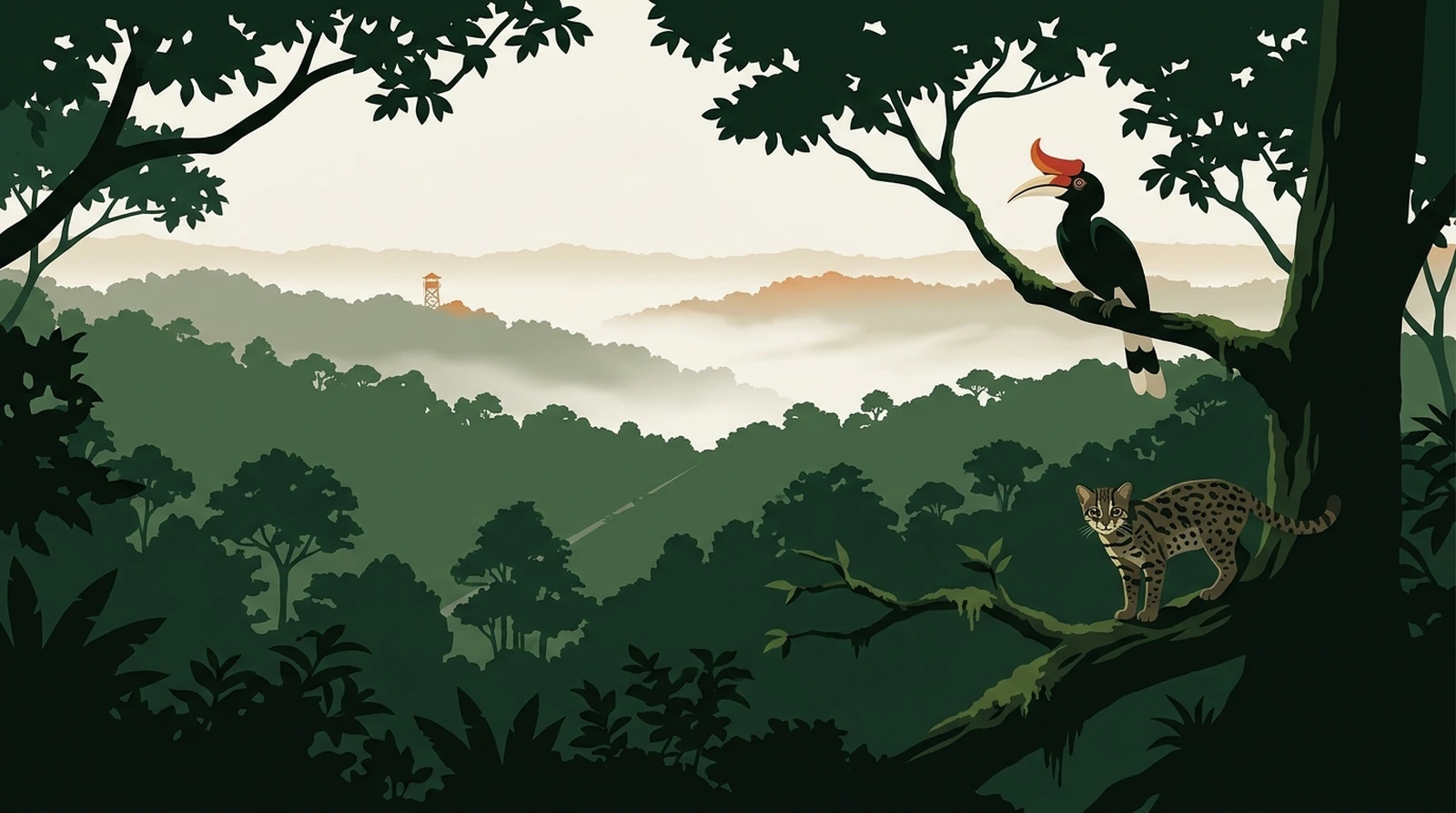
If you stay at the Danum Valley Study Centre, you are inside the working research station. You share the cafeteria with resident scientists and visiting academics. If you arrange an early morning drive to the sunrise viewpoint, you will see the Bukit Atur atmospheric tower rising above the mist. On the trails you will walk past primary forest trees tagged for the ForestGEO plot.
If you choose Borneo Rainforest Lodge, its canopy walkway brings you closer to the forest the scientists study. The lodge's canopy walkway puts you up in the stratum where the mast fruiting events occur and where the scientific discoveries regarding canopy structure were made. The lodge's construction and expansion project runs from 1 January 2025 to 22 January 2027 and adds 9 chalets. At the INFAPRO site in the Ulu Segama forest you can visit the nurseries and see how planting native trees helps the forest recover its carbon.
Alternatives
Nearby reserves and stays
Danum Valley is where the science proves the value of leaving the rainforest standing. Send your dates, your party size and your main interests and the team will come back with what can be arranged.


- Danum Valley Study Centre — The working research station inside the primary forest with access to the grid trails and the Bukit Atur viewpoint.
- Borneo Rainforest Lodge — The flagship lodge inside the conservation area featuring 31 chalets and a canopy walkway.
- INFAPRO — The restoration base in the Ulu Segama logged forest offering learning walks through the tree nurseries.
- Tabin Wildlife Reserve — A vast reserve where the Sabah Ficus Germplasm Centre works to build wildlife corridors for endangered mammals.
Questions the team is asked
Permits are mandatory for all visitors and are arranged directly by the team when you book your stay at Borneo Rainforest Lodge or the Danum Valley Study Centre.
Yes. A formalised conservation fee is built into your entry permits and accommodation costs. This money goes directly to Yayasan Sabah's Conservation and Environmental Management Division to pay for anti-poaching patrols and reserve facilities.
The plot itself is a highly controlled scientific environment and is not open for recreational hiking but the primary forest trails around the Danum Valley Study Centre take you through identical unlogged habitat where research is ongoing.
Yes. Aerial surveys confirm that healthy populations of Bornean orangutans successfully adapt to the selectively logged and regenerating woodlands of the Ulu Segama Forest Reserve outside the untouched core.
Yes. You can stay at the INFAPRO lodge in the Ulu Segama forest to see the nursery operations and learn exactly how the active enrichment planting accelerates carbon capture.
No. The 100-metre tower is a highly sensitive working facility run by the Malaysian Meteorological Department but you can view it from the Bukit Atur sunrise viewpoint on an early morning drive.
Sources referenced on this page: Foundations of Tropical Forest Biology (2001), South East Asia Rainforest Research Partnership (SEARRP), ForestGEO, Malaysian Meteorological Department, Sabah Forestry Department, Sabah Wildlife Department, Danum Valley Management Committee, Borneo Rhino Alliance, Leibniz Institute for Zoo and Wildlife Research, IUCN. Facts verified 8 September 2026.