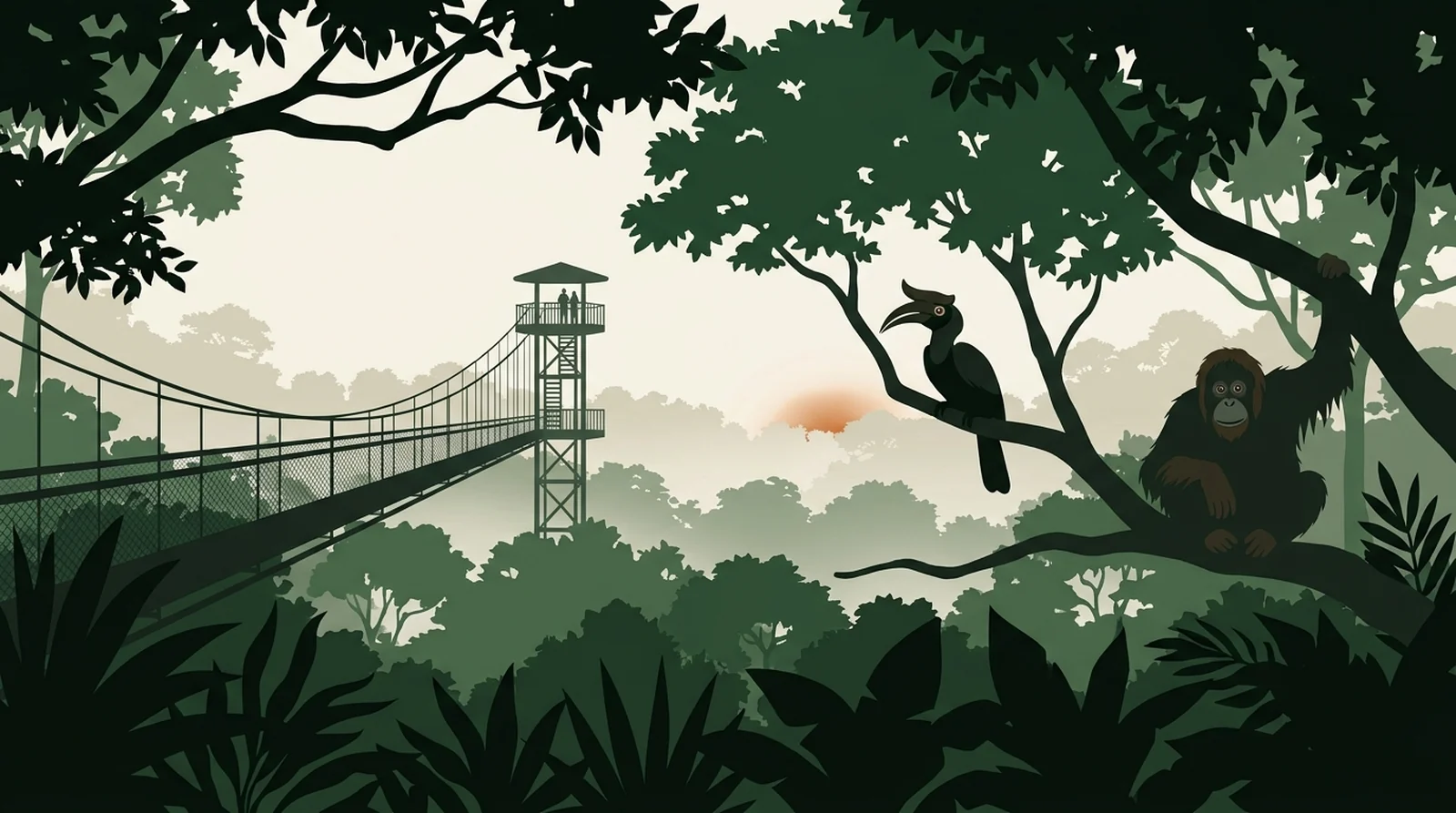
Sepilok's canopy walkway
Rainforest Discovery Centre
Run by the Sabah Forestry Department, the Rainforest Discovery Centre is a 106-hectare gateway into the Kabili-Sepilok Forest Reserve with a vast steel canopy walkway.
Why go
Gateway to the Kabili-Sepilok reserve
Two kilometres down the road from the orangutan rehabilitation centre, the Rainforest Discovery Centre is 106 hectares of lowland forest run by the Sabah Forestry Department, with a 620-metre steel skywalk standing 25 metres up in the canopy. You walk it at dawn for the birds and return at dusk for the flying squirrels, on flat paved trails that suit every generation.
In 1996 the Sabah Forestry Department established this site as an environmental education hub for local students. Recognising its appeal, they opened it to the public in August 2006. Today the 106-hectare Taman Botanikal Sepilok Forest Reserve serves as the accessible edge of the Kabili-Sepilok Forest Reserve. This is a 4,300-hectare Class VI Virgin Jungle Reserve of unlogged mixed dipterocarp and mangrove forest. It was gazetted in 1931 by the British North Borneo administration. The terrain shifts rapidly from inland hills to coastal swamps. The close mix of habitats supports the area's rich biodiversity. The ticket revenue goes directly back into the centre's upkeep and state-wide education programmes.
Sabah's easiest canopy morning
If you want to see the rainforest canopy without booking a deep-jungle lodge, this is where you go. The steel walkway gives you a steady platform for watching canopy birds. It puts you level with the branches where birds feed so you can watch without craning your neck. The walkway is engineered for crowds so it can get busy in the middle of the day but the early entry system solves this for anyone who plans ahead. Because it sits right next to the other Sepilok sanctuaries, it fits easily into a broader wildlife itinerary.
620 metres of steel at 25 metres up
The Rainforest Skywalk is the most heavily engineered structure of its kind in Sabah. Following a major expansion completed in February 2022, it now runs for a continuous 620 metres. Built entirely of heavy-duty steel with high safety railings and metal grating underfoot, it spans the forest at heights of 25 to 28 metres.
Along the route are several named observation towers. The Hornbill Tower is the highest. It reaches 27 metres to provide a 360-degree sweep of the dense canopy and distant emergent trees. From here you look across a rolling sea of green to towering menggaris trees that pierce the skyline at 60 to 80 metres. You can often see giant wild honey bee combs hanging beneath their branches.
The Trogon Tower is integrated into the main spine for scanning the mid-canopy while the Bristlehead Tower sits near prime fruiting trees favoured by canopy flocks. The Sunbird Shelter provides a resting pavilion near tightly packed foliage. The Broadbill Tower functions as a vantage point for sub-canopy species at around 15 metres above the ground. The walkway is 2 metres wide so it holds large groups safely. Its zero-sway stability makes it excellent for long-lens photography.
Over 300 species from one walkway
BirdLife International designates the Kabili-Sepilok reserve as an Important Bird Area and the centre's verified checklist holds over 300 species. The canopy walkway provides eye-level flight views of rhinoceros, black, oriental pied and bushy-crested hornbills. The great slaty woodpecker, the crimson-winged woodpecker and the endemic Bornean black magpie are regular fixtures. You will often see black-and-yellow broadbills from the skywalk. The skywalk also provides clear sightlines for Wallace's hawk-eagles and crested serpent-eagles.
Rainforest bird activity is tied to temperature and humidity so the hours that matter are 6am to 10am and 3:30pm to 6pm. The midday heat drives species deep into the shade and leaves the unshaded skywalk quiet. The official commercial ticket counter opens at 8am. If you buy your tickets the afternoon before, you can enter the gates at 6am. Buying ahead gets you into the forest during its liveliest birding hours.
A realistic target, not a promise
The Bornean bristlehead is the species many people fly to Borneo to see. It is a bizarre crimson-and-black endemic bird that occupies its own unique monotypic family. The RDC is universally known as one of the best places in the world to find it.
In the right season, bristlehead parties cross the walkway on most mornings and are seen with luck and patient watching. These are highly nomadic canopy foragers that move unpredictably through the massive reserve in noisy flocks. Give yourself time at the Bristlehead Tower or the Hornbill Tower to scan the surrounding emergent trees. Many visiting birders spend days here so allocate at least 2 or 3 full mornings if the bristlehead is your primary target.
The Pitta Trail ground hide
In 2024 the Sabah Forestry Department opened a new purpose-built bird observation hide along the Pitta Trail. Built as an open-concept station draped in camouflage netting, it is entirely free to use and requires no advance booking. The department hosted a workshop here in August 2025 to develop state-wide hide guidelines.
The hide was constructed specifically to allow photographers to observe the endemic Sabah partridge. These birds favour the dense undergrowth in this sector and have grown remarkably tolerant of quiet observers. They often approach the path so closely they can be photographed from outside the structure itself. The dark humid corridor of the Pitta Trail is also famous for sightings of the black-crowned pitta, the white-crowned shama, Diard's trogon and the brilliantly coloured rufous-backed dwarf-kingfisher.
The red giant flying squirrel launch
As daylight fades and the diurnal birds settle, the RDC offers one of the most reliable mammal phenomena in Sabah. Around 6pm red giant flying squirrels emerge from their cavity nests high in the emergent trees. They scale the vertical trunks to gain altitude and launch into the fading light to glide for distances up to 100 metres across the canopy.
Because the walkway places you 25 metres in the air, the squirrels often glide directly at eye level or just overhead. A 2023 nocturnal survey conducted from this skywalk confirmed the presence of the rare Thomas' flying squirrel and the data-deficient black flying squirrel. The odds of seeing at least one glide on a clear evening are exceptionally high if you are quietly in position by 5:45pm.
Paved trails and the lake
Back on the ground, a network of flat clearly marked trails navigates the untouched lowland forest. The Ridge Trail offers a wide open path that roughly parallels the skywalk above. The Pitta Trail is much narrower and bordered by tangled primary undergrowth. The Lakeside Trail skirts the central freshwater lake with a boardwalk suspended over the water. Take this route to look for kingfishers and freshwater aquatic life.
The Kabili-Sepilok reserve supports a resident wild population of around 200 Northeast Bornean orangutans. They live alongside the 60 to 80 rehabilitated individuals that roam freely from the nearby centre. You will sometimes encounter a mother and infant foraging near the steel walkway. Rangers strictly advise visitors to keep a respectful distance.
Primates are abundant and highly visible across the site. Bornean gibbons call frequently at dawn while red leaf monkeys and long-tailed macaques are regular fixtures along the Ridge Trail. Pig-tailed macaques demand a wide berth because they can exhibit defensive behaviour.
Further into the forest, you can walk to the Sepilok Giant. This is a towering yellow seraya tree estimated to be 800 to 1,000 years old that measures 67 metres tall. A 15-minute hike reveals the Kabili Monster. This obah suluk tree dwarfs the Sepilok Giant by standing 75 metres high. The Kabili Trail offers a challenging 20-kilometre return trek that strikes deep into the reserve towards the coastal mangrove zone. Access to this deep-forest route requires a specific Forest Reserve Entry Permit obtained from the RDC ticket office, several litres of water, leech socks during the wet months and ideally a hired local guide.
Just behind the main visitor building is the Plant Discovery Garden. The garden covers around 1.2 hectares with endemic pitcher plants, wild orchids and medicinal forest herbs like Tongkat Ali.
Two kilometres from the orangutan centre
The RDC sits along Jalan Fabia about 23 kilometres from Sandakan town and 17 kilometres from Sandakan Airport. It is just 2 kilometres from the Sepilok Orangutan Rehabilitation Centre and the Bornean Sun Bear Conservation Centre. You can walk from most local eco-lodges in 20 minutes or take a 3-minute taxi ride.
A visit fits easily into a single-day Sepilok itinerary. You can enter the RDC at 6am for dawn birding before heading to the orangutan and sun bear centres during the mid-morning. You can then take a long lunch through the midday heat and return to the canopy walkway at 4pm for the afternoon birding and the dusk squirrel launch. Be sure to carry physical Malaysian Ringgit because all transactions at the ticketing counter are cash only and there are no ATMs inside the reserve.
Tarsiers, lorises and sleeping pittas
The guided night walk here is one of the best nocturnal ecotourism experiences in Sabah. Running from 6pm to 8pm, the walks begin on the canopy walkway for the flying squirrel launch before descending to the pitch-black terrestrial trails. Small groups of around 10 people are led by expert spotters equipped with high-powered torches and ultraviolet lights.
The guides routinely spot western tarsiers, Bornean keeled pit vipers, slow lorises, Sunda colugos and Malay civets. Lower to the ground they find sleeping pittas, lowland litter frogs and black scorpions that fluoresce a vivid blue-green under UV light. Night-walk places depend on guide availability and are booked at the counter or requested through the centre's official Facebook page rather than automated online systems. You must register and pay at the ticketing counter by 5pm on the day of the walk or reserve a slot a day in advance via the centre's official Facebook page.
How many mornings to give it
If the dusk flying squirrels and the morning bird flocks are what you are coming for, let the team know your priorities and they will build the Sepilok days around them. Send your dates, the size of your party and your main interests. The team will come back with an itinerary that gets the timings and logistics right.
--- Sources referenced on this page: Sabah Forestry Department, BirdLife International. Facts verified 15 September 2026.


Related
Keep planning
Questions the team is asked
The Kabili-Sepilok reserve supports a resident wild population of Northeast Bornean orangutans alongside rehabilitated individuals that roam freely from the nearby centre. It is not uncommon to encounter a mother and infant foraging near the walkway but you must keep a respectful distance.
The skywalk is very accessible. The physical approach from the ticket counter is fully paved and the trails leading to the primary towers are flat and broad. The 2-metre-wide steel walkway itself provides a smooth stable platform suitable for elderly visitors, multi-generational families and photographers with heavy gear.
March through May is an exceptional window for birding as the region transitions out of the heavy northeast monsoon and the trails begin to dry. June through August often brings fruiting dipterocarp trees that draw canopy flocks; rain falls all year at Sepilok.
Yes, the new Pitta Trail bird hide is open throughout the centre's operating hours and is free to use on a first-come, first-served basis with your admission ticket.
Plan your trip
Plan your Sepilok mornings
Tell the team which birds you are hoping for and they will fit the Rainforest Discovery Centre's dawn and dusk sessions around your Sepilok days.