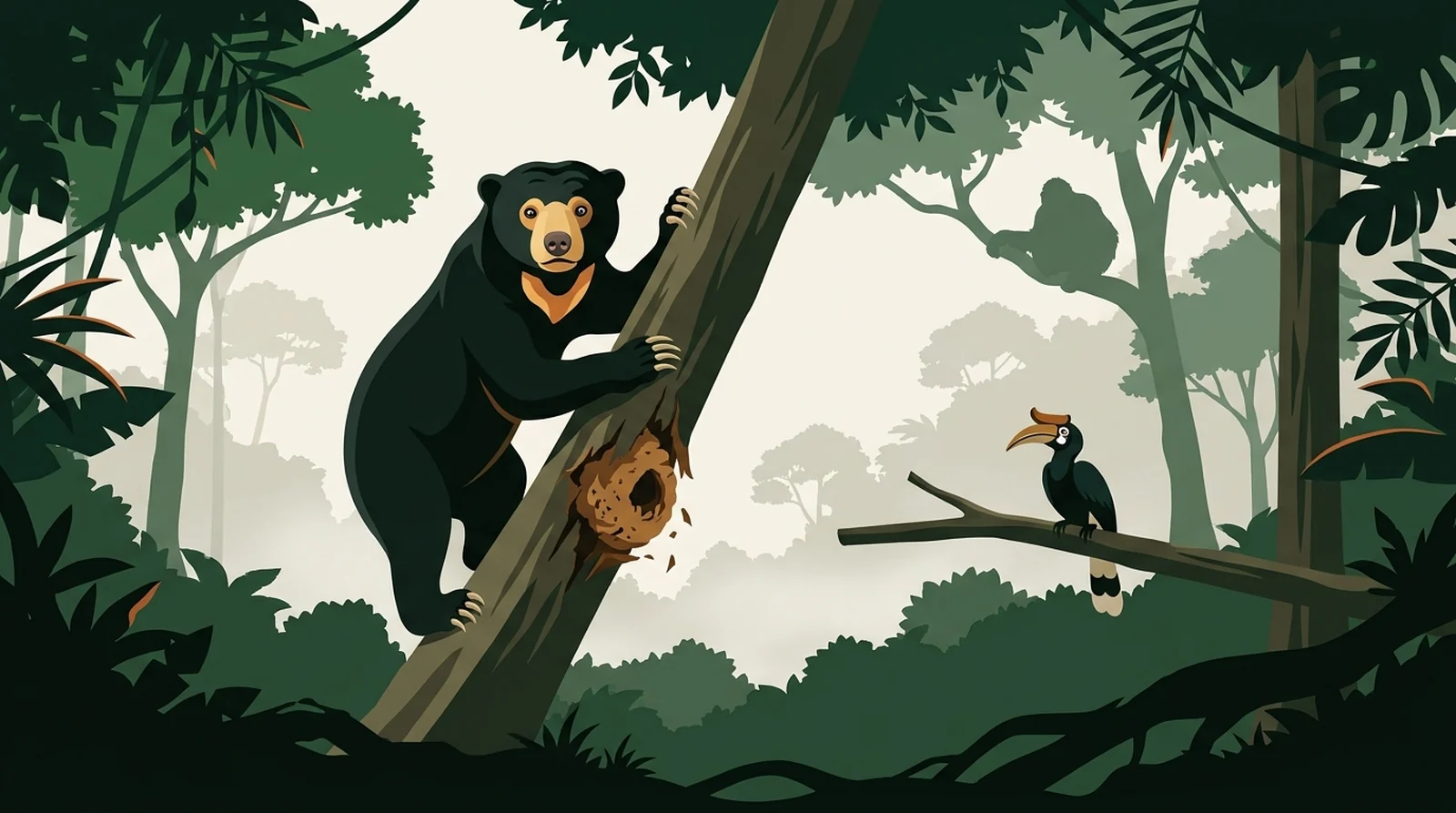
Sabah's smallest forest bear
Bornean Sun Bear
The Bornean sun bear is the smallest bear on Earth. See rescued bears at the conservation centre in Sepilok or look for their signs in the primary rainforests of Sabah.
The animal
The Bornean subspecies
Weighing just 20 to 40 kg, the Bornean sun bear is an endemic subspecies and the smallest bear on Earth. You can watch over 40 rescued bears foraging in the forest enclosures at the conservation centre in Sepilok. If you want to look for them in the wild, extended night drives in Deramakot Forest Reserve offer a realistic target.
The sun bear lineage split from mainland bears approximately 290,000 years ago during the Pleistocene epoch. Prolonged isolation on the island of Borneo subjected the species to insular dwarfism. The mainland sun bear averages up to 65 kg whereas the Bornean subspecies is remarkably diminutive. Adult females typically weigh between 20 and 40 kg and adult males range from 30 to 60 kg. This lighter frame permits them to move along thin outer branches to access stingless bee nests and fruiting bodies that would be inaccessible to heavier animals.
They have dextrous paws and an exceptionally long tongue extending up to 25 cm. They use this tongue to lap up termites and honey deep within wooden crevices. They are active during both the day and night, a pattern known as cathemeral activity. Their striking pale-yellow to orange chest mark against their dark fur serves a vital evolutionary purpose. In the dark dense understory of the rainforest the high-contrast mark functions as a visual signalling mechanism for recognition. These marks are as unique as human fingerprints and the quantity of dark speckled dots within the patch increases as the bear ages.
The IUCN Bear Specialist Group assessed the sun bear as Vulnerable in 2017. The global population has declined by roughly 30% over the past 3 generations (about 30 years) driven largely by habitat fragmentation and poaching.
Seed dispersers and insectivores
The sun bear is a prolific frugivore and a vital seed disperser. During mast fruiting events they gorge on tropical fruits. Their large gapes and strong digestive systems allow them to swallow the enormous seeds of durian and wild figs intact before dispersing them over distances exceeding 1 km from the parent tree. When fruit becomes scarce their diet shifts toward insectivory. They use their massive claws to rip open decaying logs and excavate termite mounds, helping keep insect populations in check.
Conservation outreach often highlights their ecological utility by crowning them forest engineers. A persistent myth claims that sun bears excavate stingless bee nests and create the hollow cavities that secondary nesters like rhinoceros hornbills later use. A 2024 study analysing hornbill nests confirmed they rely entirely on naturally formed tree cavities created by long-term weathering and fungal rot in massive dipterocarps. Sun bears lack the anatomical capability to bore holes large enough to house a hornbill. In ecological reality the relationship is entirely antagonistic. Sun bears are apex predators of stingless bee colonies and scale trees to destroy cavities in order to prey on sealed-in chicks and eggs.
The Sepilok conservation centre
The global epicentre for the rescue and rehabilitation of the species is the Bornean Sun Bear Conservation Centre. Dr. Wong Siew Te founded the centre in 2008. He was born and raised in Penang and studied animal husbandry in Taiwan before moving to the University of Montana to focus on the ecology of the Malayan sun bear. He was appalled by the systemic cruelty he witnessed during a nationwide survey of on-site bears and worked with local authorities to secure a forest plot adjacent to the Sepilok Orangutan Rehabilitation Centre. The facility officially opened to the public in 2014 and earned Wong the title of CNN Hero in 2017.
The centre currently houses 42 to 43 rescued sun bears. You view the animals from raised wooden platforms overlooking the forest enclosures. There are no scheduled feeding shows because keepers scatter food randomly throughout the day to encourage natural foraging behaviours. The best time to watch is mid-morning from 9am to 11:30am when temperatures are cooler and the bears actively climb trees or excavate logs. By early afternoon the tropical heat drives most bears high into the canopy to sleep in nests making sightings less dramatic.
The ultimate goal is returning rehabilitated bears to the wild. Early hard releases of adult bears into primary reserves suffered poor outcomes as on-site-raised bears lacked the instinctual skills required to forage. The centre launched the Tabin Sun Bear Project in 2023 to help only young cubs return to the wild through gradual soft releases. Bear keepers act as surrogate mothers and take rescued cubs on daily walks into Tabin Wildlife Reserve. On these walks the cubs develop climbing and defensive instincts in the forest before returning to the safety of the field centre at night.
Wild sun bear habitats
A wild sun bear in its natural habitat is seen with luck. They are solitary and notoriously elusive. Deramakot Forest Reserve offers the most realistic chance of spotting one. Research tracking habitat use shows that sun bears use 14-year-old selectively logged forests more than adjacent primary forests. The abundance of dead wood left behind creates a massive boom in termite populations providing an insectivorous feast. Deramakot's extensive network of logging roads allows for long night spotlighting safaris.
Tabin Wildlife Reserve is the staging ground for the centre's soft-release projects. An uncollared bear here is seen with luck on a night drive. In Danum Valley the dense understory makes visual terrestrial sightings exceedingly rare. They are seen with luck on the primary trail grid behind the Danum Valley Study Centre during mast fruiting years when the abundance of fallen seeds brings them to the forest floor.
Forest tracks and claw marks
Guides rely on field craft to show you the presence of sun bears in Danum Valley. They help you read the forest by pointing out freshly shattered termite mounds and torn-apart decaying logs. The most distinct sign is the presence of claw marks on the smooth trunks of dipterocarp trees. Sun bear claw marks are deep parallel wedge-shaped gouges that often ascend high into the canopy. They look distinctly different from the lighter erratic scratches of a monitor lizard or the lower-trunk rakes of a clouded leopard.
Fast lenses and camera sensors
Professional photographers visiting the conservation centre should be aware that the facility applies a camera fee for any lens 500mm and above. This goes directly to the conservation fund supporting the release efforts.
Photographing sun bears in the wild presents a unique optical challenge. Their short glossy black coats absorb ambient light while simultaneously reflecting sharp distracting glares from any direct sunlight penetrating the canopy. Overexposing to capture detail in the black fur will often completely blow out the surrounding sun-dappled foliage. Try spot metering on the bear's chest crescent or using a polarising filter to cut the glare off their coat.
When you encounter them in the deep shade of the Danum Valley understory you need to adjust your exposure. The primary rainforest canopy intercepts up to 90% of available sunlight. You require fast lenses such as a 400mm f/2.8 prime or a 70–200mm f/2.8 zoom to recover light under the dense foliage. You must push modern full-frame sensors to ISO 6,400 or even 12,800 to maintain the fast shutter speeds needed to freeze their movement.
Poachers and wildlife laws
Habitat loss and the fragmentation of lowland forests due to agricultural expansion are systemic drivers of their decline. The illegal wildlife trade remains a severe acute threat. Countries in mainland Asia hold bears in small cages to farm them for bile. Malaysia has no known commercial breeding facilities. The local traditional medicine trade relies entirely on the poaching of wild sun bears. A TRAFFIC audit found that nearly 60% of the whole gallbladders observed for sale in traditional shops were advertised as sourced from wild local bears.
Modern pharmacology confirms that the active liver-protecting component in bear bile is ursodeoxycholic acid (UDCA). Synthetic UDCA is widely available and structurally identical. Effective botanical alternatives such as Coptis chinensis provide similar properties without the need for animal derivatives. This makes the harvesting of wild bears medically obsolete. The collateral damage of the poaching trade is the illegal pet trade. Highly dependent cubs are captured and sold as exotic pets when mothers are shot in plantations.
The sun bear is classified as a Totally Protected Species under the Sabah Wildlife Conservation Enactment 1997. Penalties for poaching or trafficking include fines, imprisonment or both. Malaysian courts have increasingly used these laws to punish wildlife crime through high-profile convictions.
Related
Keep planning
Best Time to Visit Sabah Getting to Danum Valley Sabah Itineraries
Questions the team is asked
There are no known commercial bear breeding facilities in Malaysia. The local traditional medicine demand is entirely fuelled by the poaching of wild sun bears from the forests of Sabah and Sarawak.
The best time to watch is mid-morning between 9am and 11:30am. The bears are most active during these cooler hours. The tropical heat drives them into the canopy to sleep by early afternoon.
Wild sun bears live in Danum Valley. They are seen with luck as the dense primary rainforest understory makes them difficult to spot. You are far more likely to see the deep claw marks they leave on tree trunks.
The subspecies experienced insular dwarfism after being isolated on Borneo. Their reduced body mass is an evolutionary advantage allowing them to scale colossal smooth tree trunks to access stingless bee nests and fruits in the canopy.
Plan your trip
Plan your Borneo wildlife safari
Tell the team if seeing a wild Bornean sun bear on a night drive is the main priority for your Sabah itinerary.