Sabah's primary sanctuary
Sepilok Orangutan Rehabilitation Centre
Located 25 kilometres from Sandakan on the edge of a 4,362-hectare forest reserve, Sepilok is where orphaned apes learn the skills to return to the wild.
Why go
The orangutan rehabilitation centre
The Sepilok Orangutan Rehabilitation Centre sits 25 kilometres from Sandakan on the edge of the 4,362-hectare Kabili-Sepilok Forest Reserve. Raised wooden boardwalks lead into primary rainforest, where supplementary feedings support resident semi-wild orangutans as they learn to forage independently.
The facility was established by the conservationist Barbara Harrison in 1964 to deal with the immediate crisis of infant apes displaced by logging or the pet trade. Before Sepilok, an orphaned orangutan had nowhere to go. In the wild, an infant spends up to 7 years learning how to navigate the canopy and find seasonal food from its mother. The centre exists to replace that lost education.
Today, the Sabah Wildlife Department manages the facility with funding and field support from the UK-based charity Orangutan Appeal UK. The centre sits on the northern edge of the Kabili-Sepilok Forest Reserve, a protected Class VI Virgin Jungle Reserve that covers 4,362 hectares of lowland dipterocarp forest and coastal mangrove. Commercial logging and agriculture are strictly prohibited here so the habitat is intact and completely protected.
Stages of orangutan rehabilitation
When a new ape arrives, it goes straight into quarantine and a dedicated veterinary clinic to make sure it carries no human pathogens that could threaten the resident population. During this phase, the infants receive round-the-clock surrogate human care indoors. This area is completely off-limits to the public.
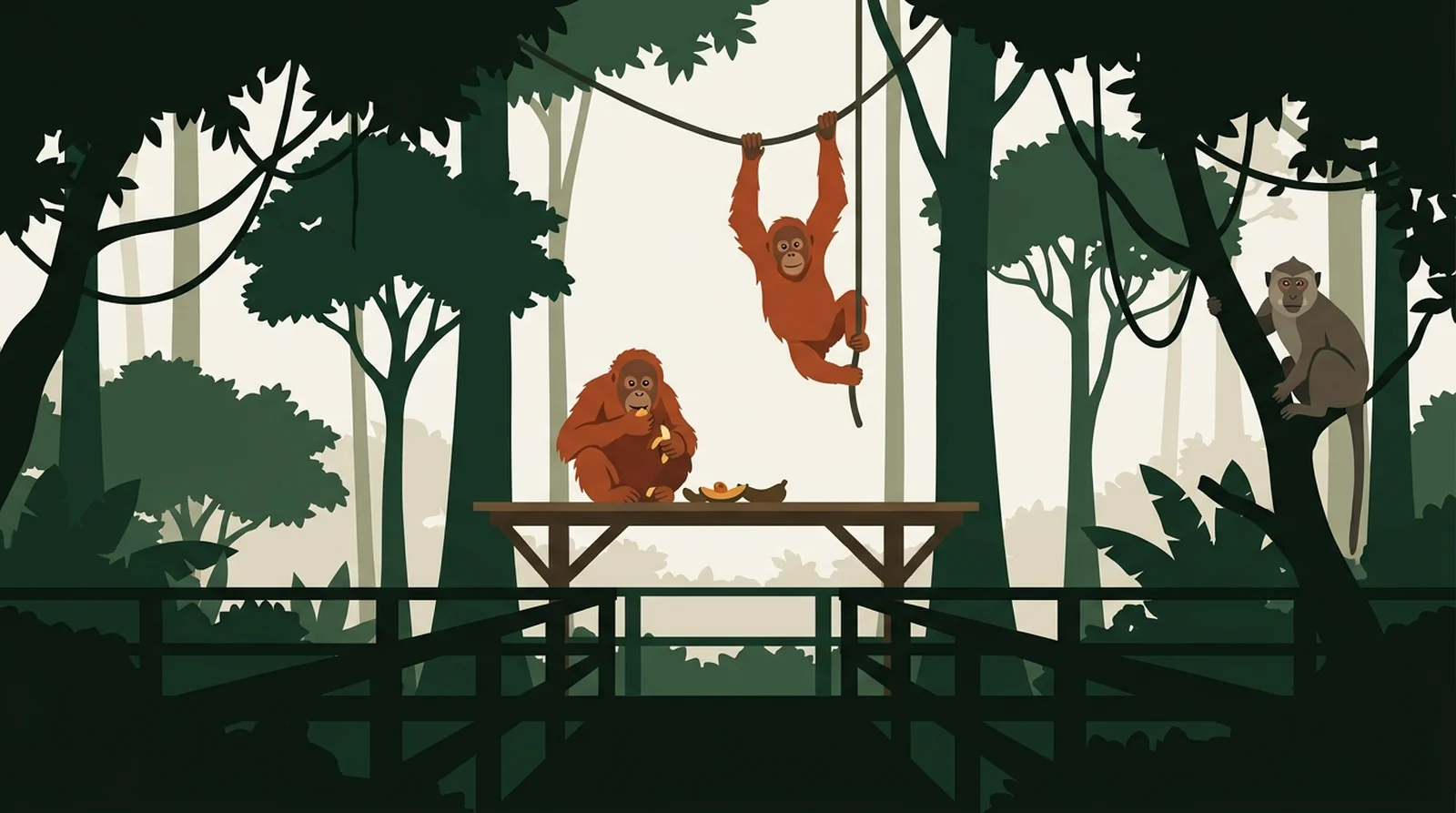
Once an ape is stable and strong enough, it moves to the outdoor nursery. You can observe this stage from inside a purpose-built observation building with large glass windows; nursery feedings are at 9:30am and 2:30pm. The glass acts as a physical barrier to prevent the transmission of human respiratory viruses or soil-borne diseases. In the nursery, the juveniles practise on climbing frames and ropes and the centre uses a buddy system to pair inexperienced apes with older ones so they can learn from each other.
The final stage takes place at the forest edge. As the apes gain confidence, they are allowed to roam the wider 4,362-hectare reserve. To make sure they get enough calories while they learn to forage, the centre provides supplementary food at the main feeding platforms. When an ape is fully independent, it is often relocated to a much larger protected area like the 120,000-hectare Tabin Wildlife Reserve to live out its life as a wild animal.
Forest edge viewing platforms
The main event for visitors is the supplementary feeding. At exactly 10am and 3pm every day, rangers place milk and bananas on a wooden platform located about 200 metres into the forest. The food is deliberately monotonous. If the centre provided high-value forest fruits, the orangutans would become permanently reliant on the platform. By serving bland food, the centre encourages the growing apes to venture deeper into the forest to find a wild diet.
Because the reserve has no fences, sightings are dictated entirely by the forest's fruiting cycle. During a mast fruiting event, when the canopy is full of wild figs and durians, the apes prefer to forage in the deep jungle. When the wild fruit runs out, the apes return to the platform in higher numbers.
An empty platform is actually a conservation success: it means the apes are finding their own food. The viewing gallery can get very crowded especially for the 10am morning session when the large tour groups arrive. If you want a quieter experience with clearer sightlines, the 3pm afternoon feeding is often the better choice.
Semi-wild and wild orangutans
It helps to understand exactly what you are seeing at Sepilok. The orangutans here are rehabilitated or semi-wild. They roam freely through the forest but they are habituated to human presence and they know to return to the platforms when they are hungry.
This is a fundamentally different experience from seeing a truly wild orangutan at Danum Valley or on the Kinabatangan. Wild apes have never received human provisioning. They live almost entirely in the trees and follow seasonal fruiting with their numbers shaped by how many apes the forest can support. Sepilok brings you into the forest to watch resident semi-wild orangutans learning the skills they need for independence. Danum Valley gives you unpredictable, authentic encounters with fully wild apes.
Boardwalk rules and macaques
The walkways are heavily frequented by opportunist long-tailed and pig-tailed macaques looking for an easy meal. Macaques and orangutans are highly vulnerable to human diseases because of their close genetic relationship to people; they are also quick to snatch anything that looks interesting.
The rules are strict. You cannot take daybags, backpacks, food, drinks or insect repellent onto the boardwalks. Insect repellents are banned on the trail because the chemicals are poisonous to the primates if they ingest them from a stolen bottle. Everything goes into a locker at the reception building.
If you see a macaque resting on the handrail, do not make direct eye contact as they read this as a threat. Looking through your camera viewfinder breaks that eye contact nicely. You must also maintain a strict 10-metre distance from any orangutan at all times. If an ape approaches you on the boardwalk, stay silent and slowly back away. Flash photography and selfies with the animals are completely banned.
Orphan rescue and release records
Since it opened, the facility has rescued over 758 orphaned and displaced infant orangutans. Published figures show a rehabilitation success rate of about 81.6 percent with roughly two-thirds of those apes eventually reaching independence and being released into the wild.
The process is not perfect. Extensive surrogate care can disrupt an ape's natural development and rehabilitants sometimes spend more time walking on the ground than they would normally which exposes them to soil-borne pathogens. Protecting wild habitat is vastly more cost-effective on a large scale than rehabilitating individual apes. However, facilities like Sepilok remain essential for dealing with confiscated orphans and the tourism revenue they generate helps fund wider conservation work across Sabah.
Travel and visiting time
The centre is highly accessible. It takes about 40 minutes by car from Sandakan city or 25 minutes from Sandakan Airport. You can use e-hailing applications like Grab or Maxim which are reliable and cost-effective. There is also a public bus from the Sandakan central market waterfront that takes roughly 45 to 60 minutes.
If you stay at one of the lodges right by the reserve boundary, you can walk to the sanctuary in 5 to 10 minutes. Staying 3 nights gives you enough time to cover all 3 centres at an easy pace and return to the canopy walkway for several dawn walks.
East coast travel plans
If you are coming to Sabah for the wildlife, Sepilok fits perfectly into the start or end of an east coast itinerary. Tell the team when you plan to travel and how many animals matter most and they will arrange the transfers and the lodge to make the days flow.
--- Sources referenced on this page: Sabah Wildlife Department; Orangutan Appeal UK; Sabah Forestry Department. Facts verified 10 September 2026.

Pairing it with Danum
Sun bears and canopy walkways
You can easily spend a full day here because 3 conservation and environmental centres sit along the same 2-kilometre stretch of road.
Directly adjacent to the orangutan centre is the Bornean Sun Bear Conservation Centre. It rescues and rehabilitates the Malayan sun bear, the world's smallest bear species. You view the bears from an elevated canopy walkway as they forage in massive forest enclosures below you.
Combination trips
Related
Keep planning
Questions the team is asked
No, tickets cannot be pre-booked online. You purchase them at the ticketing counter on the day. Payment is in cash only (Malaysian Ringgit) and there are no ATMs on site so you must bring enough cash with you from Sandakan.
Standard smartphone cameras are free. Dedicated cameras like DSLRs, mirrorless bodies and GoPros incur a small fee. The centre classifies any lens of 600mm or greater as commercial equipment and charges a separate fee so a versatile zoom lens under that threshold is best.
Yes, it operates 365 days a year. However, on Fridays the morning session closes at 11am for midday prayers before reopening at 2pm. The standard hours on other days are 9am to noon and 2pm to 4pm.
Light, breathable clothing and comfortable walking shoes. The entire visitor area is on raised wooden boardwalks, so you do not need heavy hiking boots. Bring a hat and prepare for the equatorial heat and humidity.
Plan your trip
Plan your Sepilok sanctuary visit
Tell the team your travel dates to arrange transfers and accommodation for your visit to the Sepilok Orangutan Rehabilitation Centre.