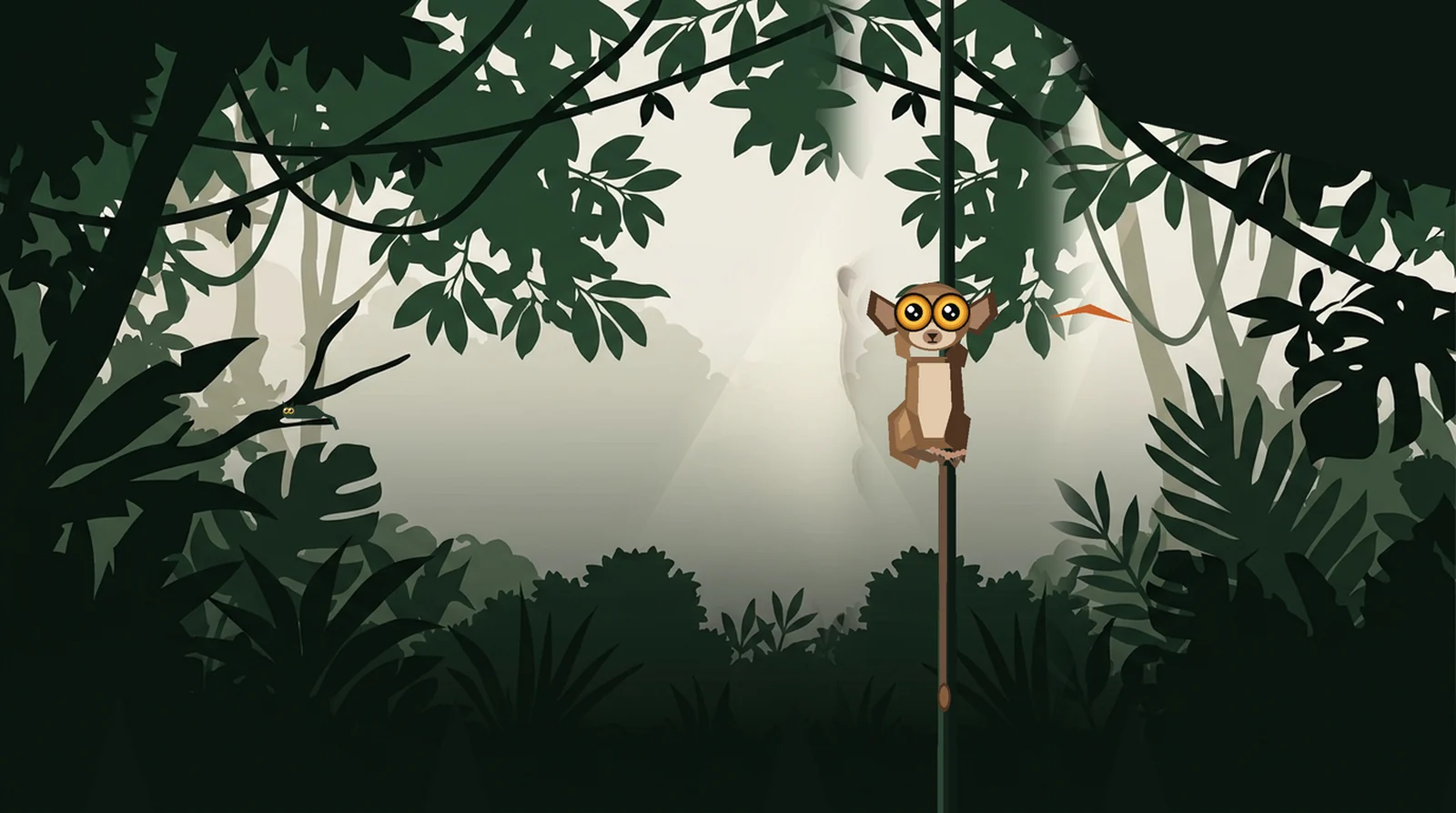
Sabah's nocturnal carnivorous primate
The western tarsier
The western tarsier is a highly specialised nocturnal primate found in Sabah's lowland rainforests. 2.5 hours from Lahad Datu, Danum Valley is where you walk the trails at night to find it.
The animal
The western tarsier
2.5 hours from Lahad Datu, Danum Valley protects 438 square kilometres of unlogged lowland rainforest. Walk the trails at night to look for the western tarsier clinging to saplings in the dense understorey. Guided walks surrounding the research station make finding this entirely carnivorous primate a realistic target during your stay.
The western tarsier was formerly known as Horsfield's tarsier. It is the only entirely carnivorous primate on Earth. It feeds exclusively on insects, small reptiles and occasionally bats. Its most distinctive feature is its massive eyes. Each eyeball is larger than the animal's entire brain. Because the eyes are too large to rotate within their sockets, tarsiers have evolved specialised cervical vertebrae that allow them to rotate their heads nearly 180 degrees in either direction to scan for prey.
They are small and cryptic. This makes them difficult to spot. Its preference for low perches makes it accessible when it is resting. The species was assessed as Vulnerable on the IUCN Red List in 2020 and populations are sensitive to habitat disturbance. The primary rainforest canopy in Danum Valley intercepts up to 90% of available sunlight. This plunges the forest floor into a permanent high-contrast gloom often referred to as the emerald shadow during the day. At night, the darkness is absolute.
The dense understorey
The western tarsier is looked for in the dense understorey of the rainforest. In Danum Valley, the western tarsier is seen with luck during a 3-night stay. Encounters are a realistic target on guided night walks on the trails immediately surrounding the Danum Valley Study Centre. The best conditions are humid nights following light rain when insect activity peaks and brings the tarsiers out to hunt.
At the Rainforest Discovery Centre (RDC) in Sepilok and in Tabin Wildlife Reserve, the tarsier is also a resident. Tabin is where Sabah's night drives pay off as the reserve borders oil palm and the edge is where nocturnal mammals hunt. A leopard cat is regular on the night drive and a clouded leopard is seen with luck. The habitat of dense understorey is consistent across these sites.
The Danum Valley Study Centre is a working research station with a cafeteria. If you want the researchers at the next table and the trails starting from your door, the Study Centre is the one. If you want a bath and a bar after your night walk, Borneo Rainforest Lodge is the one. It offers its own night walks and drives; its construction and expansion project runs from 1 January 2025 to 22 January 2027. Travel and health insurance is advised for any visit to Danum Valley and cover that includes emergency evacuation is sensible in a place this remote. Permits are arranged with the stay.
Eyeshine in the underbrush
Sighting a western tarsier in the permanent gloom of the forest at night is an acquired skill. The guides find it by slowly scanning the dense understorey vegetation with dimmed torches. They look for the specific reflection of its eyeshine low in the underbrush. Because the tarsier typically clings vertically to saplings just 1 to 2 metres off the forest floor, guides keep their search focused low rather than sweeping the high canopy.
Be sure to stay close to your guide and keep your own torch movements slow so you do not disrupt the search. Once the eyeshine is located, the guide will stop the group and use a continuous, diffuse red LED light to illuminate the animal. The tarsiers often remain stationary when lit this way. You can take time to observe them while they rest.
Continuous red LED lighting
The rules on a night walk are strict. Due to the extreme sensitivity of their oversized retinas, flash photography is universally prohibited or heavily restricted by the conservation area guides. Blasting a nocturnal primate with a high-lumen white spotlight severely damages its vision and can leave it temporarily paralysed. An animal immobilised by the light is vulnerable to predators.
Operators mandate red-light modes for pedestrian night walks. You must rely entirely on the continuous, diffuse red LED lighting provided by the guide. This protects the tarsier and ensures you do not disturb the very animal you have come to see. The etiquette is simple: turn off your white light, do not use your camera's flash and stay quiet.
Macro lenses and tripods
Photographing a tarsier in total darkness without a flash is a technical test. You cannot rely on modern autofocus systems. They will hunt endlessly and fail in the low light. You must switch to manual focus. Having focus-peaking enabled is ideal and you must focus precisely on the animal's massive eyes.
The only viable photographic method is to use a macro lens (such as a 105mm f/2.8) or a fast 70–200mm f/2.8 zoom mounted on a sturdy tripod. You will need to open your aperture to the maximum (f/2.8), push your ISO high (often to 6,400 or 12,800) and expose for 1/30s to 1/60s. Because the tarsier tends to remain still while clinging to a sapling, dropping your shutter speed to these levels is possible if your tripod is completely stable. A sharp image containing digital noise can be salvaged later but a motion-blurred image is ruined.
Danum Valley night walks
If the night drives are what you're coming for, tell the team which animals matter most and they'll build the nights around them. Send your dates, your party size and whether you prefer the research station or a comfortable lodge. The team will come back with what can be arranged.
--- Sources referenced on this page: IUCN Red List, Sabah Wildlife Department, SEARRP. Facts verified 8 September 2026.
Related
Keep planning
Best Time to Visit Sabah Getting to Danum Valley Sabah Itineraries
Questions the team is asked
Rain falls all year in Sabah and never closes the forest. Night walks run year-round. The animal is seen with luck on humid nights following light rain regardless of the month. Lahad Datu and Danum Valley receive about 2,849 mm of rain a year. April and May are typically the least wet.
No. Flash photography is heavily restricted or prohibited by guides because the tarsier has oversized, highly sensitive retinas. You must use the red LED light provided by your guide.
No. Because they are found low in the understorey just 1 to 2 metres off the ground, a macro lens (105mm f/2.8) or a fast mid-range zoom (70–200mm f/2.8) is optimal.
Walks proceed in most conditions but heavy rain can make the trails unsafe and suppress wildlife activity. The decision rests with the guides on the night.
Private transport is organised by the lodge. You can reach Lahad Datu by flight from Kota Kinabalu and from there it is a 2.5-hour drive into the conservation area.
Plan your trip
Plan your Danum Valley stay
Tell the team you are coming to look for the western tarsier and they will arrange your guided night walks.