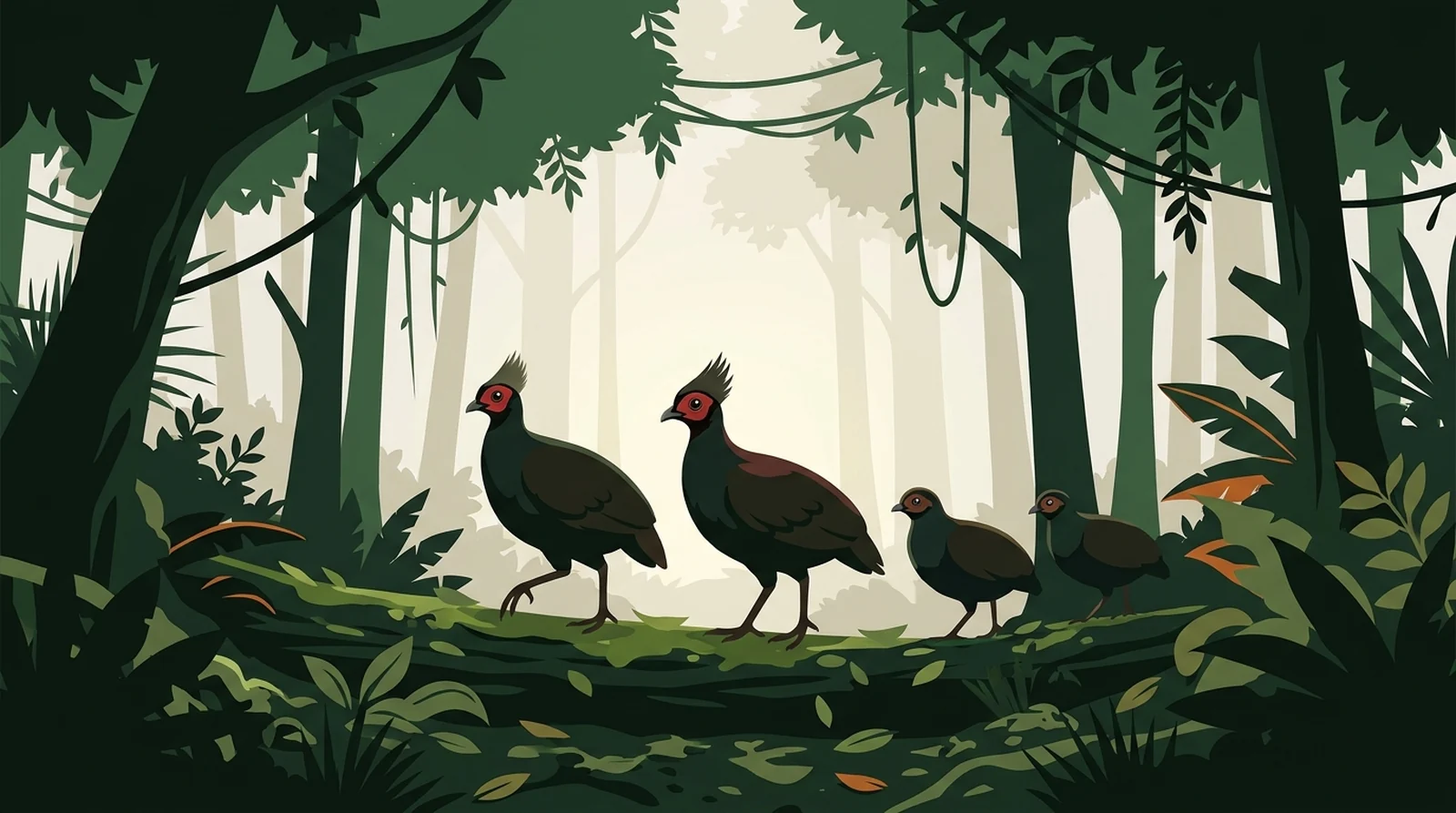
Guide to Borneo partridges
The Partridges of Borneo
The crested and crimson-headed partridges are highly sought ground-dwelling birds of the Sabah and Sarawak forests. This guide covers how to identify them, where they live and how to photograph them.
The bird
Two distinct species
The crested and crimson-headed partridges forage for fallen fruits and insects on forest floors across Sabah and Sarawak. Seeing the crested and crimson-headed species on a single itinerary is a realistic target if you start early and know the right elevations. Expect to spend your mornings watching the mountain trails or waiting in the baited photography hides to spot them.
The crested partridge and the crimson-headed partridge represent 2 very different evolutionary paths. The crested partridge is the only member of the genus Rollulus. The crimson-headed partridge is also entirely unique in its own monotypic genus, Haematortyx. Genomic sequencing in 2021 revealed that the crimson-headed bird is actually a basal relative of the peacock-pheasants rather than a true partridge.
Both species face conservation challenges. The crested partridge is evaluated as Vulnerable on the IUCN Red List as of 2021. Habitat loss to agriculture is the primary cause of its decline. The crimson-headed partridge is assessed as Least Concern in the 2025 IUCN Red List. It relies on a vast montane range to buffer its status. It does have a remarkably small global population of 670 to 6,700 mature birds. Neither species is heavily threatened by the illegal trapping trade. Their survival depends on the preservation of primary and selectively logged forests.
The crested partridge
This is a rotund gamebird measuring roughly 26 cm in length. The male has a metallic green back, dark blue-black underparts and a tall chestnut-red crest. This crest is made of soft silky feathers rather than stiff bristles. A conspicuous white band crosses the forehead. The female is bright pea-green with chestnut wing coverts and a slate-grey head. Both sexes have long black bristles at the front of the head and red bare skin around the eyes. They have bright red legs with no spurs and no hind toe.
You will frequently find them foraging in coveys of up to 15 individuals. They feed on seeds, beetles, wood ants and small molluscs. They often follow wild pigs to catch the insects disturbed in the mud. They even rely on hornbills and primates to drop broken fruit from the canopy. The family groups roost communally a few metres off the ground in low bushes to avoid nocturnal predators.
The crested partridge breeds nearly all year round. The chicks feed bill-to-bill with the parents for the first week of life. Striped chicks are active and highly visible in March. Immature males have a greyish belly and lack the red crest.
The crimson-headed partridge
The male crimson-headed partridge has a charcoal-black body that contrasts sharply with a bright crimson head, neck and breast. It has a yellow bill and a yellow ring around the eye. It is unique in having between 1 and 3 tarsal spurs on each leg. The lowest spur is notably half the length of the adjacent one. The female lacks these spurs. She has a much duller orangish-red head and a dark brownish-black bill.
These birds build their nests out of dry leaves inside thick grass or lichen tussocks. Egg-laying is recorded from mid-January. In captivity, the incubation period lasts 18 to 19 days. Juveniles accompany the adults by April.
They feed on insects and berries. They also eat small terrestrial crustaceans like forest isopods and freshwater crabs. These crustaceans provide the critical calcium the females need to lay their large clutches of 8 or 9 eggs.
Lowland and montane forests
The 2 partridges occupy different elevations. The crested partridge lives in the lowland and lower montane forests from sea level up to 1,550 m. You can look for it on the trails at Danum Valley, Tabin Wildlife Reserve and under the canopy towers at the Rainforest Discovery Centre in Sepilok. It is also found in Sarawak at Kubah National Park on the slopes of Mount Serapi and in the remote Pulong Tau National Park.
The crimson-headed partridge prefers higher altitudes. A 2024 Kinabalu study showed its density peaks between 1,500 m and 1,720 m. Once the elevation reaches 1,750 m the numbers drop off rapidly as the red-breasted partridge becomes the dominant species. The crimson-headed partridge favours poor sandy soils and kerangas heath forests. You can search for it on the Mempening Trail at Kinabalu Park, around the rim of the Maliau Basin and in the primary forests of Mulu National Park.
Both species overlap at the baited hides in the Crocker Range and Trus Madi. The Gunung Alab Substation sits at 1,850 m to 2,000 m and attracts both partridges. The commercial hides at Trus Madi operate around 1,400 m to 1,500 m and draw massive coveys of crested partridges alongside the crimson-headed birds.
Tracking partridges by sound
Finding these birds outside the hides requires sharp hearing and an early start. Local guides rely entirely on acoustic tracking to locate coveys in the dense undergrowth.
The crested partridge uses a mournful whistled duet that sounds like 'si-ul'. The second note is distinctly higher in pitch. Guides listen for this continuous low-volume call as the flock keeps together while foraging.
The crimson-headed partridge is even more vocal. It spends 83% of its daylight hours calling to defend its territory. The activity peaks between 7am and 9am. The primary call is a loud metallic 'KRO-krang'. Mated pairs sing tight antiphonal duets. Acoustic surveys also confirm a secondary hollow low-frequency call at 1.6 kHz. A guide will lead you toward the sound and try to spot the birds moving through the leaf litter. Be sure to walk quietly and keep your eyes at ground level as you approach the calling area.
Baited hides and forest trails
The baited hides at Trus Madi and Gunung Alab offer the best conditions for photography. Crested partridges are seen often at the KK Lee and CP Song hides at Trus Madi. Flocks of over 20 birds arrive to feed on the cracked corn. The crimson-headed partridge is also a regular visitor.
Photographing these birds requires specific techniques. You must shoot from the lowest possible angle. Rest your lens on a beanbag on the ground to separate the bird from the distracting leaf litter. Exposing the crimson-headed partridge is difficult. The camera meter will brighten the dark body and wash out the red head. Dial in an exposure compensation of -1.0 to protect the red colours.
The crested partridge presents its own challenges. Spot meter off the female's green body to avoid overexposing the male's white forehead band. Try to position yourself to let the sun backlight the male's red crest. The chicks move constantly. You need high ISO settings to maintain a fast shutter speed of 1/640s or faster in the dark forest.
Related
Keep planning
Questions the team is asked
The hides at Gunung Alab are now managed by the Sabah Forestry Department. All visitors must register and pay a conservation fee.
A 400 mm lens is better for the baited hides. The birds come very close to the viewing ports. A 400 mm f/2.8 lens gathers more light in the dark understorey and is wide enough to capture full-body shots.
Chicks are highly visible in March. Field observations from March 2024 at Trus Madi recorded striped chicks and transitioning juveniles actively foraging in the open.
Danum Valley is excellent for the crested partridge. The crimson-headed partridge lives much higher up the mountains and is absent from the lowlands.
Plan your trip
Plan your Borneo birding itinerary
Tell the team you want to see the crested and crimson-headed partridges, and they will build your itinerary around the right trails.