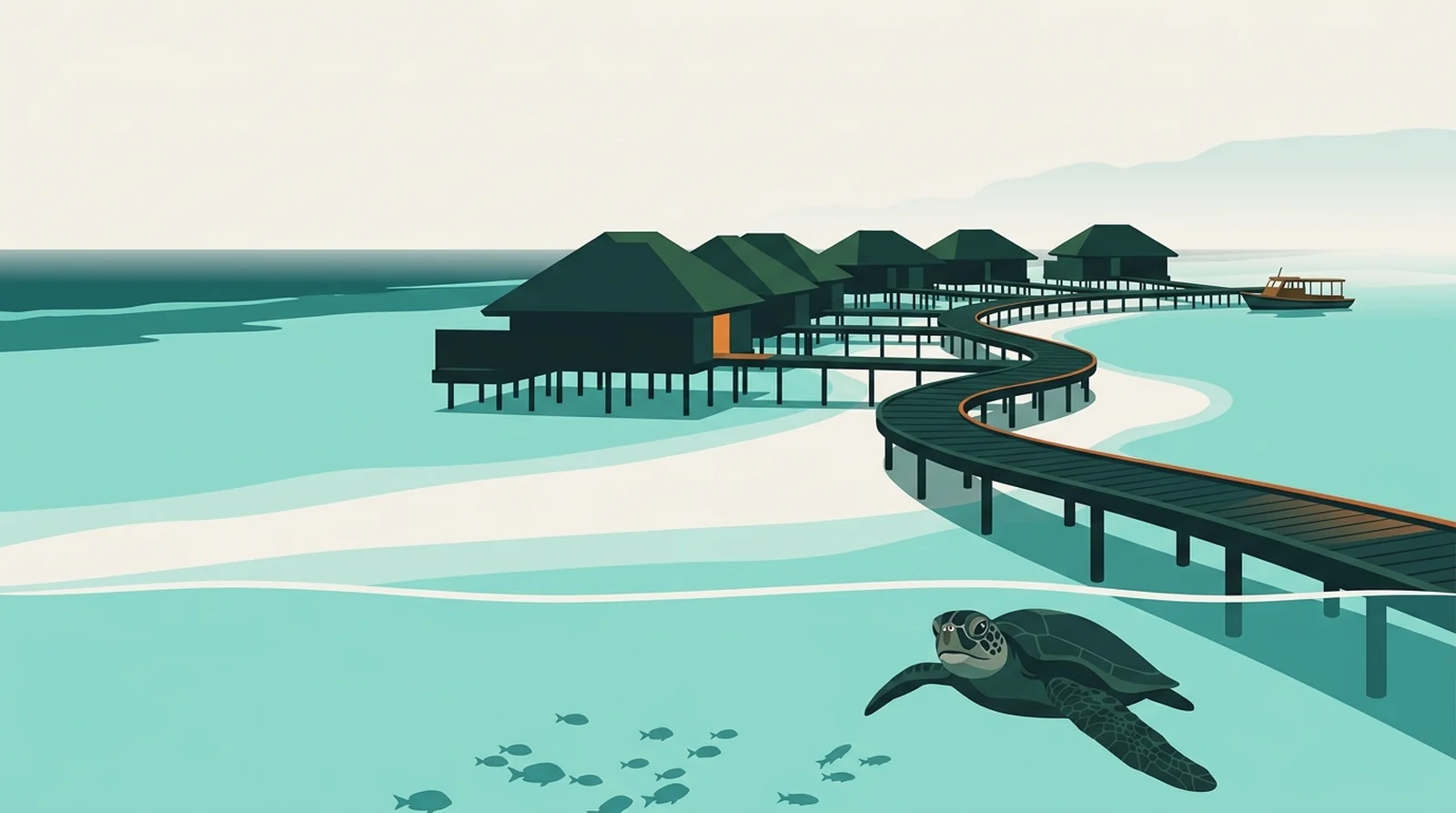
Stilt resort on a shallow sandbank
Kapalai
Forty-five minutes by boat from Semporna, Kapalai is a stilt resort built entirely over a submerged reef. It offers immediate access to exceptional macro diving and serves as a base for a day's diving at Sipadan.
Why go
The stilt resort complex
Forty-five minutes by speedboat from the Semporna mainland, Sipadan-Kapalai Dive Resort stands entirely on stilts over a submerged sandbank. You wake up to the sound of the Celebes Sea and walk to breakfast along wooden walkways with no land in sight. Couples unwind in the overwater isolation, while divers look for the cryptic macro life living directly below the wooden decks.
Kapalai sits just a few kilometres from Sipadan and Mabul. Decades ago it was a vegetated island before erosion reduced it to a sandbar. Today the Sipadan-Kapalai Dive Resort covers the footprint. Every chalet, dining area and dive centre building stands on stilts driven into the seabed. The chalets feature private balconies looking out over the Celebes Sea and the walkways connect the entire complex. At high tide, the walkways carry you above the submerged sandbank. The environment feels remote and marine.
The isolated sandbank
The isolation is the main appeal. You are entirely surrounded by water and the views are uninterrupted. The resort provides air-conditioned rooms with en-suite hot showers and 24-hour power. The meals are home-style buffet dining served in an open-air central building. The resort decks give you space to relax between dives. For beach walks, look at Mataking or Pom Pom. The terrain suits people who are steady on their feet and you spend your surface intervals reading on a deck or snorkelling around the stilts. If you want a jungle trail behind your room, combine Kapalai with a stay at Danum Valley.
Macro diving at Kapalai
The seabed around Kapalai consists of shallow sandy patches and coral rubble. The sand and rubble are the setting for specialised muck diving. The cryptic invertebrates living here demand strict buoyancy control and patience. The flamboyant cuttlefish walks along the silty substrate using modified arms and flashes bright yellow and maroon when threatened. Toxicology reports confirm its muscle tissue contains tetrodotoxin and it ranks among the few known toxic cephalopods. You also have a realistic target of finding a blue-ringed octopus resting in the rubble. This small octopus possesses a bite laced with tetrodotoxin. The blue rings are usually concealed and illuminate brightly only when the animal is stressed or hunting. You must never touch the substrate to avoid disturbing it. A dedicated macro lens is essential to capture these creatures while maintaining a safe physical barrier.
You can also find the mandarinfish in the shallow coral rubble. It secretes a toxic mucus to deter predation. It performs a highly predictable mating dance strictly at dusk. The pair rises from the rubble and releases gametes into the water column. You must use red light filters on your focus lights because mandarinfish are intensely photophobic during the ritual. Standard white lights will abort the spawning behaviour immediately. The sandy patches also harbour giant frogfish and painted frogfish hiding among the sponges. Signature nudibranchs like the blue-and-black Chromodoris dianae are documented frequently feeding on the reef matrix.
Sipadan island
Kapalai serves as a base for a day's diving at Sipadan. Sabah Parks issues 254 Sipadan permits a day allocated through licensed resorts and operators. Advanced Open Water is required since October 2022. The island closes every November and reopens on 1 December. Snorkellers also need a permit.A Sipadan permit can be guaranteed with the right resort and dive package; the team confirms what applies to your dates.
The diving at Sipadan provides a complete contrast to the Kapalai sandbar. Sipadan is an oceanic pinnacle rising 600 metres from the seabed. The geology creates nutrient-rich upwellings that support dense ecosystems. Divers head to Barracuda Point to see massive tornadoes formed exclusively by the chevron barracuda. The schooling vortex provides hydrodynamic energy savings and presents a formidable anti-predator defence. You must rely on ambient light and silhouette techniques to avoid overexposing their highly reflective scales. Massive schools of bigeye trevally mill between 2 and 15 metres below the surface.
The deep current-swept drop-offs are patrolled by the grey reef shark. This shark was escalated to Endangered status in 2020 and demonstrates high site fidelity here. The whitetip reef shark is assessed as Vulnerable and rests on sandy shelves. Green turtles graze extensively on benthic algae in the shallows. The green turtle is Endangered globally. The Critically Endangered hawksbill turtle is a realistic target here, using its narrow beak to extract sponges from the reef. At dawn you might encounter the bumphead parrotfish. This Vulnerable species is a primary bioeroder and moves in massive squadrons to excavate live coral framework.
A day at Kapalai
Your days at Kapalai are defined by the dive schedule and the tides. You wake up to the sound of the Celebes Sea and walk to the open-air restaurant for breakfast. If you dive the local sites, you board a speedboat from the dive centre for a transit lasting just a few minutes. You spend the morning hovering over the sand looking for frogfish and cryptic crustaceans. You return to the resort for a buffet lunch served in the central dining hall. The afternoon offers a second local dive or time to relax on your private sun deck.
The Eastern Sabah Security Zone dusk-to-dawn curfew sets the day's boat schedule. The curfew runs daily from 6pm to 6am. All inter-island boat trips must finish by mid-afternoon so every vessel is ashore before 6pm. Evening offshore cruising is illegal and strictly prohibited by all operators. You spend your evenings on the wooden decks watching the sunset over the water. Night diving takes place on the house reef directly beneath the resort with police clearance.
The sheltered house reef
You do not need a scuba certification to experience the marine environment. The reef directly below the stilt structures is shallow enough for rewarding snorkelling. You step down wooden stairs from the walkways straight into the clear water. The sandy seabed holds resting rays and the coral blocks attract a variety of reef fish. You snorkel around the wooden pylons to observe the marine life in a sheltered environment. The snorkelling is confined to the resort footprint so it feels safe and contained. You must be comfortable entering deep water from a ladder. It suits confident swimmers who want to explore the house reef multiple times a day.
Who Kapalai suits
Kapalai suits macro photographers looking for rare invertebrates and couples drawn to the overwater architecture. The isolation appeals to anyone who wants to sit on a balcony with nothing but the ocean ahead. If you want a pool and a spa, you should look at Mataking or Pom Pom. If you prefer to walk barefoot on a long sandy beach, Timba-Timba or Mataking are better choices. Kapalai is a pure marine environment built on wood and water.
Transfers and seasons
You reach Kapalai via the mainland town of Semporna. The transit from the Semporna jetty takes about 45 minutes by speedboat. Semporna itself is a busy maritime border town and the public jetty is crowded. Once you board the resort speedboat, you leave the crowds behind. If you combine a rainforest safari at Danum Valley with the reef, you take a private vehicle from Lahad Datu to Semporna. Lahad Datu is the main arrival airport for Danum Valley and sits roughly 150 kilometres north of Semporna. The drive takes 2.5 to 3.5 hours on mostly sealed roads.
You leave your rainforest lodge after breakfast to reach Lahad Datu by mid-morning. You continue directly to Semporna and arrive in time for the afternoon resort speedboat. This synchronised movement keeps your trip moving without an overnight stay in town. If you fly directly to the east coast, you land at Tawau airport. You take a bus or private transport from Tawau to Semporna. When you plan your departure, you must allow 24 hours between the last dive and a flight.
Sabah has no single dry season and Semporna receives about 2,342 mm of rain a year. It rains on around 278 days a year so a completely dry day is the exception. March and April are the calmest and least wet months. The northeast monsoon prevails from November through February and brings elevated swells. December and January carry the highest chance of a cancelled boat transfer. The green season runs roughly November–February and the peak season runs roughly March–October.
Wildlife & highlights
What you're likely to see


Related
Keep planning
Questions the team is asked
No. It is a large sandbank sitting on a reef. At high tide the sand is submerged and the only structure is the stilt resort.
A small section of the sandbar emerges at low tide but for most of the day there is no dry land to walk on.
No. You only need a Sipadan permit to dive at Sipadan itself. Kapalai has its own local dive sites.
Yes. The ESSZONE curfew runs daily from 6pm to 6am. All boats must be back at the resort by 6pm.
The transfer takes 2.5 to 3.5 hours by private vehicle along sealed roads.
Plan your trip
Plan your Kapalai diving
Tell the team when you want to stay at Sipadan-Kapalai Dive Resort for the shallow muck diving and Sipadan access.