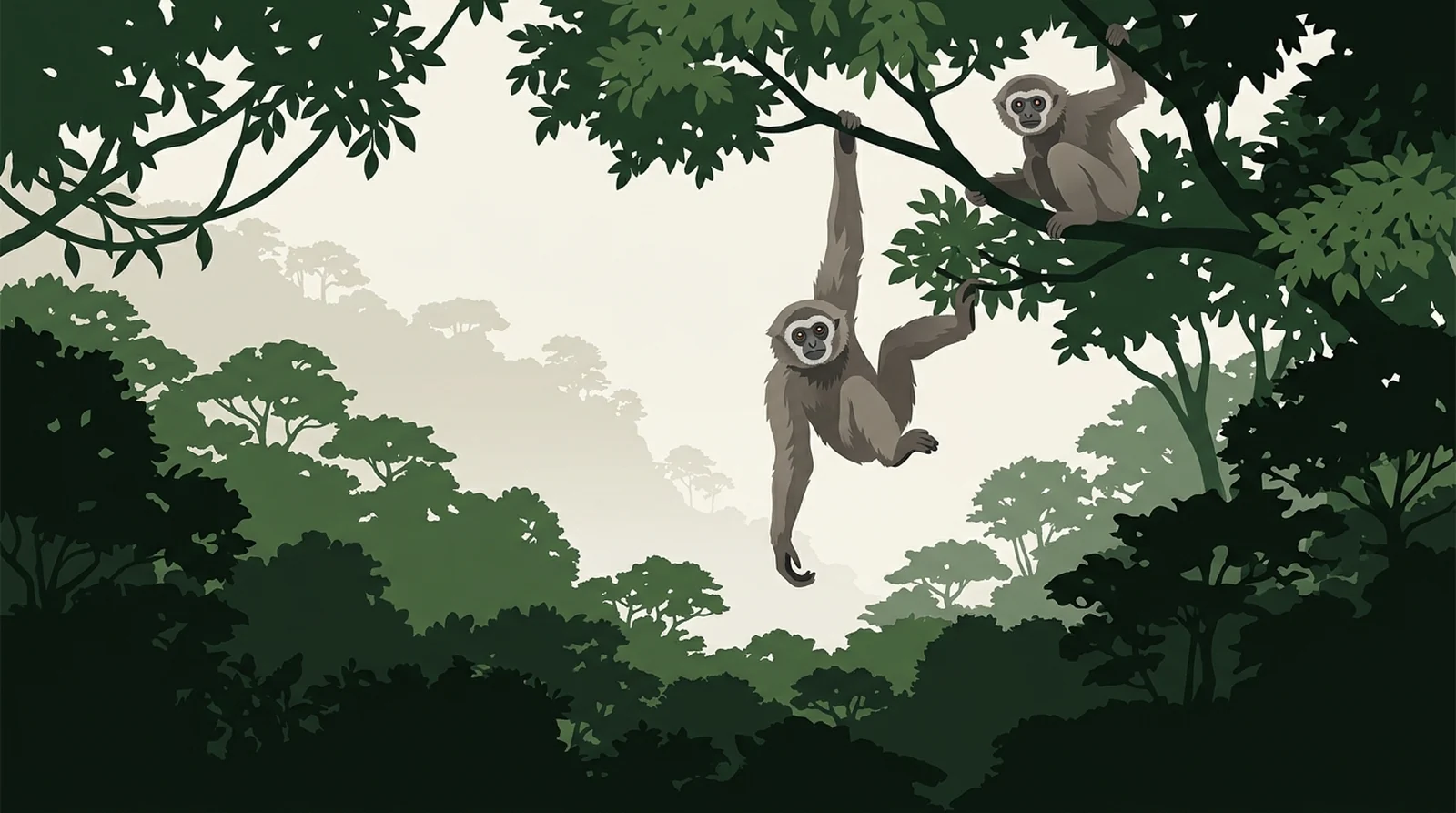
Heard every dawn in Sabah
Bornean Gibbon
The Northern grey gibbon provides the soundtrack to the rainforest. This guide explains what the dawn duet means, why the apes are rarely seen and where a sighting is a realistic target for a wildlife traveller.
The animal
The Northern grey gibbon
Forty metres above the forest floor, the Northern grey gibbon moves through the canopy at blistering speeds. You will wake to their siren call long before the morning sun clears the ridge. Finding the source of this dawn duet requires an early start and a measure of luck.
The Northern grey gibbon and Abbott's grey gibbon were formerly grouped with Müller's gibbon; the Bornean white-bearded gibbon was historically considered a subspecies of the agile gibbon. Borneo now has 4 recognised gibbon species with ranges separated by the island's ancient impassable river systems.
Sabah is home to the Northern grey gibbon (Hylobates funereus). This ape is endemic to the northern and eastern parts of the island including Brunei and North Kalimantan. The original Müller's gibbon, Abbott's grey gibbon and the Bornean white-bearded gibbon live elsewhere on the island south and west of the major rivers.
The Northern grey gibbon is classified as Endangered (IUCN, 2020). They are obligate canopy dwellers and have no anatomical adaptations for walking on the ground. Instead they rely entirely on arm-swinging to travel. This movement is called brachiation. Because they depend on unbroken canopy, they are highly sensitive to forest fragmentation and require large emergent trees to maintain their home ranges.
The morning great call
Gibbons are monogamous apes that form strong pair bonds and they defend their territories through sound rather than physical confrontation. The average home range covers 15 to 35 hectares of primary dipterocarp forest and the morning call is how they claim it.
The peak acoustic window is between 5:30am and 7am. The performance is a carefully timed duet. The female initiates a highly structured "great call" that lasts 10 to 15 seconds and rises in a rapidly accelerating trill. As she reaches the climax of the call, the male adds an exact coda to complete the sequence. Recent acoustic research shows that individual females have distinctive calls. The call acts as an acoustic fingerprint. This allows researchers and rival gibbons to identify specific females across vast expanses of forest.
Weather plays a role in the performance. A heavy rain the previous night can delay the morning solos by up to 30 minutes. The apes wait for the canopy to dry before they expend energy in the cool morning air.
Why gibbons evade view
The paradox of the gibbon is that an animal so loud is so difficult to find. This comes down to their size, their habitat and their speed.
A gibbon weighs only a few kilograms and lives in the extreme upper canopy. It is often obscured by 40 to 50 metres of dense foliage. The sound carries for a kilometre so the ape you hear is rarely the ape directly above you. When a guide navigates the undergrowth to the source of the sound, the gibbons do not freeze or hide. They flee through the branches and cover hundreds of metres in moments before you can even raise your binoculars.
To move like this, they use a specialised form of travel called ricochetal brachiation. Rather than keeping 1 hand on a branch at all times they enter a free-flight phase and become completely airborne between handholds. They possess massively developed elbow flexors and highly modified ligaments in the wrist. Their wrists act as freely rotating hooks. This allows them to swing with near-zero energetic cost while they move horizontally and reduces torsional stress when they catch the next branch. The movement creates a distinct path through the air that mimics a continuous pendulum.
Canopy walkways and riverboats
Certain habitats improve your odds of seeing a gibbon. The Danum Valley Conservation Area and the Tabin Wildlife Reserve offer some of the best realistic chances for a visual encounter.
At Danum Valley, the multi-tiered canopy walkway is your best tool. It puts you 26 metres above the forest floor. It cuts through the dense mid-canopy and allows you to observe the upper strata where the gibbons actually travel. If a pair is feeding in an adjacent emergent tree, the walkway offers unparalleled unobstructed viewing.
Along the Kinabatangan River, the dynamic changes. When the inland forests were historically cleared, wildlife was compressed into the narrow protected riparian corridors. This brings the tall overhanging trees right to the river's edge. From the open deck of a small boat, you have a clear line of sight up into the branches without a canopy blocking your view.
Finding gibbons with guides
Finding a gibbon starts with listening for calls and knowing which trees are fruiting.
Expert guides synchronise their mornings with the call. If you are on the trail by 5:30am, the guide will use directional audio to pinpoint the territory before the canopy heats up. Once the sun rises, the apes shift into their primary foraging window between 7am and 10am.
In a primary rainforest like Danum Valley, the diet of a gibbon depends on the season. The forest runs on a cycle of mast fruiting where dipterocarp trees fruit synchronously at irregular intervals. During a mast year the gibbons will gorge on the sudden abundance of seeds. During the long periods between these events they rely heavily on keystone resources like strangler figs. If your guide knows which strangler figs are fruiting along the riverbank or behind the lodge, they will wait quietly near the food source.
Maintaining connectivity between these food sources is essential for the apes. Data from long-term ecological plots show that gibbons require large emergent dipterocarp trees to maintain their home ranges. This is especially true in the selectively logged buffer zones surrounding the primary forest core.
Photographing gibbons in motion
Photographing a gibbon in the wild tests your timing and camera skills. You are shooting from the dark understorey into the bright overcast morning sky. You must deal with extreme contrast and rapid movement.
Because the apes stay high in the canopy, a long telephoto lens is mandatory. A 400mm to 600mm lens is the minimum required to bring the subject close. You are usually shooting a dark animal against a bright white sky. This contrast will trick a standard camera into rendering the gibbon as a silhouette. You must use spot metering directly on the ape's face and dial in positive exposure compensation to retain detail in the fur.
To freeze a gibbon in mid-flight, a minimum shutter speed of 1/1000s is necessary. Be ready to push your modern full-frame sensor to ISO 3,200 or 6,400 to keep the shutter speed high. A sharp image with noise can be processed later but a blurred image from a slow shutter is lost.
Responsible gibbon watching
Gibbons share a significant amount of DNA with humans and are vulnerable to human respiratory infections. A simple human virus can decimate an isolated primate population.
When viewing any ape in Sabah, ethical guides enforce a strict minimum viewing distance of 10 metres. In reality the gibbons usually enforce this themselves by staying high in the canopy. If a pair descends to feed on lower fruits you must step back. Keeping your distance helps protect the apes you have travelled to see.
Related
Keep planning
Best Time to Visit Sabah Getting to Danum Valley Sabah Itineraries
Questions the team is asked
No. Sabah holds the Northern grey gibbon while Sarawak is home to Abbott's grey gibbon. The island's major rivers act as impassable barriers to these strictly arboreal apes and split them into 4 distinct species across Borneo.
Their morning call carries for over a kilometre but the apes themselves live 40 to 50 metres high in the dense upper canopy. By the time you track the sound on foot they have usually swung away.
The peak acoustic window is between 5:30am and 7am when they perform their territorial duets. Their main feeding period follows and lasts until around 10am. The early morning is the only realistic time for a sighting.
Yes. You will need a super-telephoto lens of at least 400mm to 600mm. You will also need to shoot at very fast shutter speeds of 1/1000s or faster to capture them moving through the bright canopy.
Plan your trip
Plan your Sabah wildlife trip
Tell the team you want to search for the Northern grey gibbon and they will build your early mornings around the dawn duet.