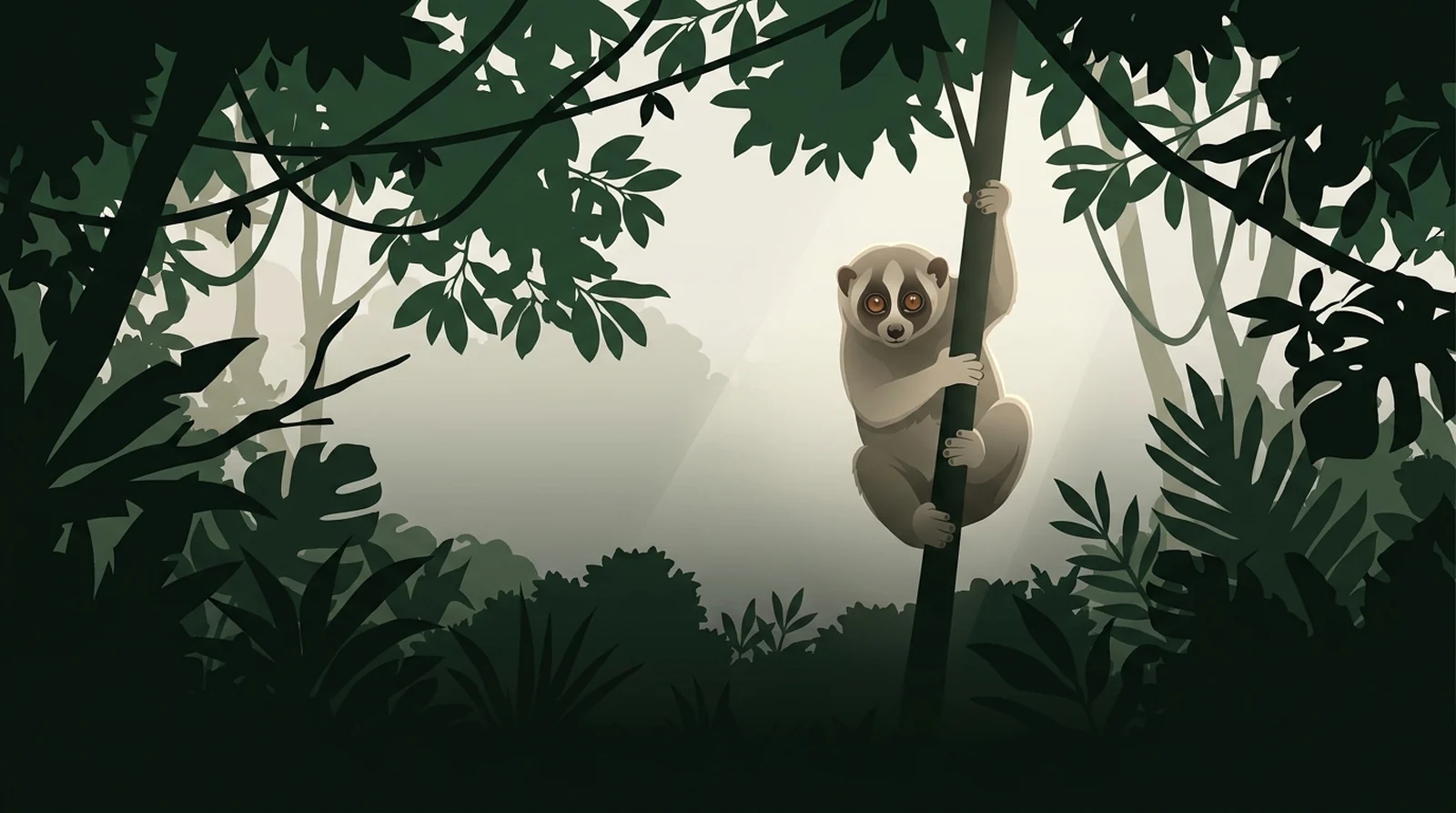
Sabah's venomous primate
The Bornean slow loris
The Bornean slow loris is a cryptic nocturnal hunter found across Sabah. It is the only venomous primate on earth and a highlight of any night safari.
The animal
Endemic eastern Sabah primates
Guided night walks and vehicle drives through the protected forests of eastern Sabah offer the only way to look for the Bornean slow loris. This strictly nocturnal and venomous primate moves with deliberate slowness through the dense mid-canopy branches to stalk insects. You will need a guide with a red-filtered light, but a sighting is a realistic target on a Kinabatangan River night safari.
Until 2013 all slow lorises in Borneo were classified as a single species under the name of the Philippine slow loris. Researchers reviewed museum specimens and facial mask morphology, elevated 2 former subspecies to full species status and discovered a third. The species endemic to the Danum Valley region and the eastern rainforests of Sabah is now formally recognised as the Bornean slow loris (Nycticebus borneanus).
You can distinguish the Bornean slow loris by its dark contrasting facial features. It has rounded circumocular patches that encircle its eyes but never reach below its zygomatic arch. It moves with cryptic slowness through the branches to avoid drawing the attention of predators and to stalk the insects and small prey that make up its diet.
The brachial gland venom
Beneath its docile appearance the slow loris possesses a sophisticated biochemical defence mechanism. It is the only known venomous primate. A specialised brachial gland located on the inside of its elbow secretes a volatile protein-rich exudate. When the animal is threatened it raises its arms in a defensive posture. It then licks the gland and mixes the exudate with its saliva to activate a potent venom.
Biochemical profiling reveals this venom closely resembles the primary cat allergen known as Fel-d1. The loris delivers the venom via a specialised set of anterior incisors called a toothcomb. A bite can cause severe necrosis and anaphylactic shock in humans and small predators. The venom is also effective at repelling parasites and olfactory-oriented predators that rely on smell to hunt in the dark.
Evolutionary biologists theorise this venom evolved alongside the primate's serpentine movements, aggressive hissing vocalisations and dark dorsal stripe as a form of Müllerian mimicry. This combination allows the slow loris to mimic the spectacled cobra (Naja naja). While the venom certainly repels predators it is also frequently deployed as a lethal weapon during fierce territorial battles between rival lorises.
Riverbanks and forest reserves
You have the best chance of finding a slow loris by joining guided night drives and night walks in Sabah's primary and secondary forests. The animals are strictly nocturnal and guides locate them by scanning the canopy for their distinct eyeshine. They tend to stick to the mid-canopy where the vines and branches are dense.
On the Kinabatangan River and in the Deramakot Forest Reserve a sighting on a night safari is a realistic target. The Kinabatangan riverbank acts as a natural corridor where guides know exactly which trees the nocturnal mammals favour. In Danum Valley the Bornean slow loris is resident and a bonus for early risers or night walkers. On a 3-night stay you can see one with luck during guided night walks on the trails immediately surrounding the Danum Valley Study Centre. Vehicle night drives along the main access roads at Borneo Rainforest Lodge also present opportunities to spot them in the roadside vegetation where the forest edge meets the gravel; the lodge's construction and expansion period runs from 1 January 2025 to 22 January 2027.
Red-filtered observation lights
Watching a slow loris requires strict ethical protocols. Guides at all reputable lodges mandate a "no white light" policy for nocturnal primates. Blasting a slow loris with a high-lumen white spotlight severely damages its sensitive retinas and disrupts its circadian rhythm. The intense light paralyses the animal. This leaves it vulnerable to nocturnal predators long after the vehicle has driven away.
Your guide will only use red-filtered lights for observation. If you carry your own torch you must ensure it has a red mode and you must never use a flash when taking photographs. This rule is absolute and protects the animal from permanent harm.
Tripods and mid-range lenses
Photographing a nocturnal animal in the rainforest tests your low-light technique. Fortunately the slow loris has a behavioural trait that works in your favour. Unlike the erratic tarsier a slow loris tends to freeze completely when illuminated by a guide's red-filtered light.
By locking your camera onto a tripod on a night walk or resting it on a beanbag over a vehicle window mount you can drop your shutter speed to 1/60s or even 1/30s without introducing motion blur. This allows you to keep your ISO manageable and preserves the fine detail in the primate's dense fur. A versatile mid-range zoom like a 70–200mm f/2.8 is ideal for this distance because it allows you to frame the animal alongside the surrounding foliage.
Modern autofocus systems will hunt endlessly and fail in the red light. You must switch to manual focus with focus-peaking enabled. Open your aperture to the maximum f/2.8 to let in as much light as possible and expose carefully for the red beam. You should always take a test shot to check your histogram and ensure you are not losing detail in the shadows.
Forest loss and wildlife traffickers
The Bornean slow loris is classified as Vulnerable on the IUCN Red List based on a 2020 assessment. Like many of Borneo's endemic species it faces intense pressure from the ongoing fragmentation and loss of its lowland forest habitat. As agricultural estates expand the remaining forest patches become isolated.
The species is also severely threatened by the illegal pet trade. Its perceived cuteness makes it a target for traffickers who extract the animals from the wild to sell them into domestic and international markets. Protecting their forest reserves and choosing ethical operators who enforce strict viewing rules are the best ways to support their conservation.
Custom Sabah wildlife itineraries
If the night drives are what you are coming for tell the team which animals matter most and they will build the nights around them. Send your dates and party size and the team will come back with a route that maximises your chances of seeing the wildlife you want.
--- Sources referenced on this page: International Union for Conservation of Nature (IUCN, 2020). Facts verified 8 September 2026.
Related
Keep planning
Best Time to Visit Sabah Getting to Danum Valley Sabah Itineraries
Questions the team is asked
A slow loris is venomous and its bite can cause anaphylactic shock. They are safe to observe in the wild because you will only ever view them from a distance in the canopy. Guides never handle wild animals.
White spotlights damage the sensitive retinas of nocturnal primates and paralyse them in fear. Red light allows you to watch them naturally without causing distress or leaving them vulnerable to predators.
No they are prosimians. This makes them a more ancient lineage of primates than monkeys and apes.
They are active all year round. Your best chance is on a dry night when you can take a long vehicle drive or walk the trails for several hours after dusk.
Plan your trip
Plan your night safaris
Speak to the team to plan guided night walks and vehicle drives to look for the Bornean slow loris in Sabah.