Practical craft for Sabah
Photographing birds in Borneo
Photographing birds in Sabah's primary rainforest requires specific field craft. This guide covers how to handle low canopy light, manage humidity and the different disciplines of shooting from electric boats, towers and hides.
The bird
The ambient canopy light
Primary dipterocarp forests operate at 95 percent humidity, and the 30-metre canopy filters out most ambient light. You will need long telephoto lenses and disciplined exposure control to pull sharp images from the dark understory. A successful photography itinerary revolves around the fruiting cycles of Ficus trees and early morning river excursions.
The acoustic signature of the Bornean rainforest is tied to the Megalaimidae family. Across the dipterocarp expanses of the Danum Valley and the mist-shrouded montane oak-chestnut forests of the Crocker Range, the resonant vocalisations of Asian barbets form a continuous soundtrack. They are the primary engineers of Ficus seed dispersal and the architects of cavity nests that support a myriad of secondary hole-nesting species.
The interior of a Bornean dipterocarp forest is dark. When you spot a canopy species like the Red-crowned Barbet hopping along a heavy branch 30 metres above you, it will often look like a dark lump against a bright tropical sky. This is the classic green-blob problem. The Red-crowned Barbet features an uninterrupted crimson crown and an entirely emerald-green body that acts as perfect camouflage among the leaves.
To handle the contrast between the dark understory and the blown-out sky, focus precisely on the bird. Modern mirrorless autofocus systems frequently catch on foreground leaves when you shoot at a steep upward angle. You will often need to override the autofocus manually to punch through the intervening foliage and secure a clear line of sight to the bird's head.
You also need to dictate your exposure settings. Dialling in positive exposure compensation of +1 to +2 EV is mandatory to properly expose the underbelly of a bird sitting against a bright canopy gap. Because you are dealing with low ambient light, you will frequently be shooting at slow shutter speeds. That makes stable support systems and perfect technique essential for sharp images.
For the endemic trio at higher elevations the aesthetic goal shifts. The montane forests of Mount Trus Madi, Kinabalu Park and Gunung Alab are frequently enveloped in rolling fog by mid-afternoon. You can use this low-contrast diffused light to capture montane-mist portraits. The soft light naturally saturates the brilliant golden nape of the Golden-naped Barbet or the vivid yellow cheek-patch of the Bornean Barbet without the harsh shadows typical of the lowland midday sun. This yields moody editorial wildlife imagery.
Heavy telephoto prime lenses
The sheer scale of the rainforest means you need reach. The standard kit for professional wildlife photographers working in Sabah relies on primary lenses ranging from 400mm f/2.8 to 800mm f/5.6.
A 600mm f/4 prime lens is often the ideal tool for the canopy. It gives you the magnification to fill the frame with a Mountain Barbet and the fast aperture to keep your ISO manageable in the dense understory. You need that optical reach to separate similar species. A classic example is telling the female Red-throated Barbet apart from the Black-eared Barbet. The female Red-throated lacks the bright red crown and black mask of the male. It presents an almost entirely plain green head. Photographers routinely misidentify it as a juvenile or a Black-eared Barbet. Look at the bill to tell them apart. The Red-throated Barbet possesses a significantly longer and heavier bill than the short stubby bill of the Black-eared complex. A long lens lets you inspect that bill size clearly.
Heavy lenses like these require serious support. You will want a heavy tripod with a gimbal head for trail work and heavy beanbags for shooting from boats or vehicles.
Flying with this heavy glass into the interior requires planning. AirBorneo operates ATR 72 turboprop aircraft on the routes from Kota Kinabalu to Lahad Datu and Sandakan. Malaysia Airlines strictly enforces a 7 kg cabin baggage limit that must include all your personal items. A 600mm prime attached to a professional body consumes over 60% of that allowance before you add a laptop or binoculars. Malaysia Airlines' Cabin Seat Baggage policy provides an extra-seat solution under the following conditions. A specialist agency can book an extra physical passenger seat specifically designated for fragile equipment up to 75 kg. The equipment is secured in a window seat and never enters the cargo hold.
Flat-bottomed electric skiffs
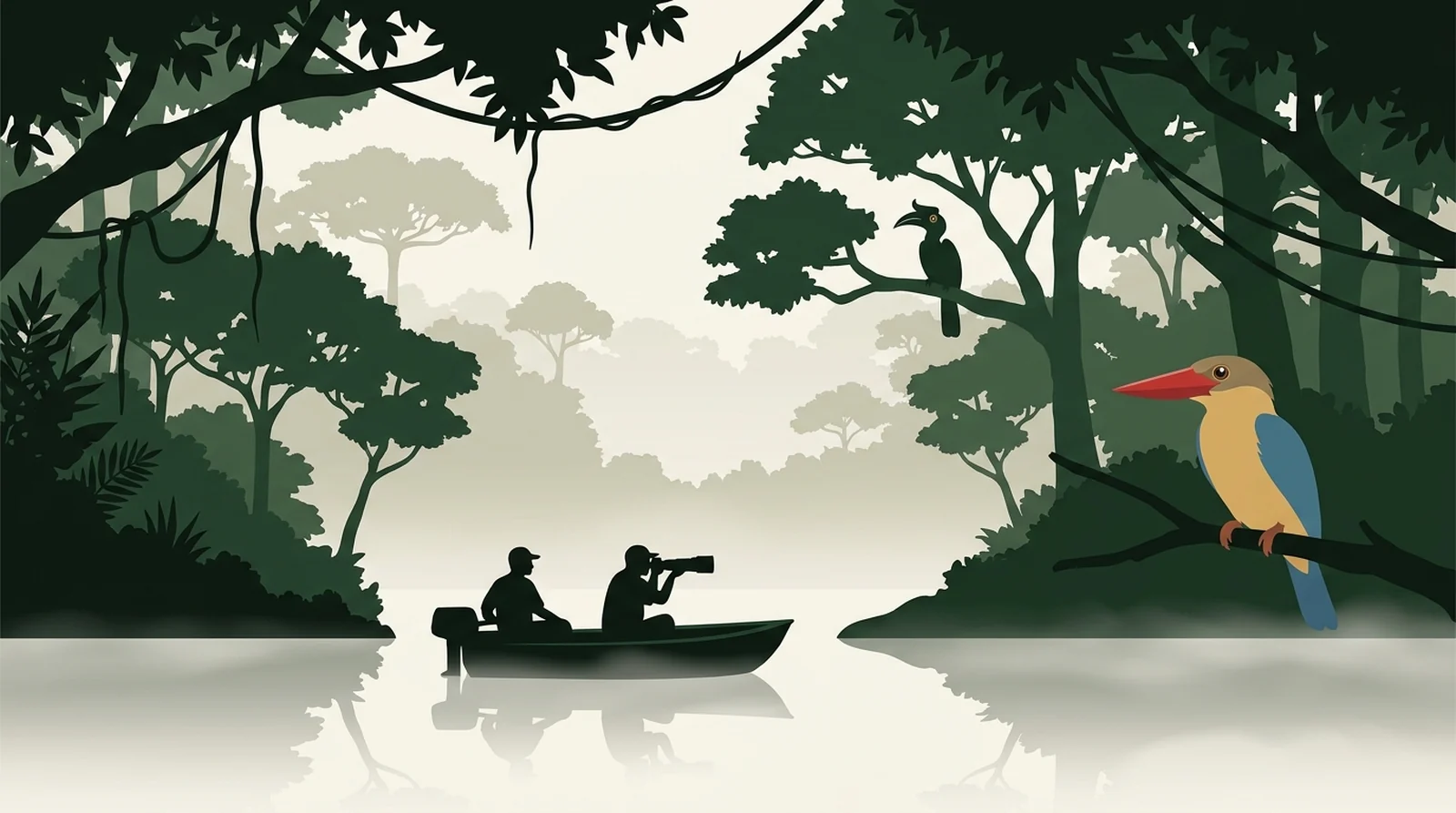
The Kinabatangan River requires a completely different approach to the forest trails. You are shooting from the water which means you have to deal with the movement of the boat as well as the movement of the bird. The degraded and secondary forests beside the river support high densities of edge-tolerant barbets. The Red-throated and Black-eared Barbets are frequently heard calling from emergent trees above the riparian zones.
The most effective platform for riverine photography is a flat-bottomed skiff with low gunwales. The low sides serve as physical rests for beanbags and heavy gimbal heads. This gives you the stability you need for super-telephoto lenses.
The propulsion system is the deciding factor. You need an electric-motor boat. Combustion engines cause micro-vibrations that transfer straight through the hull to your camera support system. When you are shooting at the slow shutter speeds forced by dense riparian foliage, those vibrations destroy image sharpness. The acoustic signature of an internal combustion engine also spooks sensitive wildlife. An electric outboard allows the boat to drift silently into flooded oxbow lakes and narrow tributaries without ruining your exposure.
Provisioned timber hides
Sabah has developed a strong hide culture in recent years. Provisioned ground-bird hides were originally built to lure terrestrial endemics like the Bornean Banded-Pitta and the Crested Partridge. They are now a major draw for photographers travelling from China, Taiwan and Korea.
The hides near the entomology camp at Mount Trus Madi and the substation at Gunung Alab sit in the mid-elevation band. They offer comfortable seating and clear sightlines. A fascinating behavioural shift means canopy-dwelling species are now regularly descending to the mid-story perches directly above the hide clearings. You will frequently see the massive Gold-whiskered Barbet attending the periphery of these hides.
Shooting from a hide is high-yield photography. It requires very little hiking and gives you a controlled environment to work in. It is an excellent way to secure eye-level portraits of difficult species without the steep angles of the forest floor. Utan Rainforest Lodge also operates a hide for the Bornean ground-cuckoo in the Sungai Kapur Virgin Jungle Reserve just outside Tabin's north-eastern boundary.
Steel suspension walkways
The public canopy walkways serve as Sabah's vertical hides. They lift you 25 metres above the forest floor and put you at eye level with the dipterocarp canopy.
The Rainforest Discovery Centre in Sepilok features a 347-metre steel walkway. The Trogon Tower here is a superb platform for observing the fruiting Ficus trees. When the strangler figs fruit, you can photograph Brown Barbets and Black-eared Barbets straight from the steel platform. The Borneo Rainforest Lodge in Danum Valley has a 300-metre walkway that gives similar access to the primary forest canopy. Trip reports consistently verify regular sightings of the Red-crowned, Red-throated, Yellow-crowned and Gold-whiskered Barbets from the canopy walkways here.
Because these are shared public infrastructures, you cannot monopolise them. Arrive before dawn to find a good vantage point before other visitors arrive. Action photography in the canopy relies heavily on anticipation. Barbets hop deliberately along heavy branches to reach fruiting clusters. By observing the bird's trajectory you can pre-focus on an isolated branch adjacent to the fruit. The ultimate trophy image is captured the millisecond the bird throws its head back to swallow a whole Ficus fruit.
Acclimatisation zones and dry boxes
The transition from a heavily air-conditioned lodge room to a 95% humidity tropical environment induces immediate and severe condensation on internal lens elements and sensors. If you walk straight out of your room and uncap your lens, you will be dealing with fogged glass for the next hour. The heavy precipitation during the green season drastically reduces available ambient light beneath the primary canopy and severely complicates optical gear maintenance. It heightens the risk of fungal growth on lens elements.
Give your gear a consistent care routine. Ask the lodge for a room with an acclimatisation zone like a veranda where your gear can slowly adjust to the ambient temperature without exposure to direct moisture. Proactive silica desiccant management is essential to trap moisture inside your bags. A specialist photography tour will provide field dry boxes to protect your equipment overnight and establish dedicated AC acclimatisation zones to prevent catastrophic lens fogging.
Safe ethical nesting perimeters
Sabahan guides enforce strict ethical rules around nesting birds. Because species like barbets excavate shallow cavities, excessive proximity causes severe stress. The Red-throated Barbet is notable for its highly specialised behaviour of excavating nest cavities directly into large arboreal termite mounds. Nesting in termite mounds likely takes advantage of the insects' natural temperature regulation.
You must use long focal lengths of 600mm to 800mm to maintain a safe perimeter and prevent alarming the parents. Broadcasting territorial calls near an active nest is banned. It forces the parents to waste vital energy in defensive displays instead of feeding their chicks. Fill-flash must be used very sparingly if at all when birds are returning to a cavity entrance.
If you are waiting at a fruiting fig tree, the ethics are simpler. Locate the tree, assess the light angle and establish a static position. The birds will generally ignore you if you minimise your movement. The calling season peaks from March through July. During this window the mid-morning choruses are deafening. The Gold-whiskered Barbet continues its rhythmic calls even through the intense heat of midday when most other avifauna fall silent.
Custom photography itineraries
If you are bringing professional glass to Borneo, tell the team exactly what species you are targeting and what support you need. They will build an itinerary that aligns with the fruiting seasons and secures the right electric boats and private vehicles for your gear.
--- Sources referenced on this page: Malaysia Airlines, IOC World Bird List and published ornithological papers. Facts verified 9 Sep 2026.
Related
Keep planning
Questions the team is asked
The best setups pair a photographic leader with a local naturalist. You have a photographic leader who helps with composition and exposure in the difficult under-canopy light. You also have an elite local naturalist who uses thermal scopes to track the birds and manoeuvres the boat or vehicle into the optimal angle.
The months from March to August represent the most stable lighting conditions for interior canopy photography in Danum Valley. This period aligns with peak fruiting seasons across the dipterocarp forests and acts as a massive draw for frugivores. February through April marks the onset of avian migration.
Barbets act as the ultimate signal species for guides. The sudden eruption of competitive vocalisations in a specific canopy quadrant instantly alerts a seasoned guide that a fig tree is fruiting. This will subsequently draw in hornbills, broadbills and leafbirds.
You have 2 distinct paths. You can choose the comfort of Borneo Rainforest Lodge with private air-conditioned vehicles; its construction and expansion period runs from 1 January 2025 to 22 January 2027. Alternatively you can focus on nocturnal species in Deramakot Forest Reserve with spotlighting from 8pm to 1am and time to sleep late the next morning.
If you are carrying a 600mm lens, you need an entire row or a dedicated window seat to yourself. Crowding a vehicle restricts your panning radius and costs you shots. A private vehicle also lets you arrange your outings around nocturnal species and sleep later the next morning.
You cannot bring it as standard cabin baggage. Malaysia Airlines' policy strictly enforces a 7 kg cabin baggage limit on ATR 72 flights; ask the team to confirm AirBorneo's current allowance. Ask the team to check extra-seat arrangements for AirBorneo; the Cabin Seat Baggage policy described here is Malaysia Airlines'. Malaysia Airlines' policy secures an extra physical seat for fragile equipment up to 75 kg; the team needs to confirm the arrangements available on your AirBorneo flight.
Plan your trip
Plan your photography trip
Tell the team about your target species and lens focal lengths so they can secure the right electric boats and private vehicles.