Sabah's endemic monotypic-family bird
Bornean Bristlehead
The Bornean bristlehead is the canopy bird serious birders travel to Sabah to see. It is the sole member of its family, deeply sociable and completely unmistakable.
The bird
The Bornean bristlehead
The Bornean bristlehead is the only member of its bird family and navigates the lowland rainforest canopy in tight groups. At Sepilok, the Rainforest Discovery Centre’s 620-metre walkway and 26.5-metre towers offer views across gaps in the canopy. On most stays, early vigils offer productive chances to watch flocks cross canopy gaps before the mid-morning heat builds.
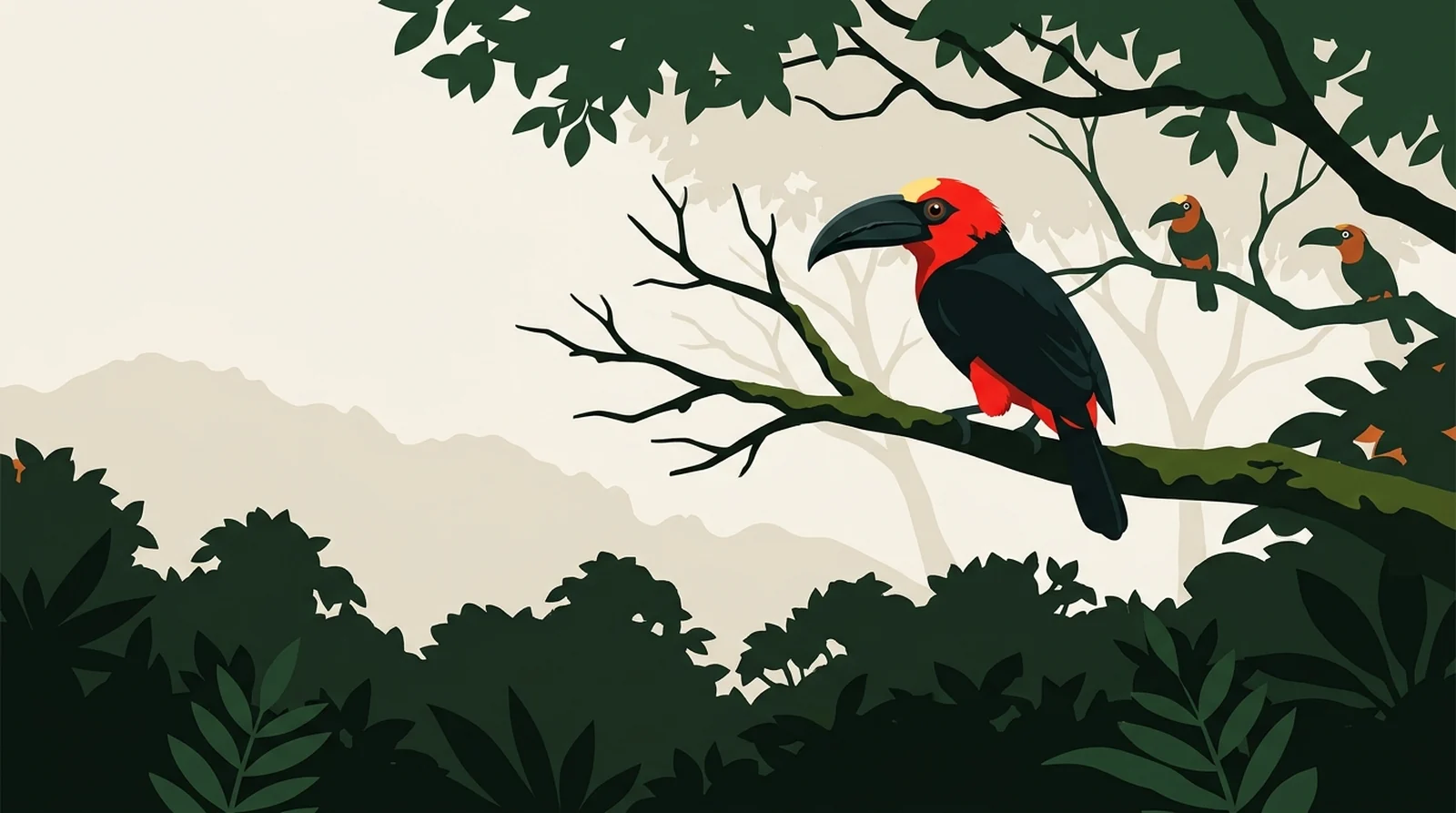
The Bornean bristlehead measures about 25 centimetres long and weighs between 115 and 150 grams. It has a chunky, top-heavy profile dominated by a massive black hooked bill. The plumage is jet-black, relieved by slate-grey ear-coverts, bright red thighs and a bright red throat and neck. In flight they reveal a conspicuous white patch at the base of the primary feathers. Young birds emerge with black thighs, red eye-rings and largely undeveloped crown bristles. They transition slowly to adult plumage as they mature.
Unlike most passerines the females are the more consistently ornamented sex. All females carry bright red flank patches. Some males show similar red feathers but it is highly variable. The red flanks remain the best diagnostic tool for identifying a female in the field.
Their name comes from their most unusual feature. From a distance the deeply yellow crown looks like a patch of bare skin. It is actually covered in stiff dermal papillae measuring 3–4 mm that resemble coarse stubble or bristles. This anatomical anomaly prompted scientists to name the genus Pityriasis after the Greek word for having a bran-like texture.
They are highly gregarious birds that travel in nomadic flocks of 6–10 individuals. These tight-knit family groups often act as the nucleus for massive mixed-species feeding flocks. They draw in trogons, woodpeckers, drongos and malkohas as they move through the high branches. Their diet is fiercely insectivorous. They use their heavy bills to mechanically dismember large armoured arthropods like giant forest cicadas, katydids, stick insects and cockroaches. They tear off wings and heavy limbs before swallowing the prey. They also supplement their diet with small arboreal frogs and lizards.
Birding significance and conservation
The bristlehead represents one of the world's great ornithological prizes because it is the sole living species in the family Pityriasidae. For birders maintaining global family lists a trip to Borneo is mandatory to tick this box.
The species also faces real ecological pressure. In 2022 the IUCN uplisted the bristlehead from Near Threatened to Vulnerable. This change reflects the reality of ongoing deforestation and peat swamp burning across the island. The destruction shrinks its primary lowland forest habitat by an estimated 2.5% every year. It is a bird entirely dependent on intact, mature forest. Seeing one in the wild is a privilege tied directly to the preservation of these protected areas.
Rainforest walkways and rivers
Because bristleheads are nomadic canopy obligates their presence in any given area is unpredictable. Look for them in reserves where towers or open sightlines help you scan the high canopy.
Sepilok (Rainforest Discovery Centre): This is the premier site globally. The centre features a 620-metre steel canopy walkway and 3 massive observation platforms including the 26.5-metre Trogon, Hornbill and Bristlehead towers. The walkway and towers bring you up to the birds' level. It allows for horizontal, eye-level observation. On most stays early vigils here are highly productive because you are waiting for the flocks to cross the gaps rather than trying to spot them through layers of leaves.
Danum Valley: Bristleheads are a realistic target here with plenty of walking and scanning. Finding the birds requires extensive walking and scanning along the main access road and the telecommunications tower area. Plan 3–4 days of roadside scanning to intercept the flocks as they move. You will spend a lot of time looking straight up.
The Kinabatangan River: Boat-based safaris offer a different approach. Flocks can occasionally be seen traversing the riparian edge or foraging in exposed branches along the riverbanks. The distances can be significant but a river cruise gives you a clear line of sight without a wall of trees in the way. It is a more relaxed way to scan the upper canopy.
Tabin Wildlife Reserve: Sighting a bristlehead here relies on scanning from the roadside along safari routes that border oil palm plantations. At Tabin, look for bristleheads from roadside openings as part of a wider wildlife stay. Tabin is a better choice for small cats and nocturnal wildlife than for a dedicated bristlehead search.
Timing and canopy viewpoints
The bristlehead is a year-round resident with no migratory season. You can look for it in any month. Sabah's weather runs on regional patterns rather than a single dry season. Rain falls all year at Danum Valley. April and May are typically the least wet months. At Sepilok the wettest month is December and the driest is May.
The time of day is crucial to finding a flock. The peak window for canopy activity occurs between 6:30am and 8:30am. Mornings immediately following overnight rain are particularly good. The moisture stimulates insect emergence high in the trees. After 9am the tropical heat builds. The flocks fall silent and vanish into the interior foliage.
For bristleheads, spend your time watching the canopy from towers and open viewpoints. The new hides built in late 2024 at Borneo Rainforest Lodge are excellent for terrestrial skulkers like pittas and partridges. The bristlehead never descends to the forest floor. You have to look up.
The flock contact calls
Because the Bornean canopy is highly dense visual scanning is inefficient. Finding them relies almost entirely on listening for their calls. The bristlehead possesses a bizarre, unmusical vocal repertoire. As a flock forages members keep in contact via a continuous undercurrent of nasal whining, humming and chattering notes.
Their signature long-distance contact call is used to regroup or signal movement. It is a loud, ringing whistle that sounds like "pit-pit-peeoo" interrupted by coarse, raven-like croaks. A good guide knows these calls well. If you can hear the flock, watch the canopy gaps for a chance to see it cross.
While they are primarily insectivorous flocks will occasionally congregate in emergent fruiting fig trees. Guides keep track of when these large figs fruit along the access roads to predict where the birds will arrive next.
Photographing the bristlehead
Photographing this species tests the limits of your technical skill and equipment. When shooting from the ground at Danum Valley or Tabin you are forced into extreme upward angles against a brilliantly backlit tropical sky. The jet-black body of the bird easily becomes a featureless silhouette. You must manually push your exposure compensation between +1.3 and +2.3 EV depending on the cloud cover to pull detail out of the black plumage and resolve the red neck.
Because peak activity is early in the morning you frequently battle dense tropical mist. Auto-focus systems routinely struggle in these low-contrast, hazy conditions. A minimum focal length of 600mm is mandatory. Modern, lightweight mirrorless setups are highly recommended. The heavy weight of traditional prime lenses makes it difficult to rapidly track erratic movements overhead. Flight shots are very hard to achieve due to unpredictable canopy cover and the bird's fast, shallow wing-beats.
The Pityriasidae bird family
For over 100 years the bristlehead was a famous taxonomic mystery. Scientists first described it in 1836 and then haphazardly grouped it with starlings, crows, woodshrikes, butcherbirds and true shrikes. Modern molecular phylogenetics finally provided clarity. By studying ultraconserved elements in their DNA researchers proved that the bristlehead belongs to a distinct evolutionary offshoot that originated in the proto-Papuan archipelago.
Today they are placed within the superfamily Malaconotoidea. They share deep ancestral ties with vangas, bushshrikes and helmetshrikes. Standing alone in the family Pityriasidae the bristlehead is a living relic of Borneo's ancient ecological history.
Related
Keep planning
Questions the team is asked
They are year-round residents. You can look for them in any month. The time of day matters more than the season. The highest activity is between 6:30am and 8:30am especially on mornings following overnight rain.
No. The ground-level bird hides built in late 2024 at Borneo Rainforest Lodge are engineered for terrestrial birds. The bristlehead is a canopy obligate and will never visit a ground hide.
No. The yellow crown is densely packed with stiff dermal papillae measuring 3–4 mm that look like coarse bristles or stubble. This creates the illusion of a bald head from a distance.
Unlike most passerines the females are the more consistently ornamented sex. All females carry bright red flank patches. Some males show similar red feathers but it is highly variable. The red flanks remain the best diagnostic tool for identifying a female in the field.
Yes. A minimum focal length of 600mm is mandatory for photographing the bristlehead. They frequently forage at heights exceeding 40 metres. Lightweight mirrorless setups are recommended for tracking their rapid movements.
Plan your trip
Ask about the Bornean bristlehead
Provide your dates and the team will build a birding itinerary around Sepilok and Danum Valley to target the Bornean bristlehead.