Sabah's endemic lowland pheasants
The Firebacks of Borneo
The Bornean Crested Fireback and Bornean Crestless Fireback are two of the island's most sought-after terrestrial birds. Here is what separates them and where photographers find them.
The bird
The two Bornean firebacks
2.5 hours from Lahad Datu, Danum Valley is 438 square kilometres of lowland rainforest sheltering Borneo's distinct endemic pheasants. Recent taxonomic updates confirm the crested and crestless firebacks are full species, making them essential subjects for a dedicated photography tour. You will appreciate the dark understory as a natural softbox to capture their subtle coppers and blues.
Taxonomy changed significantly when major authorities recognised both Bornean lineages as full species. The Bornean Crested Fireback (Lophura ignita) was split from the Malayan Crested Fireback after museum analysis proved the Sumatran subspecies was actually a hybrid swarm. The Bornean Crestless Fireback (Lophura pyronota) was similarly split from the Malayan Crestless Fireback due to deep biogeographical divergence.
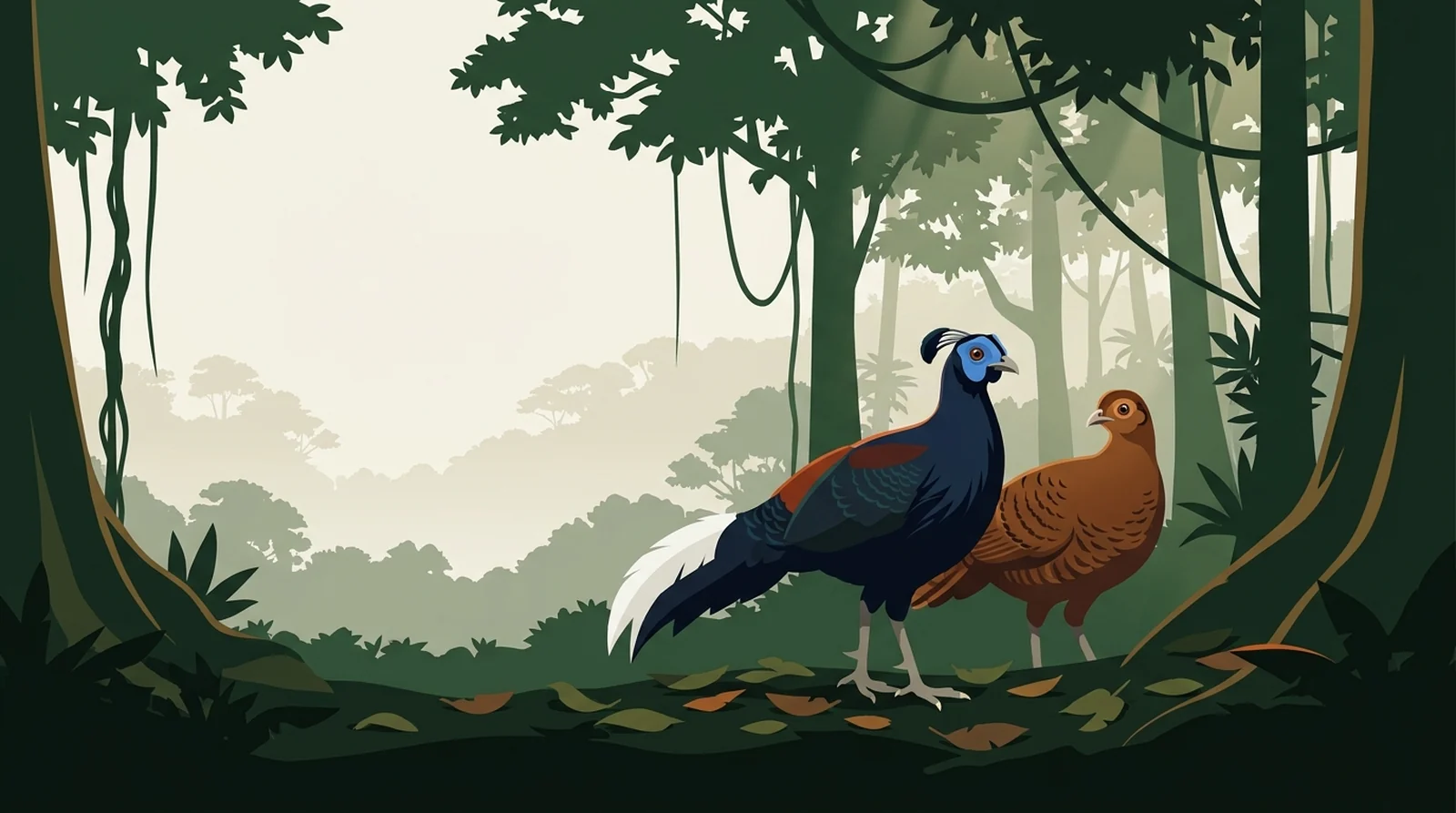
The Bornean Crested Fireback is a large bird characteristic of the mixed dipterocarp forests. Assessed as Vulnerable by the IUCN in 2020, it faces pressure from rapid habitat loss and commercial deforestation. The adult male averages 61 cm in length and carries an iridescent dark blue head with a crest of upright bare-shafted feathers. Their facial wattles are a bright cobalt blue. The upper breast is dark blue and transitions abruptly into a rich copper lower breast entirely lacking the white flank streaks seen in the Malayan birds. Males possess pronounced tarsal spurs averaging 30 mm acting as defensive weapons. The adult female is smaller at 51 cm and lacks prominent spurs. Her plumage is a cryptic chestnut capped with a dark crest. A whitish throat and fine white streaks across her chest fade into distinct scaled borders along the belly. A crucial feature for field identification is her distinctly dark blackish tail and whitish legs.
The Bornean Crestless Fireback is considerably more elusive and ecologically restricted. The IUCN assessed it as Endangered in 2022 because of its small population facing severe pressure from the conversion of peat swamps and kerangas forests. The adult male averages 38 cm and is strictly crestless. His defining facial feature is bare red skin completely lacking blue pigmentation. The bill is greenish and the legs are bluish-grey equipped with long spurs. The plumage is a deep purplish-black heavily marked with fine white vermiculations across the mantle and wings. The rump erupts into bright chestnut leading to cinnamon tail feathers anchored by black bases. The female is profoundly cryptic and appears almost entirely black with a pale throat. Female field identification relies on noting the absence of breast mottling and the slightly darker tail structure.
Danum Valley and Tabin
Where these pheasants live shapes where you look for a photograph. The Crested Fireback exhibits a higher tolerance for secondary and selectively logged forests. They frequently forage in family groups of 5 or 6 individuals. The grounds of Borneo Rainforest Lodge inside Danum Valley offer the most reliable walking stakeout in Borneo. On most stays, you can find these confiding birds scratching in the leaf litter near the staff quarters and along the primary access road. The lodge's 2 dedicated ground observation stations known as the Danum BOS and Takala BOS were completed in late 2024. These stations feature flat dirt floors engineered specifically for tripod stability alongside solar-powered ventilation. An expansion project adding 9 chalets runs from 1 January 2025 to 22 January 2027 so ask the team about specific access when booking.
Tabin Wildlife Reserve is another stronghold for the Crested Fireback. They are frequently encountered along the main dirt tracks early in the morning before they retreat into the undergrowth. A dedicated community-managed hide network at Telupid makes the Crested Fireback a realistic target at feeding stations. You reach the hide on a 30-minute uphill trek and settle in for close-range photography. When the robust Crested Firebacks arrive to feed, they operate as the dominant species at the provisioning site.
The Bornean Crestless Fireback demonstrates an extreme aversion to human presence and open tracts. It relies obligately on dense waterlogged peat swamp and kerangas forests. Recent camera-trap data confirms their presence deep in the forest interior at reserves like Deramakot where birders see them with luck. Current records reveal no predictable crossing points for this species along accessible tracks. Photographing it on a standard vehicle-based tour is a bonus. Looking for it involves silent vigils in humid waterlogged forests.
Vocalisations and acoustic signals
A general nature guide cannot substitute for a specialist birding guide in Sabah. In the dense rainforest, guides identify birds by their calls long before they come into view. The Crested Fireback produces a varied acoustic repertoire at low decibel levels. Intrasexual conflict triggers a shrill piping squeal lasting under 1 second while alarm communication is a rapid downslurred snapping note dropping sharply in frequency. Close-range terrestrial contact involves mellow grunts below 600 Hz. Displaying males also produce soft rhythmic cackles during their wing-whirring courtship rituals. Guides listen for these subtle cues while walking the trails in the early morning.
Specialist birding guides know the calls that help them track these birds. Securing a specialist guide requires booking well in advance because international tour companies contract them rapidly. The optimal acoustic period falls between March and May when resident species are highly vocal establishing territories.
Camera settings and gear
Photographing birds on the rainforest floor means adjusting your camera for deep shade and bright shafts of sunlight. The intense saturated blue wattles of the male Bornean Crested Fireback pose a severe risk of blowing out highlights in digital sensors. Photographers must proactively underexpose depending on the ambient light contrast. The exact same principle applies to the bright red facial skin of the Crestless Fireback.
Shooting down at a terrestrial bird flattens the image geometry and severs the intimacy of the portrait. You must shoot from the lowest possible physical elevation using a ground pod or beanbag when working the driveway at Borneo Rainforest Lodge or the dirt floor of a hide. A low angle isolates the bird against a smooth distant background instead of plastering the subject against a high-contrast floor of dead leaves.
The dark purplish-black plumage of both species acts as a mirror in direct sunlight. The micro-structures of the feathers reflect white glares rendering the bird as a high-contrast mass of black and pure white. The optimal time to photograph firebacks is under a bright high overcast sky or deep within the canopy shade where the light is highly diffused. This flat light acts as an enormous softbox allowing the subtle coppers and blues of the structural iridescence to render beautifully without harsh obliterating shadows. To document the Bornean Crested Fireback subspecies accurately you must capture the diagnostic buff central rectrices of the male by framing the bird broadside with a depth of field around f/5.6.
Custom photography itineraries
If the lowland endemics are what you are coming for, tell the team which species matter most and they will build the itinerary around them. Send your dates, your party size and your target list. The team comes back with the right sequence of lodges and the specialist guides that match your focus.
--- Sources referenced on this page: International Ornithological Committee, IUCN Red List of Threatened Species, Naturalis Biodiversity Center, Natural History Museum. Facts verified 9 September 2026.
Related
Keep planning
Questions the team is asked
Yes. Taxonomic updates between 2023 and 2026 recognised both the Bornean Crested Fireback and the Bornean Crestless Fireback as full species distinct from their Malayan counterparts.
Borneo Rainforest Lodge in Danum Valley offers a highly productive walking stakeout where habituated birds frequently forage along the entrance driveway. The community-managed hides at Telupid also provide reliable close-range opportunities.
Birders see this species with luck. The species avoids human presence and relies on dense waterlogged peat swamp forests where researchers study it using remote camera traps.
The pre-breeding window from March to May is the optimal period. Resident species are highly vocal and the forest trails are generally drier and more accessible.
You will need fast prime lenses and advanced camera bodies capable of rendering clean images at extreme ISOs because the forest floor remains profoundly dark until mid-morning. Ground pods are essential for low-angle portraits.
Plan your trip
Plan your Sabah birding itinerary
List the Bornean firebacks as your main targets and the team will build a dedicated itinerary featuring the most reliable lodges and acoustic guides.