Sabah's Critically Endangered bird
Helmeted Hornbill
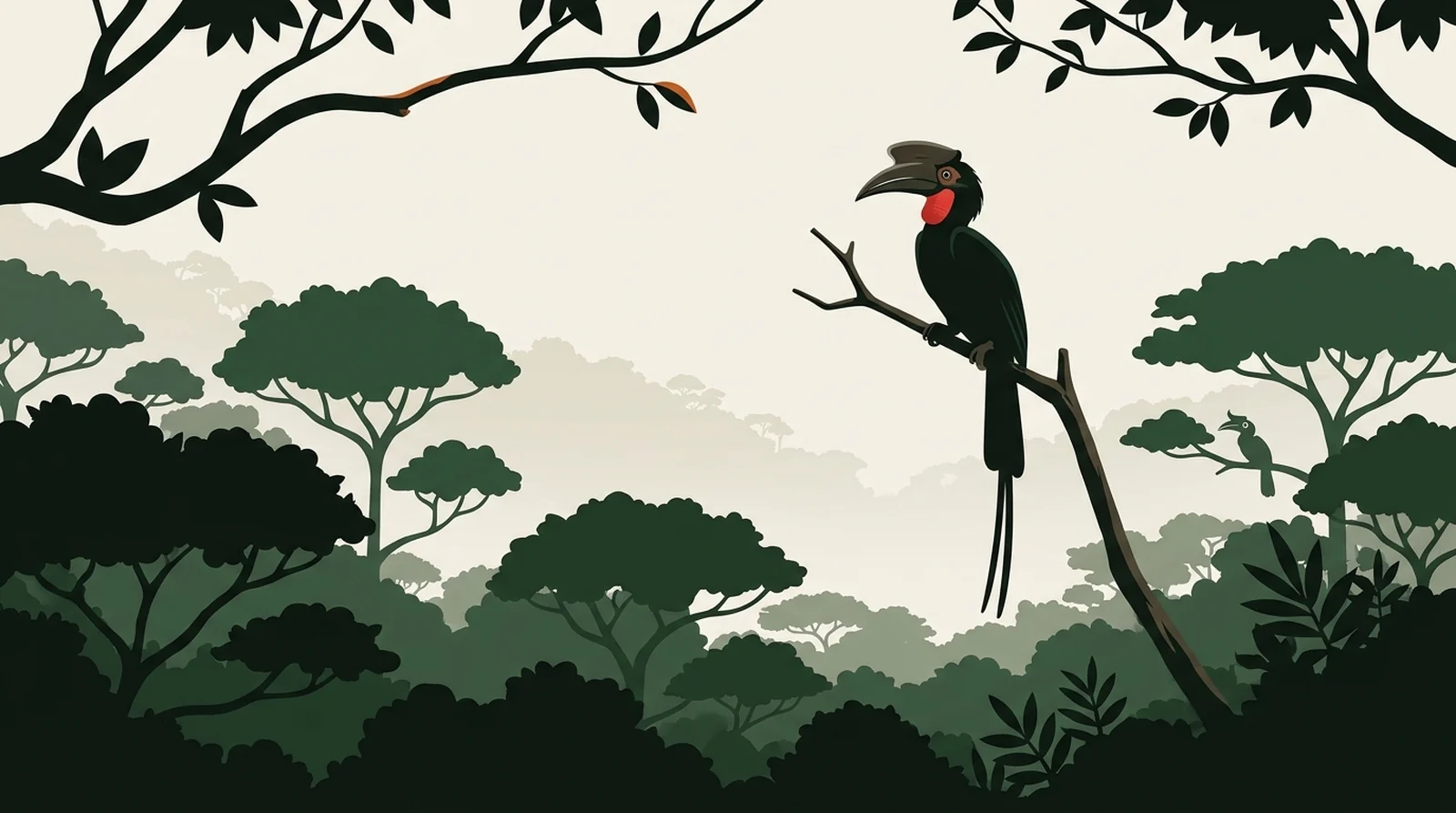
The helmeted hornbill is an apex bird of the primary lowland rainforest. It is known for its solid red casque, an accelerating call and spectacular mid-air jousts.
The bird
The giant hornbill
The 1.5-metre helmeted hornbill is a massive apex bird that requires the ancient emergent trees of Sabah's primary lowland rainforests. It features a solid red and yellow casque built for mid-air jousts and a heavy call that carries across the canopy. Spend time on the walkways at Danum Valley and you might be lucky enough to see this critically endangered species.
The helmeted hornbill (Rhinoplax vigil) is an apex frugivore of the Sundaic rainforest. Its physical presence is extraordinary. A male can reach 120 centimetres in body length with 2 central tail feathers extending a further 50 centimetres. The bird has a wrinkled red throat patch that is pale blue or greenish in females. When in flight it lacks underwing coverts so air forces through the feathers to create a loud whooshing sound.
The bird acts as a primary farmer of the forest. It has a highly specialised diet that depends on lipid-rich figs but it will actively hunt animal prey such as lizards, rodents and the nestlings of smaller birds to provide vital protein during the chick-rearing phase. Telemetry studies show the bird is a highly effective seed disperser and is capable of moving seeds up to 14.5 kilometres across the landscape. This vast movement maintains the genetic flow of the rainforest ecosystem.
The breeding cycle is an astonishing feat of biological endurance. The female requires a massive natural cavity in a giant dipterocarp tree with a protruding structural perch near the entrance. She enters the cavity and the entrance is sealed with a plaster made of mud, fruit pulp and faeces. Only a narrow slit remains. She stays inside for up to 150 days to incubate the egg and rear the chick while undergoing a catastrophic moult that temporarily leaves her flightless. The male acts as the sole provider for 5 months and returns to the nest multiple times a day to regurgitate figs and animal prey.
The solid red casque
The most remarkable feature of the helmeted hornbill is its casque. While other hornbills have hollow casques that amplify their calls, this species has a dense structure supported by massive internal bone struts called trabeculae. The casque makes up roughly ten per cent of the bird's total body weight. The natural colour of the keratin is pale yellow. The bird cosmetically dyes it brilliant red and orange by rubbing its head against a preen gland near the base of its tail.
This heavy architecture evolved for high-speed impact. Males engage in spectacular mid-air jousts where they line each other up across the canopy and collide head-on. The impact produces a loud clack audible from more than 100 metres away.
The dense keratin that allows this behaviour is identical in molecular composition to human fingernails and rhino horn. It is known as red ivory. Between 2011 and 2012 transnational organised crime syndicates began targeting the helmeted hornbill to supply a demand for carved status symbols in East Asia. The poaching pressure decimated breeding populations in a matter of years. Contraband is moved through established transit hubs via air and sea from Kalimantan passing through ports in Shenzhen and Hong Kong. The primary destination is mainland China specifically traditional carving centres in Fujian province where a historical carving industry was illicitly repurposed for black-market wildlife goods.
You must protect the exact locations of these birds. Because the female is sealed inside the nest for 5 months, killing the provisioning male condemns the female and the chick to starvation.
Nest guarding programmes
The catastrophic poaching surge caused a rapid population collapse across the species' range. In 2015 the IUCN Red List bypassed standard threat progression criteria and uplisted the helmeted hornbill directly from Near Threatened to Critically Endangered. Global governments passed a resolution at the 2016 CITES conference demanding urgent enforcement action.
Law enforcement agencies and wildlife forensic scientists are fighting back. Chinese authorities have actively intercepted shipments and handed down severe prison sentences. Scientists use DNA barcoding to identify seized keratin as helmeted hornbill and are developing stable isotope analysis to trace where poached birds came from. These methods help authorities identify illegal wildlife products and could help them trace supply chains to their source.
In Sabah conservationists are working to protect the birds and their breeding habitat. Community-led nest-guarding programmes employ indigenous communities to physically protect active nest trees during the vulnerable breeding cycle. NGOs including HUTAN have pioneered artificial nest box research in the Kinabatangan floodplain using heavy marine wood boxes. While other hornbills use these artificial cavities, the helmeted hornbill has not yet adopted them, likely because it requires a specific protruding perch to support its heavy casque. Protecting the remaining ancient trees in situ remains an absolute necessity.
Primary lowland rainforest
The helmeted hornbill is strictly confined to heavily protected mature lowland and hill dipterocarp forests. It rarely ventures into degraded secondary growth. In Sabah the species maintains a resident presence in the Danum Valley Conservation Area, the Kinabatangan Wildlife Sanctuary, Tawau Hills Park and the Imbak Canyon Conservation Area.
Imbak Canyon is a notable stronghold. A 2021 rapid assessment suggested a healthy local density of up to 4.62 individuals per square kilometre. This density is bolstered by local Murut indigenous beliefs that actively deter hunting. The species is totally protected under the law in both Sabah and Sarawak.
The accelerating call
You will almost certainly hear a helmeted hornbill before you ever see one. The call has 2 parts and carries over long distances through dense vegetation. It begins with a slow series of loud hoots that sound like a heavy axe striking wood. Over several minutes the hoots accelerate in tempo before climaxing in a hysterical cackling laugh.
The birds call at similar frequencies to rhinoceros hornbills but time their calls to avoid drowning one another out. The sound holds deep anthropological significance in Borneo. Local Malay lore refers to it as the bird that chops down the mother-in-law's house. For the Punan Bah people it is a sacred sentinel. Among Dayak and Iban communities it represents the ultimate symbol of fidelity. The birds project this call across vast valleys but they stay very high in the emergent canopy and remain notoriously shy.
Park sighting rules
Seeing a helmeted hornbill is a spontaneous gift of the forest. Ethical operators do not publish specific trails or fruiting tree locations because poaching syndicates actively mine digital trip reports.
You must follow a strict code of ethics if you encounter one. Using audio playback to lure the bird is strictly prohibited. Playback causes severe physiological stress and pulls males away from critical foraging duties that support the sealed-in female. It can also expose the birds to hunters. All photographers must completely strip GPS coordinate tags from their image metadata before posting photographs online. Public leaking of exact coordinates acts as a roadmap for poachers. Enjoy the sighting from a respectful distance and keep the specific location a secret.
Sabah birding itineraries
If you want to focus your time on the primary rainforest reserves that support the helmeted hornbill tell the team your dates and they will design the itinerary. Let them know your target species and your photography goals. They will come back with a route that puts you in the best position to experience the ancient canopy.
--- Sources referenced on this page: BirdLife International (2018), IUCN Hornbill Specialist Group (2016), Sabah Wildlife Department (2021), HUTAN (2013). Facts verified 8 September 2026.
Related
Keep planning
Questions the team is asked
The dense casque is supported by thick bone struts and evolved to sustain extreme high-speed impact. Males use it to engage in mid-air jousts over territory.
The female seals herself inside a natural tree cavity using mud and faeces to protect against nest predators like macaques and civets. She stays inside for up to 150 days to incubate the egg and rear the chick while she undergoes a complete moult.
Audio playback is strictly prohibited. It stresses the birds, disrupts their vast territorial patrols and pulls the male away from finding food for his sealed-in family.
The Danum Valley Conservation Area is a realistic target for a chance encounter. If you see one, photograph it from a respectful distance and keep its exact location private.
Eco-tourism provides an economic counter-weight to logging and poaching. Your visit directly funds the conservation work that protects the rainforest of a lineage some 130 million years old reserves these birds rely on.
Plan your trip
Plan your Sabah birding trip
Tell the team your dates to arrange a specialist guide who can help you look for the helmeted hornbill in Sabah's primary rainforest.