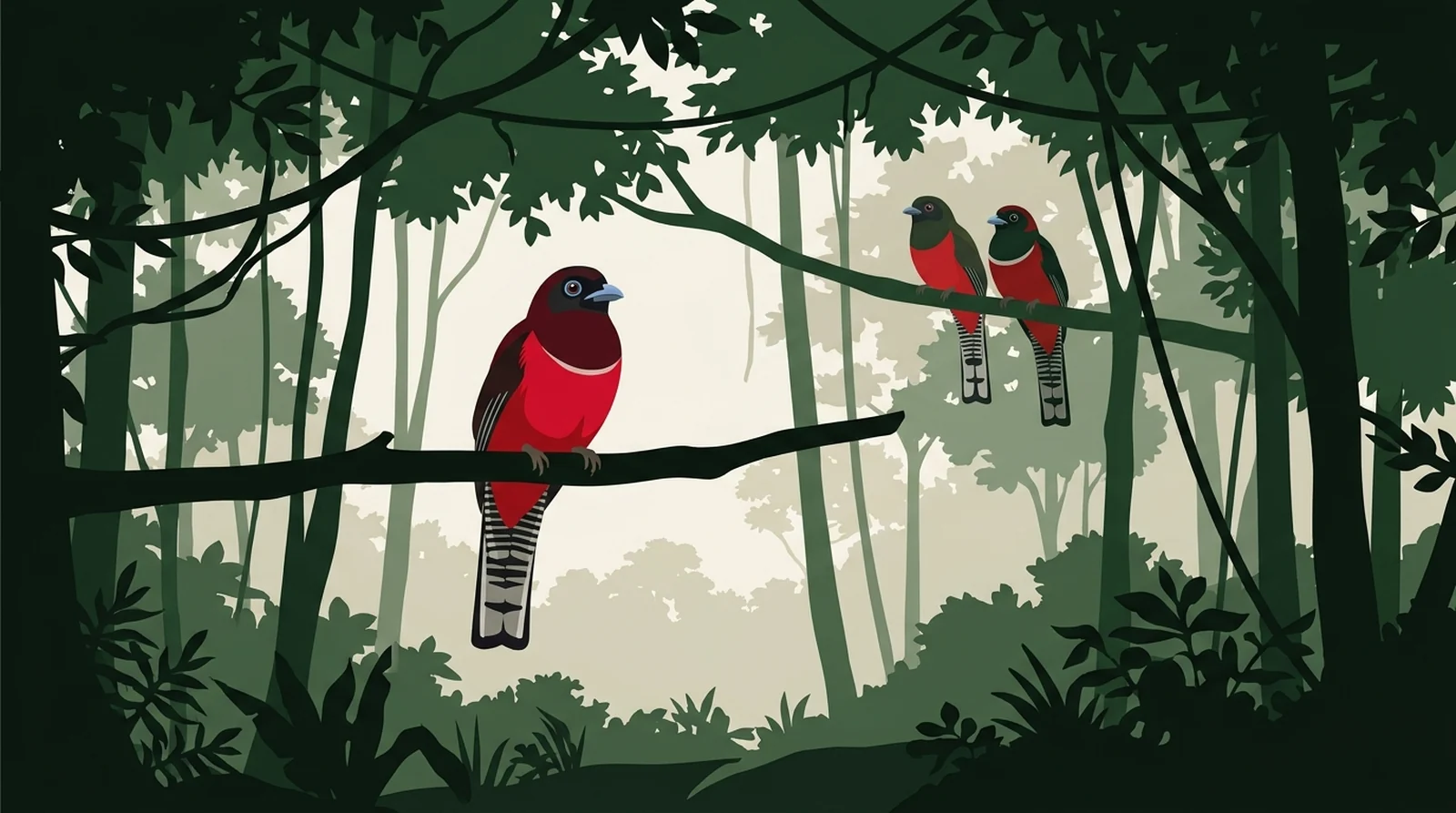
Sabah's five lowland species
Bornean Lowland Trogons
The lowland and hill forests of Sabah support 5 species of trogon. Finding them takes patience and photographing them requires very specific camera settings.
The bird
Lowland rainforest trogons
The lowland and hill forests of Sabah support five species of trogon, which hunt insects in the rainforest. Finding them means listening for their calls and scanning the shadows, with a specialist birding guide to help.
Many people arrive in Sabah hoping to see Whitehead's Trogon. You need to know that Whitehead's Trogon is strictly a montane bird. Look for it in montane forest at 1,400–2,000 metres on peaks like Mount Kinabalu. It will not be seen in the lowland dipterocarp forests. The forests below 1,500 metres hold 5 different species. They are all sit-and-wait predators that feed exclusively on wild arthropods like cicadas and stick insects. They have a unique heterodactyl toe arrangement where digits 3 and 4 point forward and 1 and 2 point backwards. Their leg muscles account for only three per cent of their body weight so they cannot walk along branches. They rely entirely on short flights to reposition or snatch prey from the leaves. Trogons are long-lived birds with high territorial site fidelity. Historical data from the region indicates annual survival rates of 77 per cent with some individuals living over a decade. A trogon will often hunt the exact same circuit of branches day after day.
Five Bornean trogon species
The bright males are easy to tell apart. Female trogons are harder to tell apart in the dim understorey.
The Scarlet-rumped Trogon is the smallest trogon in the world. It measures 23 to 24 centimetres in length and weighs between 34 and 43 grams. The IUCN Red List confirmed its status as Near Threatened in 2024. The male has a black head and throat that contrast strongly with a rich red lower breast and belly. He has a blue bill and a thin blue eye ring. The female has a dull brownish head and a reddish-pink belly. You can separate her from other female trogons by her distinct pinkish rump and uppertail coverts. The male calls in a rapid 12-note sequence of short "yau" notes that accelerate and become quieter towards the end.
The Red-naped Trogon reaches 32 centimetres in height. Its Near Threatened status was verified in September 2026. The male features a black head and upper breast with a bright blue facial skin patch and eye ring. A crisp white breast-line divides the black throat from the bright red underparts. The definitive mark is the band of bright red feathers wrapping around the back of the head. The female possesses a grey-brown head and upper breast. Her underparts are entirely yellow to yellow-brown. The call is a slow and methodical "pau pau" series.
Diard's Trogon is a medium-large bird of 34 centimetres. Its Near Threatened status was verified in September 2026. The adult male features a black head and a mid-to-hind crown with a distinct maroon wash. A pink hind-collar and a pink breast-line separate the black upper section from the purplish-red belly. The female exhibits an earthy brownish head and her lower underparts are a bright pinkish-red. Photographers frequently misidentify her as the rarer Cinnamon-rumped Trogon. The vocalisation is a rhythmic sequence of 10 to 12 "kau" notes where the second note is higher than the first and the final few descend noticeably in pitch.
The Cinnamon-rumped Trogon is an indicator species for intact understorey vegetation. The IUCN uplisted it to Vulnerable in 2023 due to severe lowland habitat loss. The male is 25 centimetres long with a black hood and a distinct blue bill. The back and tail plumage are pale brown cinnamon and the under-tail is white bordered by black. The female has a rufous-brown head and a yellowish-rufous to pinkish belly. The call is a short "ta-y-aup" cry with a massive pause of 10 to 15 seconds between calls. They also produce a secondary purring call.
The Orange-breasted Trogon is a hill and submontane specialist found between 500 and 1,500 metres. Its Least Concern status was verified in September 2026. The male has an olive-yellowish head and a brilliant orange-yellow breast and belly. The female has a greyish-brown head and pale yellow underparts. The call is a rapid "tau-tau-tau" series.
Trogon sites across Borneo
Danum Valley Conservation Area is the premier lowland trogon location in Asia. The reserve protects intact lowland dipterocarp forest that supports healthy populations of Scarlet-rumped, Red-naped, Diard's and Cinnamon-rumped Trogons. The 300-metre canopy walkway stands near Borneo Rainforest Lodge. Diard's and Scarlet-rumped Trogons cross the canopy here on most mornings. The undulating and deeply shaded ground trails like the Nature Ridge and Waterfall trails are the primary habitat for the Cinnamon-rumped Trogon.
Tabin Wildlife Reserve offers a mosaic of logged and primary forests. It supports Diard's and Scarlet-rumped Trogons on most stays. The Rainforest Discovery Centre at Sepilok is an excellent alternative to Danum Valley. It features a 620-metre canopy walkway standing 25 metres high with a dedicated Trogon Tower. The walkway is very reliable for Scarlet-rumped and Diard's Trogons and occasionally yields the Red-naped Trogon. The flat jungle trails follow small streams and attract high insect activity that draws trogons lower into the understorey during the heat of the afternoon.
Trogons are cavity nesters that favour rotten stumps and termitaria. Specialised guides locate low-hanging nest cavities along the tributaries and oxbow lakes of the Kinabatangan River. Approaching these alcoves silently by electric boat provides excellent photographic opportunities without the need for heavy jungle trekking.
In Sarawak, you can look for Diard's Trogon and Cinnamon-rumped Trogon at Kubah National Park on Mount Serapi. Gunung Mulu National Park offers an altitudinal gradient where you find Scarlet-rumped and Red-naped Trogons in the lowlands before transitioning into Orange-breasted Trogon territory on the lower slopes.
Guided trogon tracking
The primary breeding season runs from late February through August. Territorial calling is at its peak and adults actively forage to feed chicks. They are most active between 6am and 10am and again from 3:30pm to 6pm.
There are no baited trogon hides in Borneo. Trogons are strictly arboreal predators that will not come to the ground for mealworms. Without a pre-built hide, your guide uses a perch-return stakeout. Trogons keep returning to favoured perches. If a bird flushes from a favoured hunting branch, the correct protocol is to wait quietly near the original perch. The bird will frequently return to the exact same branch within 20 to 30 minutes to resume hunting.
Ethical guiding dictates strict playback restraint. Excessive audio playback causes these territorial birds to abandon their hunting circuits entirely. Good guides use short audio bursts to confirm presence and then switch to silent waiting.
Rainforest trogon photography
Photographing these birds in primary dipterocarp rainforest takes careful exposure and patience. The understorey of Danum Valley is perpetually dark.
When a shaft of dappled sunlight strikes the intensely saturated red breast of a male trogon, the digital camera sensor will struggle to meter the scene. The auto-exposure gets confused by the dark green foliage and will overexpose the bird so the red channel blows out into a featureless glowing blob. You must manually dial in negative exposure compensation of -0.7 to -1.3 EV to preserve the delicate feather detail in the red breast. You then rely on post-processing to lift the shadows of the green background.
Because of their weak feet, trogons cannot turn around on a branch without using their wings. When they land, they almost always face away with their dull back to the observer. You need to freeze and wait. They possess highly flexible necks and will eventually rotate their heads 180 degrees to scan for predators. This offers a clear over-the-shoulder profile shot that highlights the vivid breast and the vermiculated wing coverts.
During the courtship and nesting periods from March to August, trogons frequently move in pairs. Because they hunt in the dim mid-storey, photographers typically shoot wide open at f/2.8 or f/4 to keep ISO speeds manageable. If a male and female perch on adjacent branches at slightly different depths, shooting wide open guarantees one bird will be out of focus. You must rapidly stop down to f/7.1 or f/8 and push the ISO to 6400 or 12800 to ensure both birds are sharp.
Custom rainforest birding itineraries
If the trogons are what you are coming for, tell the team which species matter most and they will build your itinerary around the right trails. Send your dates and the size of your party and the team will come back with what can be arranged.
--- Sources referenced on this page: IUCN Red List of Threatened Species. Facts verified 9 Sep 2026.
Related
Keep planning
Questions the team is asked
The primary breeding season from late February through August is the optimal window. The birds are highly vocal and active while feeding chicks. March to May is an excellent time because resident species are establishing territories and the forest is relatively dry.
No. Whitehead's Trogon is a montane species that lives at elevations above 1,400 metres on peaks like Mount Kinabalu. The lowland dipterocarp forests of Danum Valley hold the Scarlet-rumped, Red-naped, Diard's and Cinnamon-rumped Trogons.
There are no baited hides for trogons because they are sit-and-wait predators that hunt live arthropods in the mid-storey canopy. They will not come to the ground for bait. Photography relies on the perch-return stakeout method and waiting quietly.
You need fast prime lenses of f/2.8 or f/4 and a camera body capable of rendering clean images at extreme ISO settings like 6400 to 12800. The forest floor remains dark until about 7:30am and the canopy blocks a lot of light throughout the day.
Yes. Finding trogons means recognising their calls before you can see them. A general nature guide does not have the extensive auditory library required to track them.
Plan your trip
Plan your trogon birding trip
If you are coming to photograph lowland trogons, tell the team your target species and they will arrange the right guides and trails.