Frogs and reptiles of Sabah
Herping in Borneo
The lowland and montane rainforests of Malaysian Borneo support hundreds of endemic amphibians and reptiles. This is how the night walks work and what you will find.
The animal
Borneo's frog families
Danum Valley records 56 amphibian species alone while the 1,563-metre elevation of Kinabalu Park Headquarters creates entirely distinct montane habitats. Scan dead leaves for eye-shine and explore dark trails with a guide to look for Wallace's flying frogs and arboreal pit vipers. An itinerary crossing lowland dipterocarp forests and cool mountain streams places you in the right habitats to photograph these nocturnal specialists.
Borneo's amphibians occupy highly specialised niches across the forest floor and the canopy. The major families present completely different behaviours and physical adaptations.
The Bornean horned frog, now formally classified as Pelobatrachus nasutus, is a master of camouflage. It relies entirely on its angular body and the dermal projections above its eyes to vanish into the dead leaves. It remains motionless rather than using toxic secretions for defence. Finding one visually is a matter of luck but a guide will listen for its distinct call that sounds like a hammer striking an anvil.
Near the rivers the giant river toad (Phrynoidis juxtasper) is a realistic target. The females are massive and reach up to 21.5 cm in length. They exude a milky toxic secretion containing bufotelin from their large parotoid glands and skin warts if threatened. High in the montane rainforests of Sarawak the Bornean rainbow toad (Ansonia latidisca) survives. This endangered species is characterised by long spindly limbs and variegated dorsal skin splattered in bright green, purple and red pebbly warts. It was unseen by science for 87 years until a UNIMAS team rediscovered it in 2011.
Microhyla borneensis lives in the pitchers of Nepenthes ampullaria plants. This miniature species breeds entirely within the water-filled pitchers. The adult males measure a minuscule 10.6 to 12.8 mm. You may see older literature refer to it as Microhyla nepenthicola before taxonomists corrected the name.
Habitat dictates what you find. The cool torrential streams of the Silau-Silau trail at Kinabalu Park Headquarters are the domain of the Kinabalu torrent frog (Meristogenys kinabaluensis). Its tadpoles have modified abdominal suckers to graze on algae while clinging to rocks in raging waterfalls. At Poring Hot Springs the fast-flowing Mamut and Kipungit rivers host foot-flagging rock skippers like Staurois latopalmatus and Staurois natator. These species have evolved similar body adaptations for life in fast-flowing water. Be sure to check the deep leaf litter at Poring for the Sarawak slender litter frog (Leptobrachella gracilis). This endemic species uses a unique 1.22-second jumping sequence where it raises its head, closes its eyes and uses a forelimb-assisted propulsion technique during take-off. The poisonous rock frog (Odorrana hosii) is a bright green species that clings to wet boulders near the same streams.
The Wallace's flying frog (Rhacophorus nigropalmatus) glides between the emergent trees using highly webbed feet. It descends to the ground and uses forest pools to construct bubble nests during mating. In the high altitudes you can target the localised montane shrub frog Philautus nephophilus.
Arboreal and terrestrial snakes
The snakes you meet on a night walk are predominantly arboreal hunters.
The snake most visitors hope to see is the Bornean keeled green pit viper (Tropidolaemus subannulatus). The sexes look very different. The females are large and bright green with thin crossbands while the males are diminutive and top out at 46 cm. You will often see them coiled motionless on low branches overhanging the trails. The gold-ringed mangrove cat snake (Boiga dendrophila annectens) is another regular on the night drive. Despite its name it is frequently encountered in lowland primary rainforests far from the coast. You can identify it by the yellow bands that extend fully across its back.
The apex elapids command total respect. A 2024 taxonomic revision split the king cobra (Ophiophagus hannah) into 4 distinct species across Asia. Guides will point out the differences when discussing the apex predator of the Bornean canopy. The blue Malayan coral snake (Calliophis bivirgatus) is a terrestrial hunter with venom glands extending for a quarter of its body length. It possesses a unique toxin named Calliotoxin that induces immediate spastic paralysis in the fast-moving snakes it hunts.
The Bornean dark-necked slug snake (Asthenodipsas borneensis) is an endemic specialist of the lowland forests including the trails around Poring. It was recently elevated to full species status based on distinct morphological traits like its smooth dorsals. The reticulated python (Malayopython reticulatus) is a realistic target on night walks along the access roads of Danum Valley.
Borneo's forest lizards
Borneo's lizards occupy every layer of the forest architecture.
The agamid genus Draco uses an actively controlled membrane supported by elongated ribs and pectoral muscles to glide between dipterocarp trunks. There are 9 Draco species formally catalogued in Borneo including Draco cornutus and Draco sumatranus. Parachute geckos use similar adaptations to glide through the air. They are now grouped in the genus Gekko.
At ground level and on the lower tree trunks the Borneo anglehead lizard (Gonocephalus bornensis) is a major reward. Adult males are bright green while females are a rust-red hue. The Sabah bow-fingered gecko (Cyrtodactylus ingeri) is strictly endemic to the hot springs and immediate lowland area around Poring. It is identified by its lack of a preanal groove and 8 preanal pores forming a distinct angular series.
The earless monitor (Lanthanotus borneensis) is a semi-aquatic subterranean lizard representing an ancient lineage endemic only to northern Borneo. It is strictly protected under Malaysian federal law and listed under CITES Appendix I. To protect the remaining populations from the illicit pet trade no specific locality data or habitat identifiers are ever published or shared by guides.
Borneo herping locations
The best itineraries link distinct elevations and forest types.
Kubah National Park (Sarawak): The famous Frog Pond here offers explosive breeding density. On a humid night it is possible to identify over 20 species. This density inspired the International Bornean Frog Race. It is a citizen-science event initiated in 2012 by UNIMAS to raise conservation awareness.
Danum Valley Conservation Area (Sabah): The lowland dipterocarp forest here is ancient and never logged. Night walks along the access roads or designated trails are excellent for finding the Wallace's flying frog, the Borneo anglehead lizard and the reticulated python.
Kinabalu Park Headquarters (Sabah): The cool climate and high elevation make this the site for montane endemics. The cool torrential streams around the Silau-Silau trail are the exclusive domain of the Kinabalu torrent frog and Kobayashi's horned frog (Pelobatrachus kobayashii).
Poring Hot Springs (Sabah): At an elevation of 400 metres Poring provides a vital lowland contrast to Kinabalu Park Headquarters. The riparian margins bordering the Kipungit stream and the rocky ascents of the Langanan trail are highly productive for torrent-dwelling frogs and nocturnal snakes.
Rainforest Discovery Centre (Sabah): The wetland areas and well-maintained trails are accessible and reliable for arboreal vipers, gliding agamas and Hylarana frogs.
Night walk conditions
Herping relies heavily on localised moisture. At Poring the wetter months are typically November through March but heavy rain falls all year. The absolute best conditions for a night walk occur immediately after an intense late-afternoon convectional thunderstorm. The sudden influx of water triggers explosive amphibian breeding and brings out the nocturnal snakes that hunt them. A humid night with standing water on the trails will always be more productive than a dry week.
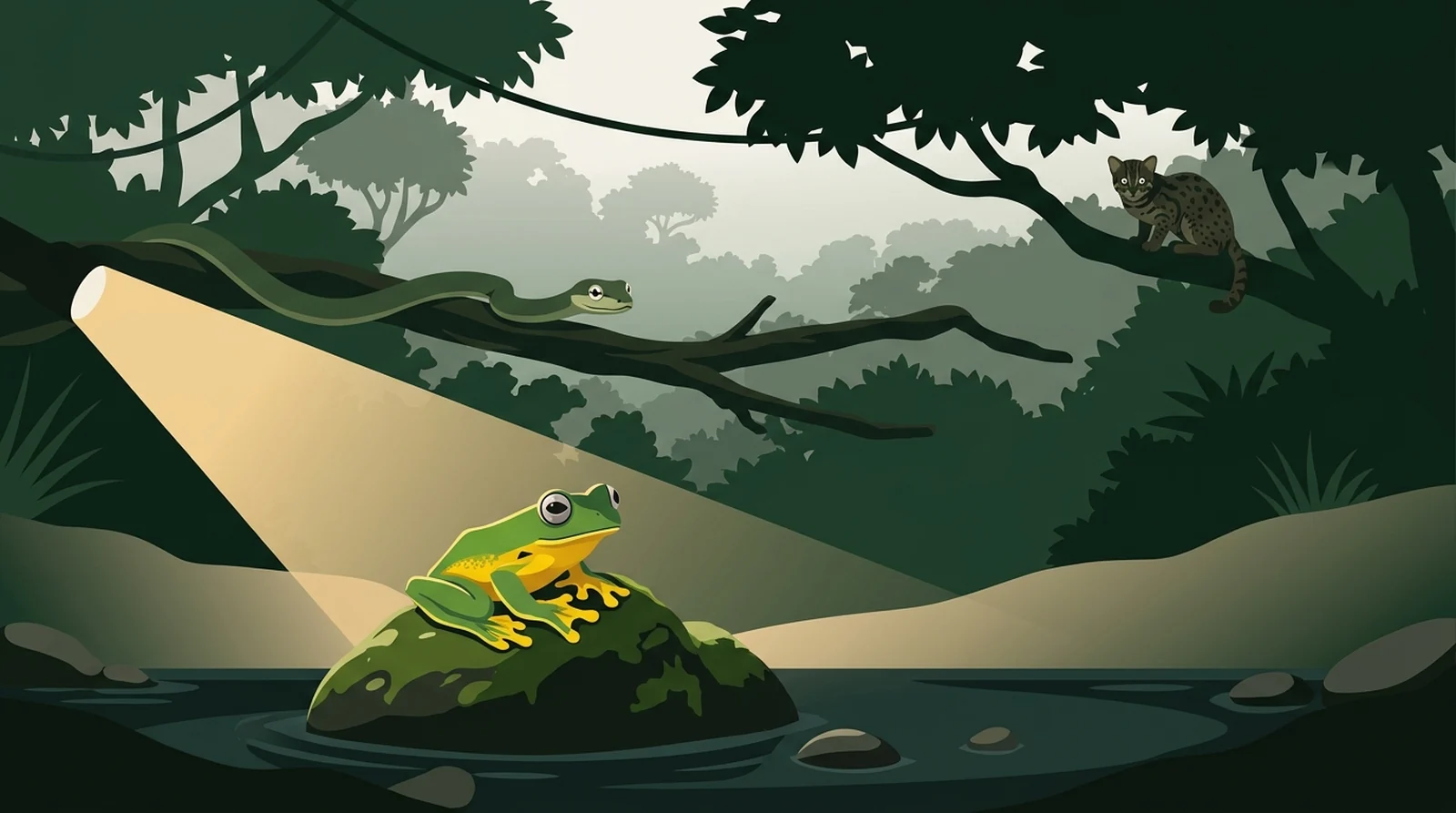
Finding cryptic species visually without an acoustic cue is nearly impossible. Expert guides rely heavily on acoustic call identification. For spotlighting, guides hold a strong tightly focused torch beam at eye level to catch the eye-shine of frogs and nocturnal reptiles. Different groups of animals reflect different colours in the torchlight. A seasoned guide uses these reflections to distinguish a hunting spider from a resting tree frog from 50 metres away.
Responsible herping practices
The rules for interacting with Borneo's herpetofauna are uncompromising. The Sabah Biodiversity Enactment requires anyone collecting specimens or conducting biological research to hold an Access Licence from the Sabah Biodiversity Centre. For ecotourists and photographers the rule is simple: strictly visual observation.
Handling is completely prohibited. Amphibians breathe cutaneously. The natural oils, salts and chemical residues from insect repellent on human hands are toxic and rapidly degrade their skin.
The most pervasive threat to amphibians globally is chytridiomycosis. It is a disease caused by the Batrachochytrium dendrobatidis fungus. While Asia currently acts as a firewall with a low rate of infection, the pathogen is present. It spreads mechanically via wet footwear crossing between catchments. Responsible herpers must use a potassium permanganate or Virkon wash station or thoroughly disinfect boots and tripod legs with a bleach solution or veterinary disinfectant before entering and after leaving the forest trails.
Photographing frogs and reptiles
Amphibians and nocturnal reptiles have highly sensitive retinas adapted for low light. Experienced guides use red-light headlamps for general scanning to minimise disturbance.
Once an animal is located photographers must observe a strict maximum flash count. Excessive strobe flashes cause temporary blindness. This leaves the animal vulnerable to predators long after you have moved on.
Snakebite first response
Snakebites during supervised professional herping excursions are exceedingly rare. Guides watch for vipers and elapids along the trail ahead of you. If an envenomation does occur, the Malaysia Ministry of Health Clinical Practice Guidelines dictate the response. Traditional treatments are highly dangerous. You must never cut the wound, attempt to suck out venom, apply ice or use a traditional arterial tourniquet. For suspected elapid bites the immediate application of the Pressure Immobilisation Technique using an elastic bandage is recommended to delay the lymphatic flow of neurotoxins. For viperid bites the universal standard remains rapid transport to a local medical facility and strict physical immobilisation of the affected limb. Immediate evacuation to a regional medical facility stocked with appropriate antivenom is the only definitive treatment.
Related
Keep planning
Best Time to Visit Sabah Getting to Danum Valley Sabah Itineraries
Questions the team is asked
You do not need an academic research permit for standard photographic ecotourism as long as you do not handle, swab or collect any animals. You pay the standard Sabah Parks conservation fees to enter the national parks and arrange your night walks with a licensed guide.
Unguided solitary night walking is strictly prohibited in places like Poring and Kinabalu Park due to the risk of flash floods and getting lost. You must be accompanied by an authorised nature guide or park warden.
Snakebites during supervised walks are exceedingly rare. Guides are trained to spot vipers and elapids long before you reach them. You must wear proper trekking footwear and stay on the designated paths.
Amphibian activity depends on recent rainfall rather than a specific calendar month. Rain falls all year and a heavy afternoon downpour can trigger activity that night.
No. Because the earless monitor is critically threatened by the illegal wildlife trade guides will never target this species, share its location or answer questions about its habitat.
Plan your trip
Plan your Borneo herping trip
Tell the team which endemic frogs and nocturnal snakes matter most to your photography to arrange the specialised guides you need.