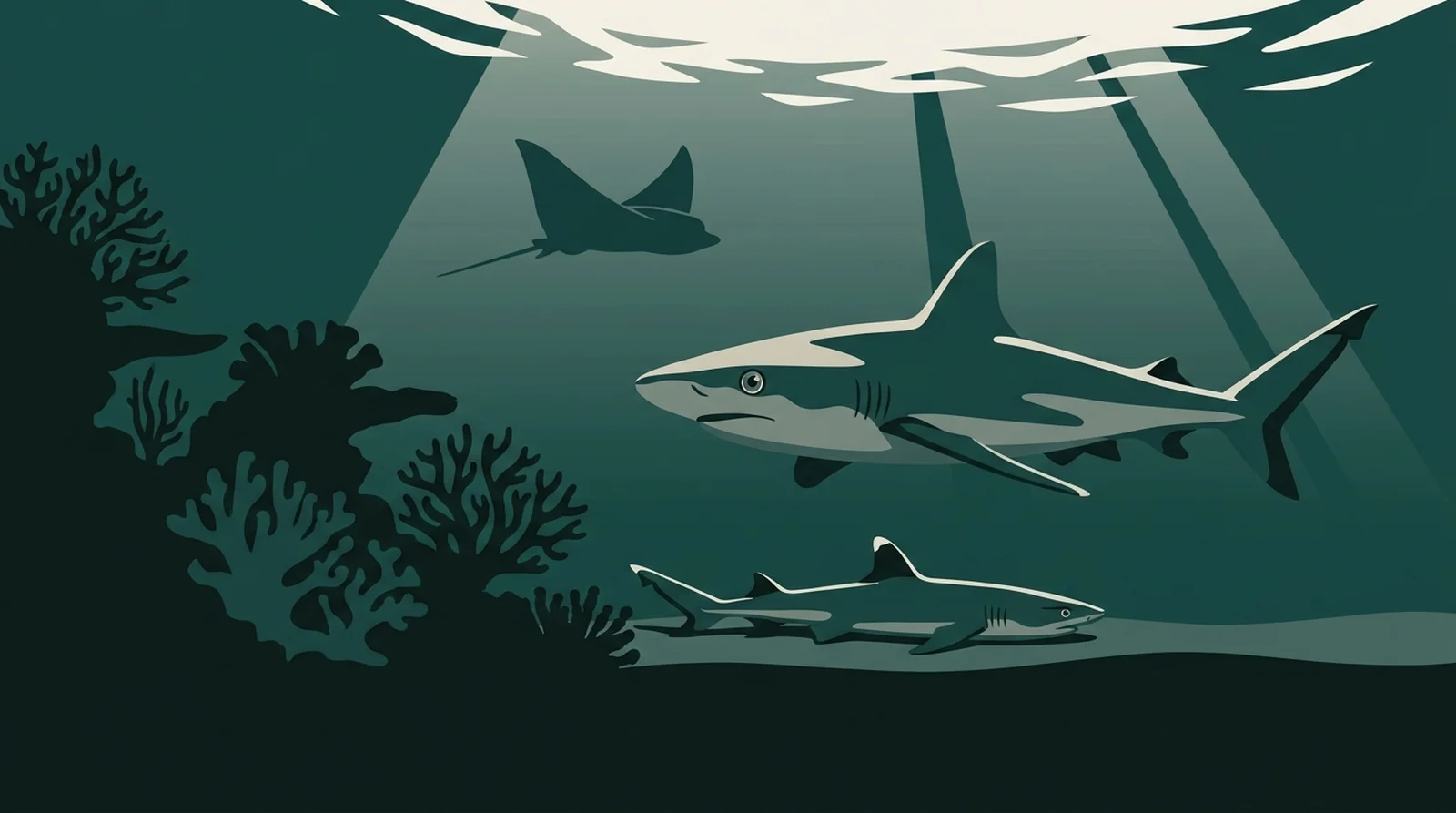
Pelagic and reef species
Sharks and rays
The Celebes and South China Seas hold some of the highest elasmobranch densities in the Coral Triangle, from the resident reef sharks of Sipadan to the deep-water hammerheads of Layang Layang.
The animal
Protected Malaysian waters
The Celebes and South China Seas hold some of the highest elasmobranch densities in the Coral Triangle. Sipadan supports resident reef sharks on the steep drop-offs, and the remote atoll of Layang Layang draws scalloped hammerheads from the deep. Keep an eye out for whitetip reef sharks resting on the sand and manta rays passing the offshore walls.
Shark populations globally face existential pressures from overfishing, habitat loss and the international shark-fin trade. In response, Malaysia amended its Fisheries Regulations in 2019. The scalloped hammerhead, great hammerhead, smooth hammerhead, winghead shark, oceanic whitetip and whale shark are all now fully protected species. The regulations make it illegal to cut or retain the fins of these animals on board commercial vessels.
The reef sharks divers encounter most often at Sipadan (the grey reef shark and the whitetip reef shark) are listed globally as Endangered and Vulnerable. Because Sipadan is a protected marine park with a strict daily limit of 254 permits, these resident populations are shielded from the fishing pressures that affect the wider Coral Triangle. The island is closed every November to give the marine environment a month of complete rest, reopening 1 December. A decade of precise dive logs tracking over 13,000 individual dives recently helped Sipadan achieve global recognition as an Important Shark and Ray Area (ISRA).
Sipadan drop-offs and seabed
Sabah's marine reserves support a clear hierarchy of sharks partitioned by depth and current. On the sheer walls of Sipadan, the grey reef shark is the dominant medium-sized predator. These sharks show profound site fidelity. This means the individuals you see patrolling South Point are established residents rather than passing visitors. They swim continuously to push water over their gills and they favour the steep current-swept drop-offs where they hunt for smaller reef fish.
The whitetip reef shark occupies the seabed and the reef architecture. Unlike grey reef sharks, whitetips use buccal pumping to pull water over their gills so they can rest completely motionless on the sand. You will find them lying on the ledges at Whitetip Avenue or tucked into the cavern entrances. They are largely nocturnal hunters and use the daylight hours to conserve energy before moving out across the reef at dusk.
Layang Layang oceanic atoll
Layang Layang is a remote oceanic atoll 300 km northwest of Kota Kinabalu surrounded by waters that plunge 2,000 m into the South China Sea. Between March and May, the atoll becomes one of the most reliable places in the region to encounter aggregations of scalloped hammerheads. These aggregations are often female-dominated and gather near the seamount during the day for social interaction and predator avoidance before dispersing at night to hunt in deep water.
The wide, flattened head of the hammerhead acts like a broad metal detector. It spreads the shark's electrosensory pores over a larger surface area to sweep the seabed for hidden prey. The placement of the eyes at the extreme ends of the head also affords exceptional forward binocular overlap to track swift prey.
Diving with hammerheads requires discipline. The sharks are highly sensitive to noise and bubbles and they ride the deep cold-water thermoclines. Encounters typically mean a negative entry, a rapid descent to 25 or 30 m in the blue water and hovering motionless in the current. If you swim toward the school, they will sound into the abyss. The March to May window offers the highest statistical probability for advanced divers to witness schooling hammerheads provided the oceanographic conditions align.
Sulu Sea plankton blooms
Lankayan Island sits in the Sulu Sea and is known for sea turtle nesting and macro life; its resort closes every January and February. You will occasionally read reports of a "Lankayan Window" for whale sharks passing the island. While whale sharks do migrate through these waters to feed on seasonal plankton blooms, they are a magnificent bonus for divers who happen to be in the water when one passes rather than a resident species you can plan a trip around. The 2019 fisheries amendments strictly protect whale sharks across all Malaysian waters.
Deep channels and walls
Manta rays, devil rays and eagle rays transit the deep channels and offshore drop-offs of Sabah. They are highly pelagic so they do not hold territory on the shallow inner reefs like Mabul Island or Kapalai. At Sipadan, divers occasionally spot manta rays soaring in the blue water off South Point or Barracuda Point.
Because they are wide-ranging filter feeders and foragers, sightings are entirely opportunistic. If you are diving the outer walls, keep an eye on the blue water away from the reef. A manta ray passing through the thermocline is one of the great rewards of a deep drift dive. The blue-spotted ribbontail ray is much more common and can be found resting in the sandy shallows or under coral overhangs across the Tun Sakaran Marine Park.
Recreational scuba divers
The safety question is the one non-divers ask most often. The reef sharks, hammerheads and rays you encounter in Sabah are not a threat to recreational divers. There is no documented history of unprovoked shark attacks on scuba divers at Sipadan or the surrounding islands.
Sharks possess highly evolved sensory systems. The noise of scuba exhaust bubbles, the bright flashes of underwater strobes and the sheer size of a human in the water make divers an intimidating presence. A shark's natural instinct is to maintain its distance or retreat if it feels crowded. Erratic finning, chasing or rapid pursuit will instantly drive them down the reef wall.
The estuarine crocodile presents a documented risk to humans in Sabah's turbid coastal estuaries and river mouths such as the Kinabatangan floodplain. They do not live on the oceanic coral reefs where the diving takes place.
Sabah marine parks
- Sipadan: Grey reef sharks and whitetip reef sharks on almost every dive. Manta rays and eagle rays occasionally seen in the blue water at South Point. Scalloped hammerheads historically recorded deep at South Point between July and November.
- Layang Layang: The premier site for scalloped hammerheads in the March to May window alongside passing manta rays.
- Tun Sakaran Marine Park and Pom Pom: Occasional passing eagle rays and whitetip reef sharks but these sites focus heavily on macro life, turtles and coral restoration.
- Lankayan: Occasional passing whale sharks with no fixed season.
Related
Keep planning
Best Time to Visit Sabah Getting to Danum Valley Sabah Itineraries
Questions the team is asked
No. All shark diving in Sabah is open-water diving. The species here are reef and pelagic sharks that do not require cage protection.
You will most likely see a whitetip reef shark resting on the sand or a blacktip reef shark in the shallows. Stay calm, float quietly on the surface and enjoy the view. Do not dive down to chase it.
You can but it is rarely effective. Powerful strobes illuminate particulate matter in the current to create severe backscatter. For schooling hammerheads or grey reef sharks out in the blue, ambient light and a high ISO setting produce the best results. Never fire rapid strobes directly into a resting animal's eyes.
Layang Layang is a deep-water wall-diving destination with strong currents and blue-water descents. It requires an Advanced Open Water certification and excellent buoyancy control.
Sabah Parks issues 254 Sipadan permits a day. If you pre-book a dive package with the right resort, your Sipadan days can be guaranteed. The team confirms the stay requirements for your dates and handles the permit allocation.
Plan your trip
Plan your Sabah dives
Tell the team your preferred dates to secure your Sipadan dive permits and arrange your Layang Layang itinerary.